深圳溯源
无法加载取货服务可用情况
衣服尺寸:
胸围/腰围/臀围:106/88/108 厘米
衣长:116 厘米
细节描述:
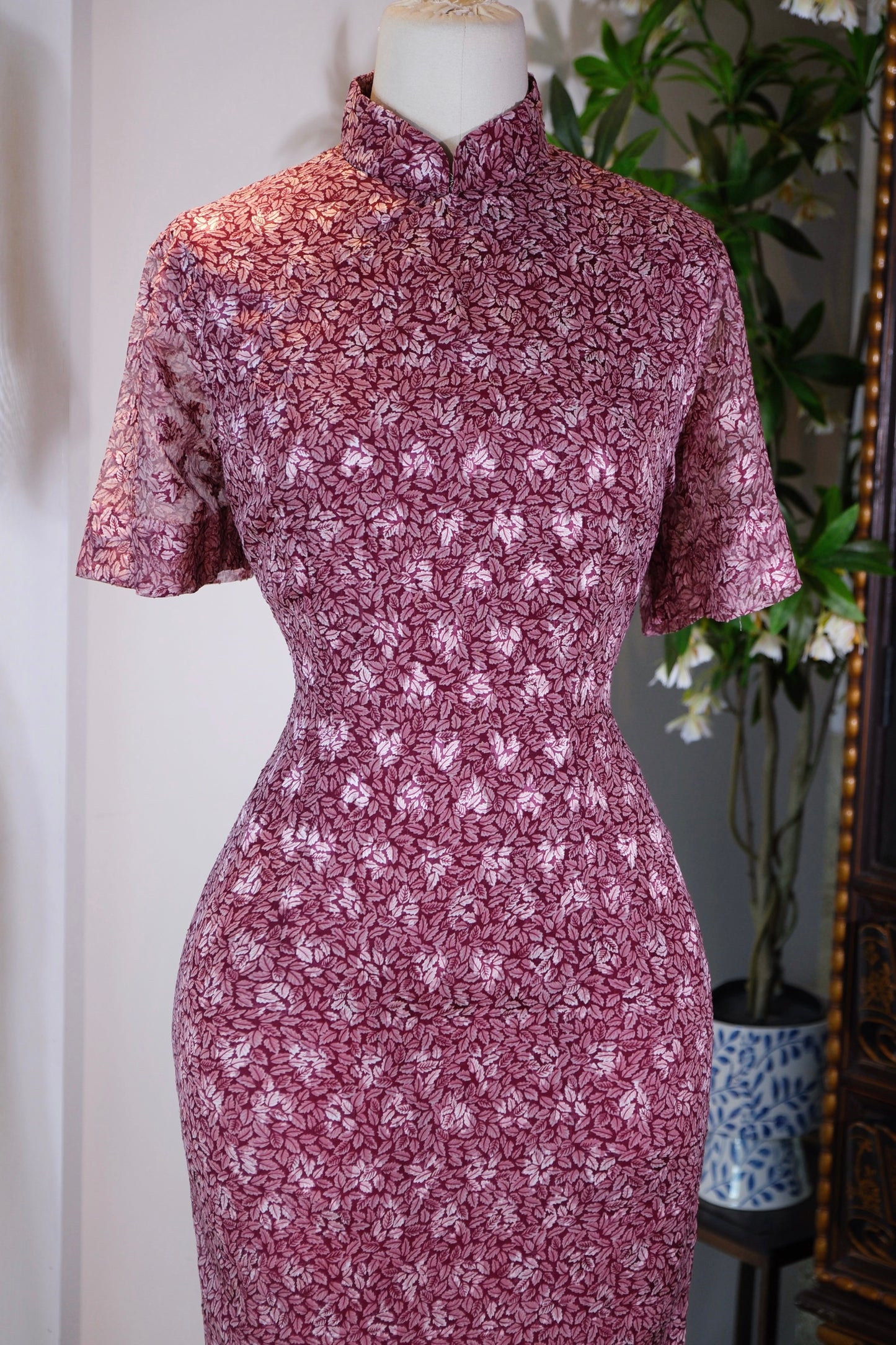
在台北迪化街的旧布行阁楼里,这件紫红色雪纺旗袍曾被樟木箱妥帖收藏。它诞生于1960年代的台湾,彼时纺织业正承接日本技术转移,雪纺面料以“轻、薄、透”的特性成为名媛新宠。不同于上海旗袍的浓艳牡丹,这件衣裳的图案是细碎的紫叶纹——叶片以白粉勾边,叶脉用银线暗绣,远看似暮春落英,近观如月下竹影,恰合《长物志》所言“花叶扶疏,不事雕琢而自有风韵”。
六十年代的台湾旗袍,正处在“海派”与“本土”的交融期。设计师摒弃了繁复的滚边,以隐形拉链替代传统盘扣,却在领口保留三粒手工纽襻,暗合“天圆地方”的东方哲思。雪纺的轻盈与修身剪裁形成张力,走动时裙摆如水波荡漾,恰似《洛神赋》中“翩若惊鸿,婉若游龙”的动态之美。据台湾纺织史料记载,彼时能定制此类雪纺旗袍者,多为外交官眷属或电影明星,现存完整品不足百件,其稀缺性堪比宋锦残片。
这件旗袍的紫叶纹,实为“落叶归根”的隐喻。1949年后迁台的江浙裁缝,将江南的“满地花”技法与台湾本土植物结合,创造出这种“叶非叶,花非花”的抽象图案。叶片以渐变紫红为底,从领口的浅粉过渡至裙摆的深绛,暗合《考工记》“青与赤谓之文,赤与白谓之章”的设色古法。雪纺面料的透肤感,让叶纹在肌肤上若隐若现,正如晚唐诗人温庭筠笔下“新帖绣罗襦,双双金鹧鸪”的含蓄情致。
如今,这件旗袍静立于展柜,雪纺的经纬间仍留存着六十年代的海风与茉莉香。它不仅是衣饰,更是一部穿在身上的断代史——见证着台湾纺织业的崛起,承载着江南美学的流变,更以紫叶纹的永恒之美,诉说着“衣以载道”的东方智慧。正如文物学家王世襄所言:“古物之贵,不在其价,而在其能穿越时空,与今人对话。”这件旗袍,正是这样一位沉默的讲述者。
Purple Leaves & Flowing Light: The Temporal Whispers of a 1960s Taiwan Chiffon Qipao
Measurements / Size Guide:
Bust / Waist / Hips: 106/88/108 cm
Total Length: 106 cm
Detailed Description:
In the attic of an old fabric store on Dihua Street in Taipei, this purplish-red chiffon Qipao was once meticulously preserved in a camphor wood chest. Born in 1960s Taiwan, it arrived at a time when the local textile industry was inheriting Japanese technological transfers, and chiffon fabric—with its "light, thin, and transparent" characteristics—became the new favorite among socialites. Unlike the opulent peonies of Shanghai Qipaos, the pattern of this garment features delicate purple leaf motifs. The leaves are outlined in white powder-tone print, with veins darkly embroidered in silver thread; from a distance, they resemble falling blossoms in late spring, while up close, they look like bamboo shadows under moonlight. This perfectly aligns with the aesthetic described in Zhang Wu Zhi (The Treatise on Superfluous Things): "flowers and leaves are sparse and well-spaced; without excessive carving, they possess their own natural charm."
Taiwanese Qipaos of the 1960s were in a period of fusion between the "Haipai" (Shanghai) and "Local" styles. Designers abandoned complex piping and replaced traditional frog buttons with invisible zippers, yet retained three handcrafted button loops at the collar, subtly echoing the Oriental philosophy of "Round Heaven and Square Earth." The lightness of the chiffon creates tension with the slim-fit tailoring; when in motion, the hem ripples like water, embodying the dynamic beauty described in the Ode to the Goddess of the Luo River: "As fluttering as a startled swan, as graceful as a soaring dragon." According to Taiwan textile historical records, those who could afford to commission such chiffon Qipaos at the time were mostly dependents of diplomats or movie stars. Today, fewer than a hundred complete pieces exist, making its rarity comparable to fragments of Song Dynasty brocade.
The purple leaf motif of this Qipao is, in fact, a metaphor for "falling leaves returning to their roots." The tailors from Jiangsu and Zhejiang who moved to Taiwan after 1949 combined the "all-over floral" (Mandi Hua) techniques of Jiangnan with native Taiwanese flora, creating this abstract pattern where "leaves are not quite leaves, and flowers are not quite flowers." The leaves feature a gradient purplish-red base, transitioning from pale pink at the collar to deep crimson at the hem, adhering to the ancient color-setting rules of Kao Gong Ji (The Artificers' Record): "The combination of green and red is called Wen (pattern); the combination of red and white is called Zhang (composition)." The sheer quality of the chiffon fabric allows the leaf patterns to appear faintly against the skin, reminiscent of the subtle sentiment in Late Tang poet Wen Tingyun's lines: "On her new embroidered silk jacket, a pair of golden partridges."
Today, this Qipao stands silently in a display case, with the sea breeze and jasmine scent of the 1960s still lingering within its chiffon warp and weft. It is not merely an adornment but a dynastic history worn on the body—witnessing the rise of Taiwan's textile industry, carrying the evolution of Jiangnan aesthetics, and narrating the Oriental wisdom of "clothing as a vessel for the Way" through the eternal beauty of its purple leaves. As the antiquarian Wang Shixiang once said: "The value of an ancient object lies not in its price, but in its ability to traverse time and space to converse with people of today." This Qipao is precisely such a silent narrator.