深圳溯源
无法加载取货服务可用情况
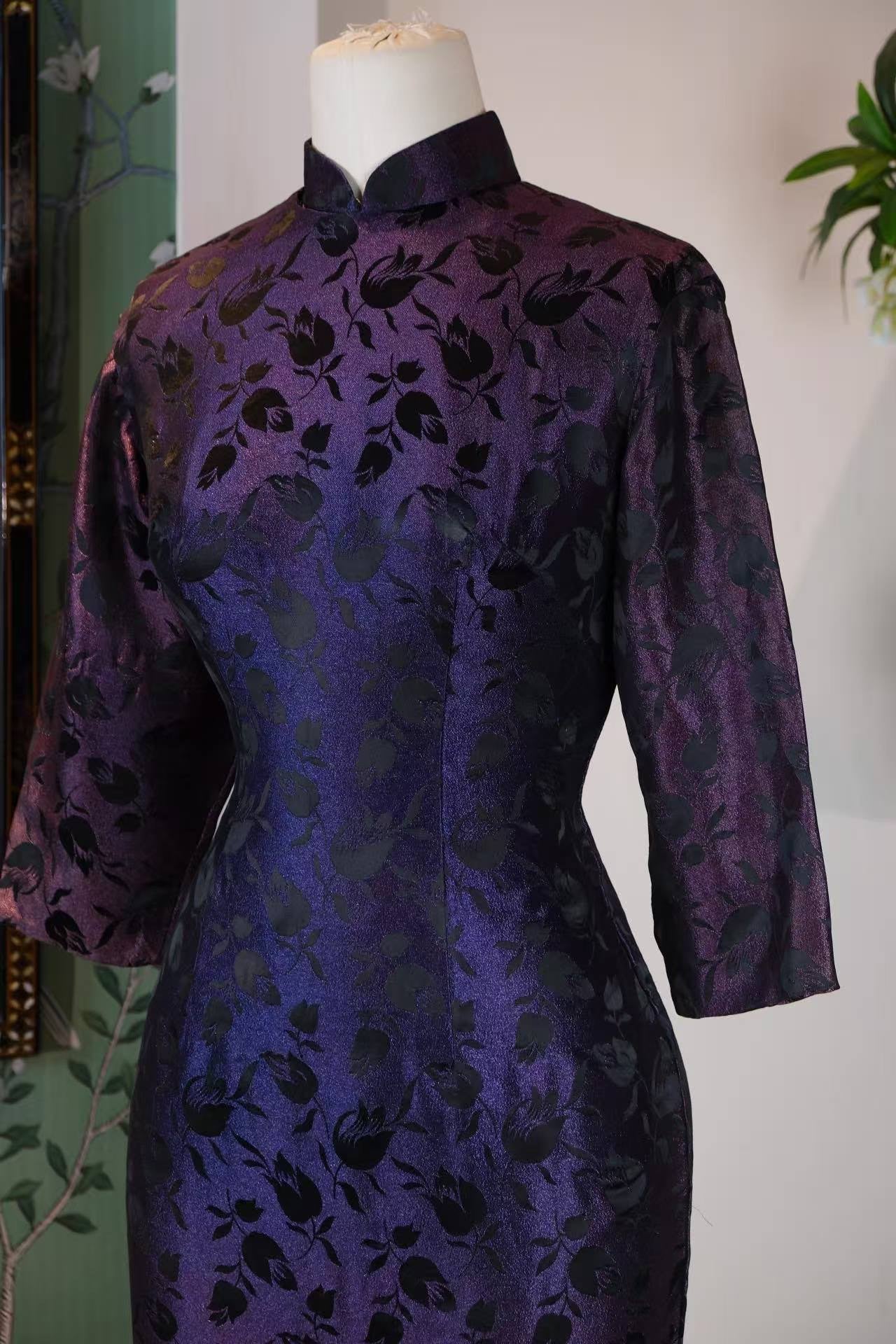
紫金幻色·六十年代香港提花织金渐变古董旗袍
一襟天光云影:渐变织金的时空美学
“日落胭脂红,无雨必有风。”当暮色浸染香江,
繁花入锦:郁金香纹样的异域风华
旗袍通体以郁金香纹为骨,花瓣舒展如绸,枝蔓缠绕似藤,暗合《
金线浮光:织造技艺的稀缺史诗
细观经纬,金线以“挖花”工艺穿梭于紫缎之间,
风华绝代:香港旗袍的黄金时代
六十年代的香港,是东方与西方、传统与现代的十字路口。
结语:穿越时空的霓裳羽衣
“繁华落尽,梦一场。”当指尖抚过这紫金交织的织物,
"A collar reflecting celestial light and cloud shadows: The spatio-temporal aesthetics of gradient gold-weaving."
"When the sunset glows rouge-red, if there is no rain, there must be wind." This masterpiece from a Hong Kong atelier feels as if the final rays of twilight over Victoria Harbour have been woven into its warp and weft. The gradient of purple and blue faints like a sunset—from a rich rouge at the collar to a deep indigo at the hem. It echoes the poignant splendor of Eileen Chang’s famous line: "Life is a gorgeous robe, crawling with fleas"—yet this robe uses gold-threaded jacquard to transform the fissures of time into eternal luster.
The Qipao uses the tulip as its structural motif, with petals stretching like silk and vines twining like ivy, echoing the romantic imagery of The Songs of Chu: "Walls of fragrant herbs and altars of purple; the hall is filled with scattered pepper scent." Originally from Persia, the tulip became a symbol of "exotic elegance" upon reaching the Middle East and China via the Silk Road. Here, outlined in black-gold jacquard, the petals resemble ink droplets while the foliage mimics "iron-wire" calligraphy. This balance of strength and softness conceals the aesthetic cipher of 1960s Hong Kong: inheriting the delicacy of Suzhou-Hangzhou weaving, merging with the fervor of Lingnan embroidery, and subtly aligning with the fluid "psychedelic aesthetics" of the Western world at that time.
Closely examining the weave, the gold threads utilize a "Wa Hua" (Pattern-digging) technique, traveling through the purple satin to create a relief-like, three-dimensional texture. This represents the pinnacle of post-war Hong Kong textile craft. Achieving a "Gold-Jacquard Gradient" required artisans to manually concoct botanical dyes and undergo seventy-two rounds of immersion and air-drying to produce a fabric "colored like heaven, with gold like flowing fireflies." Each stitch of the tulip motif required precise positioning on the loom; the slightest error would ruin the entire bolt. Today, surviving specimens represent less than a thousandth of the original production—truly "wearable intangible heritage."
Hong Kong in the 1960s stood at the crossroads of East and West, tradition and modernity. To which Hong Kong socialite did this belong? Perhaps it witnessed the clinking of glasses at a high-society banquet or danced light-footedly to the sound of waves at Repulse Bay. Every inch of gold thread carves the grace of that "floating world" era.
Conclusion: Celestial Raiment Traversing Time "When the prosperity fades, it remains but a dream." Brushing your fingertips across this purple-and-gold fabric is like touching the tides of Hong Kong from half a century ago. It is more than a garment; it is a poem: using tulips as ink, gold threads as a brush, and gradients as its soul, it writes an eternal footnote for "Oriental Aesthetics" in the river of time. To collect it is to preserve a segment of unfading splendor—much like the nights of 1960s Hong Kong, forever brilliant in the reflection of every golden silk thread.