深圳溯源
无法加载取货服务可用情况
衣服尺寸:
胸围/腰围/臀围:94/84/104 厘米
衣长:110 厘米
细节描述:
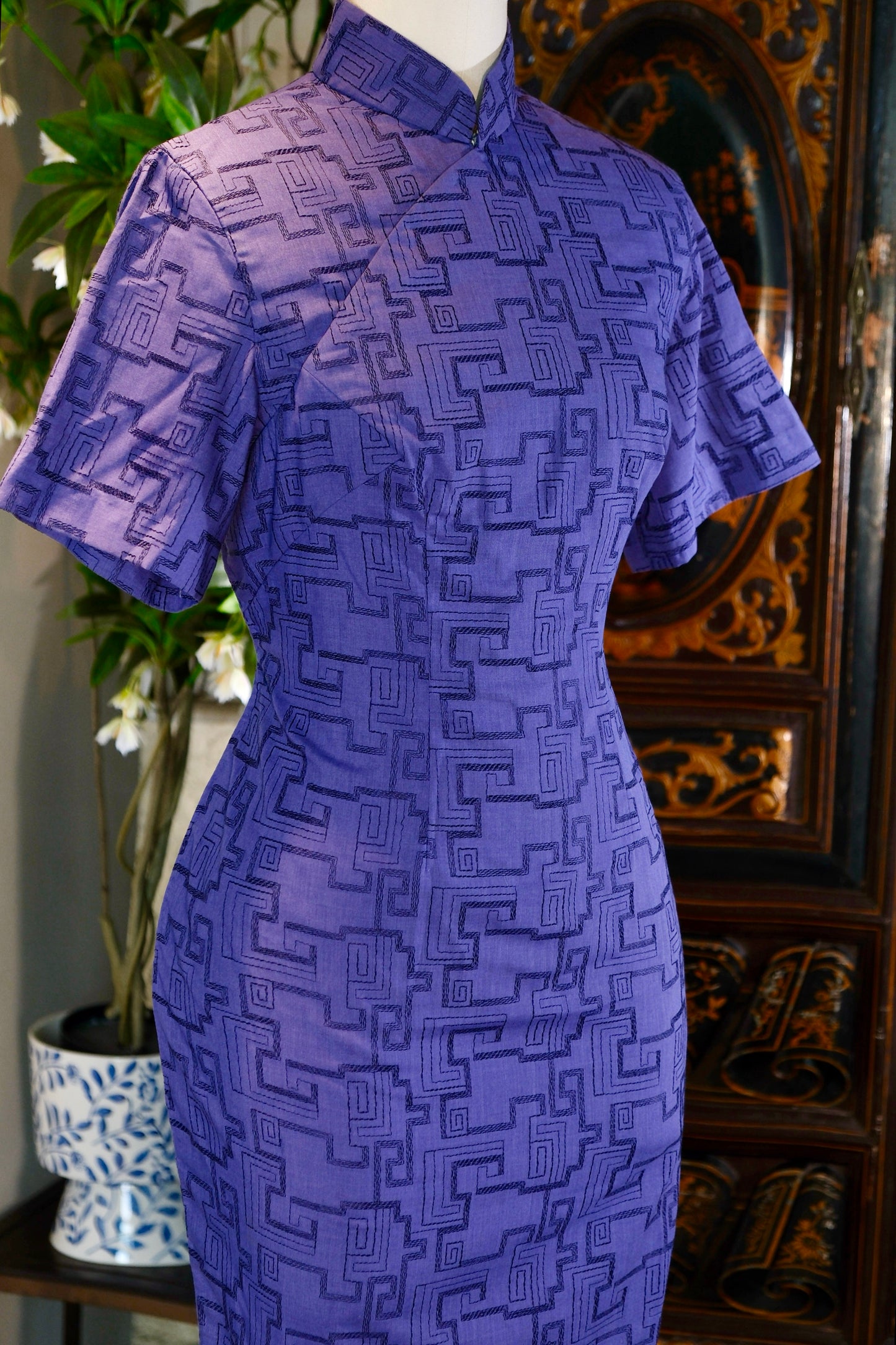
在台北牯岭街的旧衣摊,或是香港砵甸乍街的唐楼深处,偶能遇见这样一件旗袍:它以沉静的靛紫为底色,布面上蜿蜒着深紫近黑的几何回纹,像是将青铜器上的雷纹拆解重组,又似把《周易》中“无平不陂,无往不复”的哲思,织进了经纬交错的丝线里。这是上世纪六十年代台湾产的古董旗袍,机绣的针脚细密如发,却藏着比手工更精准的秩序感——那是工业时代与传统美学的第一次温柔碰撞。
一、图案:青铜纹样的现代转译
旗袍上的几何图案,绝非简单的装饰。它以“回纹”为母题,这种源自商周青铜器的纹样,本就有“富贵不断头”的吉祥寓意。但六十年代的台湾设计师,却用现代主义的解构手法,将传统回纹的“方正”转化为“流动”:线条不再拘泥于直角,而是以45度斜角转折,形成连续的“之”字形,仿佛水波在丝绸上凝固,又似云气在空间中流转。这种设计,恰与同时期西方“欧普艺术”(Op Art)的视觉实验不谋而合,却又带着东方特有的含蓄——没有强烈的色彩对比,仅以同色系的深浅变化,营造出“远看山有色,近听水无声”的层次感。
更妙的是,这些几何纹样并非平面铺陈,而是随旗袍的剪裁“生长”。在腰身处,纹样因收省而自然聚拢,形成视觉上的“束腰”效果;在开衩处,线条则顺势延展,如同水墨画中的“飞白”,给静态的布料注入了动态的韵律。这种“纹样随形”的设计,正是中国服饰“天人合一”理念的体现——图案不是附加的装饰,而是与身体、与空间共生的生命体。
二、故事:海岛上的旗袍余韵
六十年代的台湾,是旗袍最后的“黄金时代”。1949年随国民党迁台的大批江浙沪裁缝,将海派旗袍的精髓带到了这座海岛。但此时的旗袍,已不再是上海霞飞路上名媛们的“社交战袍”,而是化作了寻常女子的日常衣裳——她们穿着它去菜市场买菜,去学校教书,去电影院看《梁山伯与祝英台》。这件旗袍的主人,或许就是这样一位台湾女子:她在台北的烈日下,穿着它走过迪化街的布行,在台南的台风天,把它熨烫得平平整整去参加女儿的毕业典礼。
而它的“机绣”身份,更藏着一段特殊的历史。六十年代的台湾,正从农业社会向工业社会转型,纺织业是当时的支柱产业。这件旗袍的面料,很可能产自台南的纺织厂,用的是当时最先进的“提花机”——机器能精准控制经纬线的交织,织出比手工更复杂的图案。但设计师并未让机器“喧宾夺主”,反而巧妙利用机绣的“规整性”,让几何纹样呈现出一种“机械时代的诗意”:每一根线条都笔直如尺,却又因布料的垂坠而自然弯曲,如同工业文明对传统美学的致敬,而非取代。
三、稀缺性:不可复制的时代标本
如今,这样的六十年代台湾旗袍已极为罕见。原因有三:其一,当时的台湾纺织业以出口为主,内销的高档旗袍产量本就不多;其二,机绣旗袍在六十年代是“奢侈品”,普通人家往往“一件旗袍穿十年”,磨损后多被改制为童装或抹布,能完整保存至今的凤毛麟角;其三,这件旗袍的“几何机绣”风格,是特定历史时期的产物——七十年代后,台湾旗袍逐渐被西式服装取代,这种融合传统与现代的设计,也随之消失在历史长河中。
从艺术史的角度看,这件旗袍更是“中西合璧”的典范。它既有中国服饰的“立领”“右衽”“开衩”等传统元素,又吸收了西方“立体剪裁”的理念(如收省、装袖),更在图案上实现了“传统纹样的现代转译”。这种“三合一”的设计,在全球服饰史上都属罕见——它不同于同时期香港旗袍的“西化”(如缩短裙长、加大开衩)而是独属于台湾的“文化混血”产物。
四、结语:穿在身上的历史
这件旗袍,像一封来自六十年代的情书,字里行间都是那个时代的温度。它的紫色,是台湾夏日傍晚的天空;它的几何纹,是工业化浪潮中坚守的传统;它的机绣针脚,是时代转型期的温柔妥协。当我们凝视它时,看到的不仅是一件衣服,更是一个时代的缩影——那是传统与现代的对话,是海岛与大陆的血脉相连,是工业文明对东方美学的深情回望。
或许,这就是古董衣的魅力:它不说话,却比任何史书都更生动地讲述着过去。而这件六十年代台湾几何机绣旗袍,正是那本“穿在身上的历史”中,最动人的篇章之一。
Measurements / Size Guide:
Bust / Waist / Hips: 94/84/104 cm
Total Length: 110 cm
Detailed Description:
In the quiet corners of Taipei’s Guling Street or deep within the historic tong lau buildings of Hong Kong’s Pottinger Street, one might occasionally encounter such a qipao. It features a tranquil indigo-purple base, upon which deep purple—nearly black—geometric fretwork meanders. It looks as if the Leiwen (thunder patterns) from ancient bronzeware have been deconstructed and rearranged, or as if the philosophy from the I Ching—"No level ground without a slope, no going out without a return"—has been woven into the interlocking warp and weft. This is a 1960s vintage qipao from Taiwan; its machine-embroidered stitches are as fine as hair, yet they harbor an order more precise than handwork—the first gentle collision between the Industrial Age and traditional aesthetics.
The geometric patterns are far from simple decoration. Using the "Fretwork" (Huiwen) as a motif—a pattern originating from Shang and Zhou dynasty bronzeware symbolizing "endless wealth"—1960s Taiwanese designers used modernist deconstruction to transform traditional "squareness" into "fluidity." Lines no longer adhere to right angles but turn at 45-degree slants, forming continuous "Z" shapes. It is as if water ripples have solidified on silk or clouds are drifting through space. This design aligns perfectly with the Op Art visual experiments in the West during the same period, yet it carries a uniquely Oriental restraint—creating a sense of depth where "from afar the mountains have color, but up close the water makes no sound."
More brilliantly, these geometric patterns are not flatly laid out but "grow" with the qipao’s tailoring. At the waist, the patterns naturally converge due to the darts, creating a visual "cinched" effect; at the side slits, the lines extend naturally, like "flying white" in ink wash painting, injecting dynamic rhythm into the static fabric. This "pattern following form" is the realization of the Chinese concept of "Harmony between Heaven and Man"—the pattern is not an added ornament but a living entity coexisting with the body and space.
The 1960s was the final "Golden Age" of the qipao in Taiwan. Large numbers of tailors from the Jiangnan region who moved to the island in 1949 brought the essence of Haipai (Shanghai-style) tailoring. However, at this point, the qipao was no longer the "social battle armor" for socialites on Shanghai’s Avenue Joffre; it had become the daily attire of ordinary women—worn to the market, to school, or to the cinema. The owner of this piece might have been such a woman, wearing it through the textile shops of Dihua Street under the Taipei sun, or ironing it flat for her daughter’s graduation during a Tainan typhoon.
Its "machine-embroidered" identity hides a specific history. In the 1960s, Taiwan was transitioning from an agrarian to an industrial society, with textiles as a pillar industry. This fabric likely came from a Tainan mill using the most advanced Jacquard looms of the time. The designer did not let the machine "overpower" the piece; instead, they utilized the regularity of machine embroidery to present a "poetry of the mechanical age." Every line is as straight as a ruler, yet it curves naturally with the drape of the fabric—a tribute from industrial civilization to traditional aesthetics.
Today, such 1960s Taiwanese qipaos are extremely rare for three reasons: First, the textile industry then focused on exports, leaving few high-end qipaos for domestic sale. Second, machine-embroidered qipaos were "luxury items" in the 60s; ordinary families often wore one for a decade, and once worn out, they were repurposed into children’s clothes or rags. Third, this "geometric machine-embroidery" style was the product of a specific historical window—after the 70s, Western clothing replaced the qipao in Taiwan, and this fusion design vanished.
From an art history perspective, this qipao is a model of "East meets West." It retains traditional elements like the standing collar and right-side closure while absorbing Western 3D tailoring (darts and set-in sleeves) and achieving a modern translation of traditional motifs. This "triple-threat" design is rare in global fashion history—differing from the "Westernization" of Hong Kong qipaos of the same period (shortened hems, higher slits), it is a unique product of Taiwan’s "cultural hybridization."
This qipao is like a love letter from the 1960s. Its purple is the Taipei summer sky at dusk; its geometric lines are the traditions held firm amidst industrial waves. When we gaze upon it, we see a dialogue between tradition and modernity, and industrial civilization’s deep look back at Oriental aesthetics.