深圳溯源
无法加载取货服务可用情况
绿金流韵:六十年代香港古董旗袍的艺术密码与稀缺价值
在东方美学的谱系中,旗袍始终是那抹最婉约的剪影,
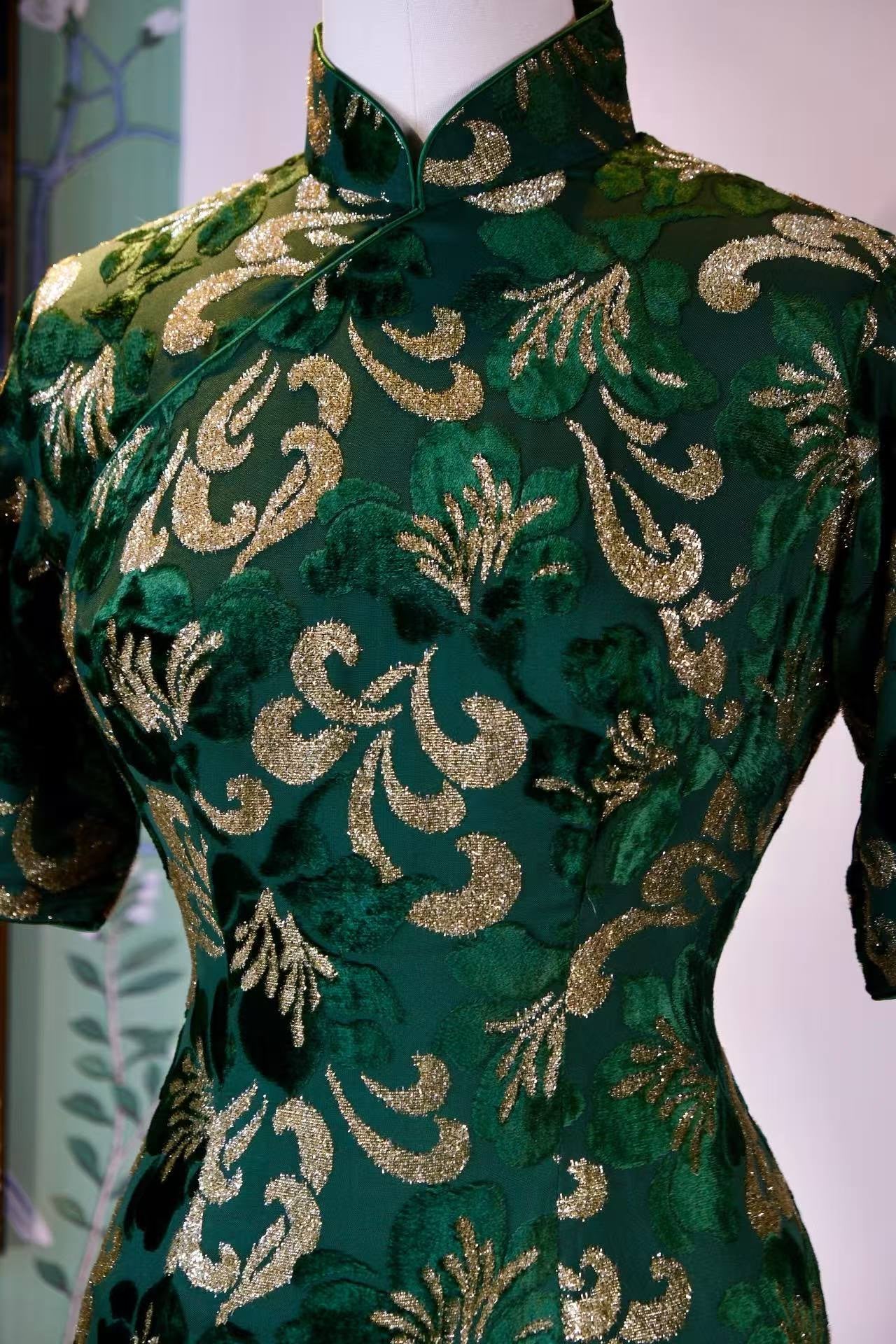
旗袍面料以深邃墨绿为底,金色丝线穿梭其间,
金色纹样以“织金”工艺实现立体浮雕感:光线掠过时,
意大利真丝烧花工艺赋予面料通透肌理,
更难得的是,香港作为彼时远东时尚枢纽,
六十年代的香港旗袍,本就因产量稀少而珍贵:彼时成衣工业未兴,
这件旗袍的稀缺性,更在于其“意大利面料+香港工艺”
In the genealogy of Oriental aesthetics, the cheongsam has always been the most graceful silhouette. This masterpiece from the 1960s, with its ingenious craftsmanship and the indelible mark of its era, weaves a fluid epic of fashion history. Crafted from Italian imported silk burnout devoré velvet with gold brocade (Weaving Gold) and tailored by the hands of Hong Kong masters, it outlines the opulence and elegance of bygone days.
The fabric features a profound dark emerald base, with golden threads interlacing to form intricate yet orderly botanical motifs. A close inspection reveals the continuous flow of scrolling grass patterns (Juan Cao)—leaves curling like budding sprouts and vines intertwining as if in an endless cycle of life, echoing the celebration of vitality in the Classic of Poetry: "The flowers of the trumpet creeper, their leaves are so green." It also integrates the majesty of floral patterns, with layered petals resembling peonies in full bloom, resonating with the rich imagery in Dream of the Red Chamber: "Pomegranate flowers in bloom reflect the palace attire."
The golden patterns achieve a three-dimensional relief effect through the "Zhi Jin" (Weaving Gold) technique: as light passes over, the gold threads leap like fireflies, creating a subtle contrast with the matte texture of the velvet base—reminiscent of the play of light and shadow described in the Dao Lian Zi poem: "Gold threads on the silk shirt cast a dim shadow." This "Gold-on-Green" color scheme inherits the Ming Dynasty tradition of "background and pattern complementing each other" while integrating 1960s modernism, serving as a paragon of Sino-Western aesthetic fusion.
The Italian silk burnout (Devoré) process bestows a translucent texture upon the fabric; selectively etched yarns create faint perforations like emerald mist. The weaving gold technique weaves metallic threads into the velvet pile, realizing the visual luxury of a "gold-threaded garment." Furthermore, the "Incense-Stick Piping" (Xiàn Xiāng Gǔn) refers to the piping being as slender as a stick of incense. Craftsmen had to hand-pipe edges with 0.5cm wide velvet strips; the curves of the collar, cuffs, and slits relied entirely on the master's intuition—a craft documented as early as Tiangong Kaiwu but revitalized by Hong Kong tailors in the 1960s.
Notably, as the Far East's fashion hub at the time, Hong Kong preserved the Shanghai-style fitted tailoring (the high collar, half-sleeves, and side slits are classic "Hong Kong Work" features) while absorbing Western 3D draping concepts. This allows the long cheongsam to hug the silhouette without restriction, possessing an inherent rhythmic grace in every step.
Hong Kong cheongsams from the 1960s are precious due to their limited production: before the rise of the ready-to-wear industry, most were bespoke. A cheongsam featuring Italian velvet, handmade gold brocade, and incense-stick piping was a luxury reserved for the elite. Moreover, given the passage of time—velvet's susceptibility to wear and gold thread's tendency to shed—well-preserved specimens are extremely rare, with perhaps fewer than a hundred remaining globally.
The scarcity of this piece also lies in its transnational DNA—"Italian Fabric + Hong Kong Craftsmanship." It witnessed the hidden exchanges between Eastern and Western fashion industries during the Cold War era. As fashion historian James Laver said: "Fabric is the skin of history, and pattern is the coat of arms of an era." When the golden scrolling grass on the emerald velvet flows in the light, we see not just a garment, but a frozen moment in time: the prosperous nights of 1960s Hong Kong, the refined tempering of Italian artisans, and the lingering silhouettes of socialites from the past—all overlapping to become an unfading footnote to Oriental aesthetics.