深圳溯源
无法加载取货服务可用情况
衣服尺寸:
胸围/腰围/臀围:88/68/88 厘米
衣长:138 厘米
细节描述:
一、纹样:南洋风物的丝绒浮雕
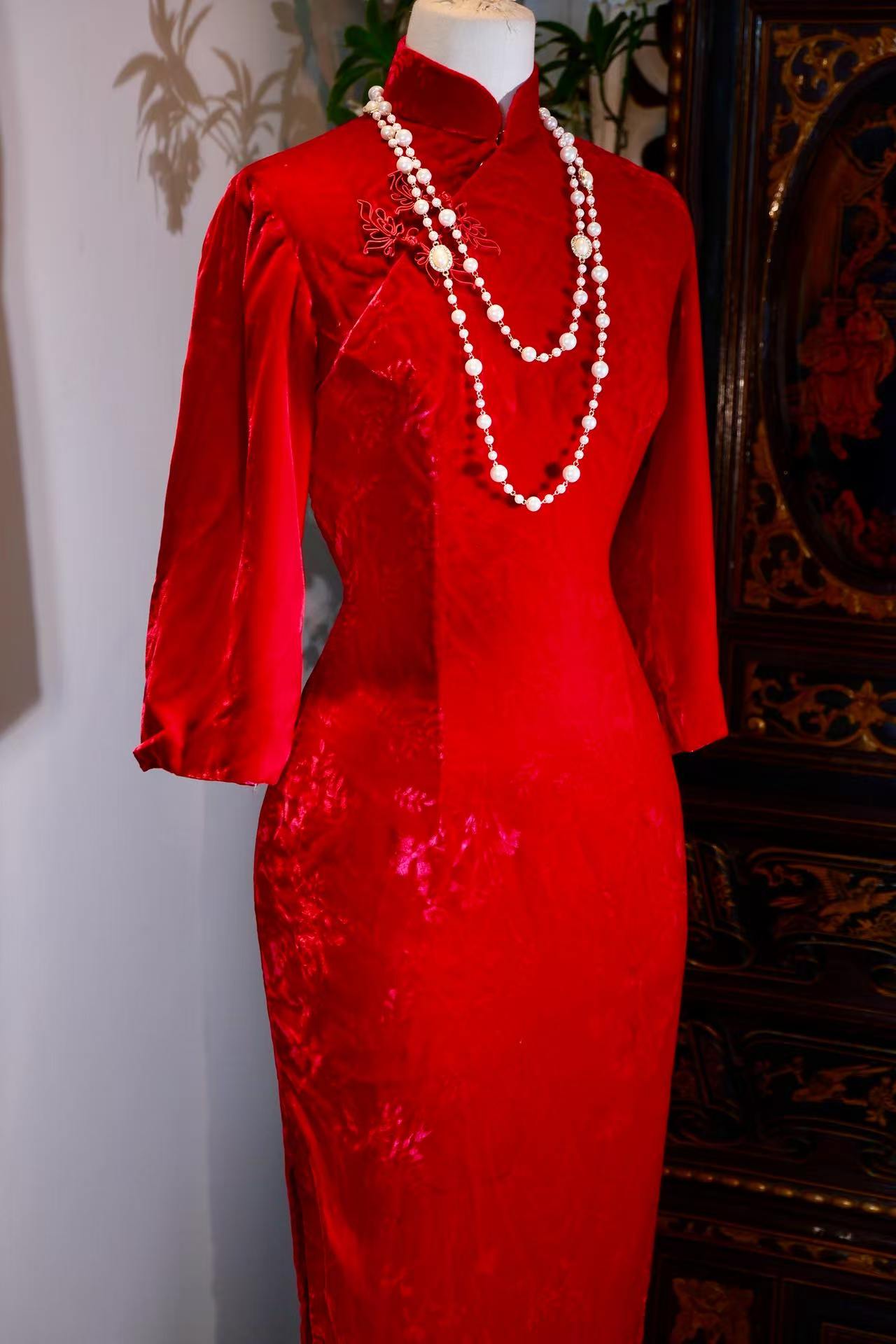
这件旗袍最摄人心魄之处,在于其面料上那若隐若现、繁复绮丽的南洋草叶纹。
这并非传统中式旗袍中规整的牡丹或梅兰竹菊,而是一种极具热带风情的植物图腾。纹样取材于南洋群岛盛产的蕨类与阔叶植物,叶片舒展、藤蔓卷曲,呈现出一种蓬勃向上的生命力。这种纹样在六十年代的台湾纺织界被称为“南洋风”,它打破了传统东方审美的内敛,融入了东南亚艺术的奔放与野性。
工艺上,采用的是当时极为考究的“钢模压花丝绒”技术。在厚重的胭脂红丝绒底料上,工匠利用高温钢模压烫出凹凸有致的草叶肌理。光线流转间,丝绒的倒顺毛效应使得花纹时而深邃如夜,时而鲜亮如火。这种“隐花”的处理手法,正如《园冶》中所言“虽由人作,宛自天开”,将南洋的郁郁葱葱以一种含蓄而奢华的方式,定格在红色的海洋中。
二、故事:海峡彼岸的“南洋旧梦”
这件旗袍诞生于上世纪六十年代的台湾,那是一个特殊的“流金岁月”。
彼时的台湾,汇聚了来自上海的精良剪裁技艺与来自南洋的丰富物资。这件旗袍便是那个时代的缩影:它的面料极有可能源自当时台湾与马来西亚、新加坡等地频繁的纺织贸易。在那个航空业尚未普及的年代,南洋的富商眷属或往来于海岛间的摩登女性,常以此类丝绒旗袍作为晚宴或节庆的礼服。
胭脂红,是华人世界最喜庆的颜色,而南洋草叶纹则代表了异域的自由与浪漫。这件衣服的故事,或许关乎一位居住在台北阳明山的官太太,在某个微凉的冬夜,披着皮草披肩,身着这件旗袍出席一场高朋满座的宴会;又或许,它曾属于一位下南洋闯荡归来的千金,带着海风的味道,将这份热带的热烈带回了宝岛。
由于六十年代进口压花丝绒成本高昂,且工艺复杂,此类旗袍多为量身定做的“高定”孤品,存世量极少。它不仅是一件衣服,更是一段关于迁徙、融合与繁华的实物证词。
三、艺术:海派骨相,南洋皮相
从艺术风格审视,这件旗袍完美诠释了“中西合璧,海陆交融”的美学高度。
- 剪裁上的海派风骨: 它的版型继承了海派旗袍的精髓——立领挺括,勾勒出东方女性的颈部线条;七分袖设计,露出手腕的纤细;腰身极度贴合,强调S型曲线,下摆微收,行走时摇曳生姿。这是典型的六十年代“改良旗袍”廓形,既有东方的含蓄,又有西方的立体剪裁逻辑。
- 色彩上的视觉张力: 胭脂红(Rouge Red)是一种极具侵略性的颜色,代表着成熟女性的自信与韵味。搭配同色系的压花草叶纹,形成了“红上加红”的层次感,这种同色系穿搭(Tone-on-tone)即便放在今天的时尚语境下,依然前卫而高级。
- 稀缺性的学术价值: 在服装史的研究中,六十年代台湾产的“南洋风”旗袍是一个独特的门类。它不同于苏绣的细腻,也不同于京绣的庄重,它带有一种独特的“岛屿美学”。这种压花丝绒面料因年代久远,丝绒极易磨损或脱胶,能保存至今且绒面完整、色泽如新者,可谓凤毛麟角。
结语:
这件旗袍,是凝固的时光。当你抚摸那凹凸的草叶纹理,仿佛能触碰到六十年代台湾那个湿润、热烈、充满故事的夜晚。它不仅仅是一件古董衣,更是一朵盛开在岁月深处的南洋红莲。
Measurements / Size Guide:
Bust / Waist / Hips: 88/68/88 cm
Total Length: 138 cm
Detailed Description:
The most arresting feature of this qipao lies in its fabric—the faint, intricate, and magnificent Nanyang foliage motifs.
These are not the conventional peonies, plum blossoms, or orchids of traditional Chinese qipaos, but rather a tropical botanical totem. The patterns draw inspiration from the lush ferns and broad-leaved plants of the Nanyang archipelago; with sprawling leaves and curling vines, they radiate a sense of vigorous upward vitality. In 1960s Taiwan, this was known as the "Nanyang Style." It broke the restraint of traditional Eastern aesthetics, infusing the wildness and passion of Southeast Asian art.
In terms of craft, it employs the prestigious "Steel-Mold Embossed Velvet" technique of the era. On a heavy rouge-red velvet base, artisans used high-temperature steel molds to press out the rhythmic textures of the foliage. As light shifts, the nap of the velvet makes the patterns appear deep as night at one moment and brilliant as fire the next. This "hidden flower" treatment aligns with the philosophy in The Craft of Gardens: "Though made by human hands, it appears as if created by heaven." It captures the lushness of Nanyang in a subtle, luxurious manner, frozen within a sea of red.
This qipao was born in 1960s Taiwan, a unique "Golden Era."
At that time, Taiwan was a crossroads where refined Shanghainese tailoring met abundant resources from Southeast Asia. This garment is a microcosm of that period: its fabric likely originated from the frequent textile trade between Taiwan and regions like Malaysia and Singapore. In an age before widespread air travel, the families of Nanyang tycoons or modern women traveling between islands often wore such velvet qipaos as formal attire for banquets and festivals.
Rouge Red is the most auspicious color in the Chinese world, while the Nanyang foliage represents exotic freedom and romance. Its story might belong to a socialite in Taipei’s Yangmingshan, attending a grand banquet on a chilly winter night draped in a fur stole; or perhaps it belonged to a daughter of a wealthy family returning from the South Seas, bringing the warmth of the tropical breeze back to the island. Given the high cost and complexity of imported embossed velvet in the 60s, such pieces were usually bespoke "Haute Couture"—rare artifacts of migration and fusion.
Artistically, this qipao represents an aesthetic peak where "East meets West, and Land meets Sea."
Shanghainese Heritage in Tailoring: Its silhouette inherits the essence of the Shanghai style—a crisp standing collar that defines the neckline, three-quarter sleeves revealing slender wrists, and an extreme fit that emphasizes the S-curve. This is the quintessential "Modified Qipao" of the 1960s, combining Eastern reserve with Western structural logic.
Visual Tension in Color: Rouge Red is an assertive color, representing the confidence of a mature woman. Paied with monochromatic embossed foliage, it creates a "tone-on-tone" depth that remains avant-garde and high-fashion even by today’s standards.
Academic Value of Scarcity: In the study of costume history, the "Nanyang Style" qipaos of 1960s Taiwan are a distinct category. Unlike the delicacy of Suzhou embroidery or the solemnity of Beijing style, it possesses a unique "Island Aesthetic." Because vintage velvet is prone to wear or de-gapping over decades, a piece found with its pile intact and color as fresh as new is truly a "phoenix feather and unicorn horn"—a rarity among rarities.
This qipao is solidified time. When you touch the raised textures of the foliage, you can almost feel the humid, passionate, and storied nights of 1960s Taiwan. It is more than a vintage garment; it is a red Nanyang lotus blooming in the depths of history.