深圳溯源
无法加载取货服务可用情况
衣服尺寸:
胸围/腰围/臀围:90/76/96 厘米
衣长:108 厘米
细节描述:
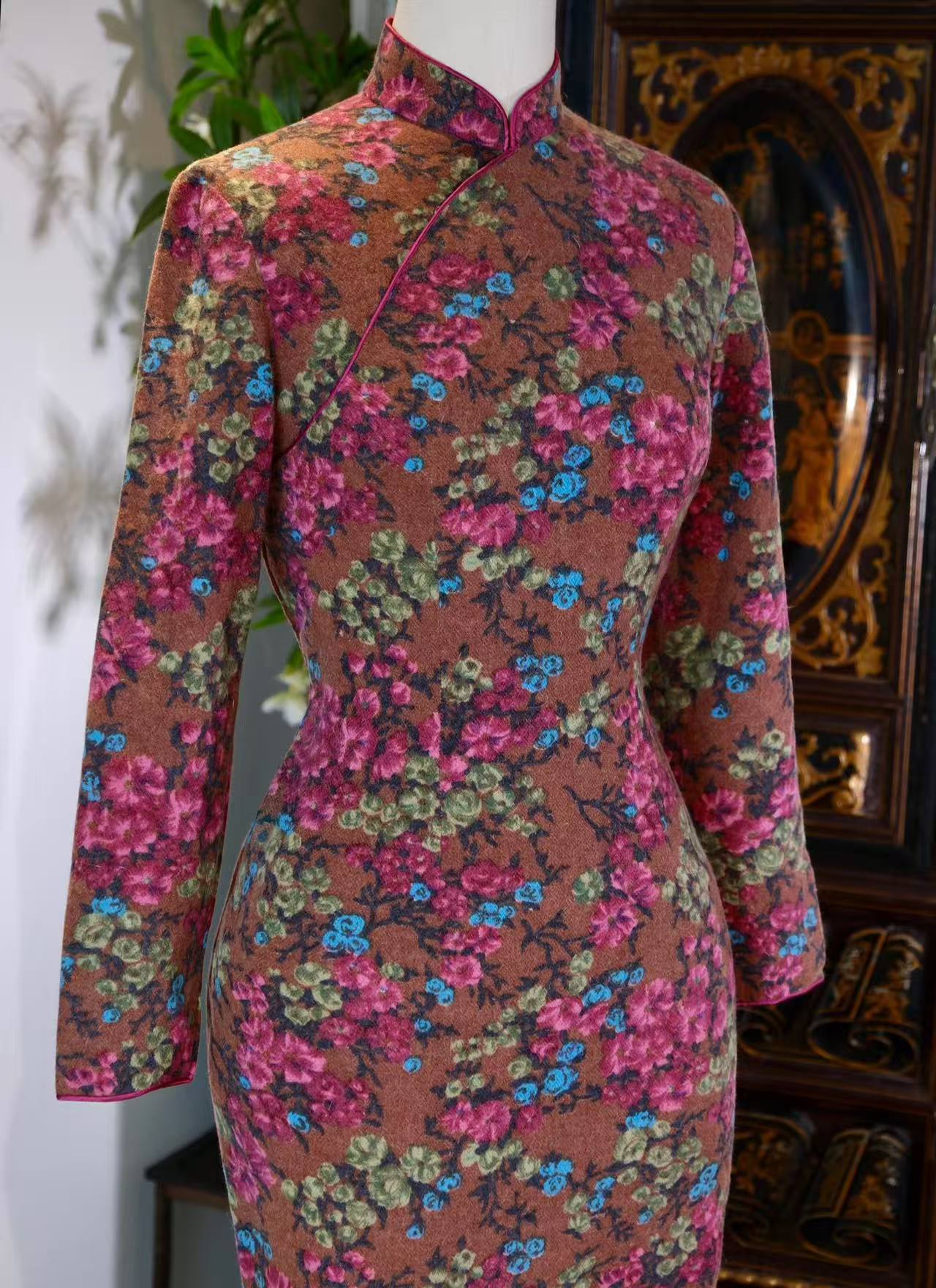
这件诞生于上世纪六十年代香港的羊绒印花旗袍,以羊绒为骨,以繁花为魂,将东方女性的温婉与西方剪裁的立体感熔于一炉,成为时光长河中永不褪色的艺术标本。
图案描述:繁花似锦的东方诗意
旗袍表面铺陈着细密的缠枝花卉纹样,主花为胭脂红与玫粉色的牡丹、芍药,间以天青色的梅花与橄榄绿的枝叶,在暖棕色底布上交织成“乱花渐欲迷人眼”的盛景。花朵以工笔重彩的技法晕染,花瓣边缘略带渐变,仿佛晨露未晞时的娇嫩;枝叶则以写意笔法勾勒,墨色浓淡相宜,暗合“疏可走马,密不透风”的传统美学。
特别值得注意的是,图案中暗藏“四季同框”的巧思:春之梅、夏之荷、秋之菊、冬之兰以抽象形态共存,既呼应《诗经》“桃之夭夭,灼灼其华”的生命礼赞,又暗含“四时有序,万物有灵”的东方哲学。
古董衣的故事:香江岁月里的锦绣传奇
六十年代的香港,是东西方文化碰撞的熔炉。这件旗袍的诞生,恰逢港岛旗袍工艺的黄金时代——彼时,上海老裁缝南迁香港,将海派旗袍的精致与粤港的务实结合,创造出“港式旗袍”的独特风格。羊绒材质的选用,既是对欧洲贵族面料的致敬,亦是对东方“软黄金”的传承;而印花工艺则突破了传统刺绣的局限,以现代印染技术还原传统纹样的神韵,堪称“古法新用”的典范。
据考证,此类羊绒印花旗袍在当时多为名媛贵妇定制,因羊绒面料昂贵、印花套色复杂(需至少五次套印方能呈现层次),存世量极为稀少。这件旗袍的绲边采用“线香绲”工艺——以细如发丝的丝线包边,针脚细密如鱼子,非二十年经验的老师傅不能为,更印证其“一针一线总关情”的手工温度。
艺术风格与稀缺性:东方美学的现代转译
从艺术风格看,这件旗袍完美诠释了“中西合璧”的六十年代美学:立领、斜襟、开衩保留传统旗袍的形制,而收腰、长袖的剪裁则借鉴西方晚礼服的立体廓形,使穿着者既有“云想衣裳花想容”的古典韵味,又不失“曲线玲珑”的现代美感。
其稀缺性更体现在三重维度:
- 材质稀缺:六十年代羊绒面料多依赖进口,成本高昂,非寻常人家所能企及;
- 工艺稀缺:“线香绲”与多色套印工艺如今已濒临失传,年轻裁缝鲜少掌握;
- 时代稀缺:作为冷战时期香港“文化飞地”的产物,它承载着特殊历史语境下的身份认同与审美选择,是不可复制的时代切片。
结语:时光里的文化使者
这件旗袍不仅是服饰,更是一部穿在身上的文化史。它让我们看见:当东方遇见西方,当传统碰撞现代,当手工邂逅工业,会绽放出怎样惊艳世界的火花。正如张爱玲所言:“对于不会说话的人,衣服是一种语言,随身带着的袖珍戏剧。”——而这件六十年代的羊绒印花旗袍,正是时光长河中最动人的那幕戏。
Measurements / Size Guide:
Bust / Waist / Hips: 90/76/96 cm
Total Length: 108 cm
Detailed Description:
This cashmere printed qipao, born in 1960s Hong Kong, uses cashmere as its bone and flourishing flowers as its soul. It melts the gentleness of Oriental women and the three-dimensionality of Western tailoring into one furnace, becoming an unfading artistic specimen in the long river of time.
The surface of the qipao is spread with dense scrolling floral patterns. The primary flowers are carmine and rose-pink peonies and herbaceous peonies, interspersed with celadon-colored plum blossoms and olive-green foliage, weaving a magnificent scene on a warm brown base fabric that "confuses the eye with a riot of blossoms." The flowers are rendered with the "Gongbi" (meticulous) heavy-color technique; petal edges feature subtle gradients as if tender with morning dew. The branches and leaves are outlined with "Xieyi" (freehand) brushwork, where the ink tones are perfectly balanced, echoing the traditional aesthetic of "leaving enough space for a horse to gallop, yet staying dense enough to block the wind."
Of particular note is the clever design of "four seasons in one frame": the plum of spring, lotus of summer, chrysanthemum of autumn, and orchid of winter coexist in abstract forms. This both echoes the celebration of life in the Classic of Poetry—"The peach tree is young and elegant, brilliant are its flowers"—and implies the Oriental philosophy that "the four seasons have their order, and all things have their spirit."
Hong Kong in the 1960s was a melting pot of Eastern and Western cultures. The birth of this qipao coincided with the golden age of Hong Kong qipao craftsmanship—a time when veteran tailors from Shanghai migrated south, combining the refinement of the "Haipai" (Shanghai-style) qipao with the pragmatism of Guangdong and Hong Kong to create the unique "Hong Kong-style" qipao. The choice of cashmere is both a tribute to European aristocratic fabrics and a heritage of the Oriental "soft gold." Meanwhile, the printing process broke through the limitations of traditional embroidery, using modern dyeing technology to restore the charm of traditional patterns, making it a classic example of "using modern methods to revive ancient ways."
Research suggests that such cashmere printed qipaos were mostly custom-made for socialites and noblewomen of the time. Due to the high cost of cashmere and the complexity of multi-color printing (requiring at least five separate overlays to achieve such depth), surviving pieces are extremely rare. The piping of this qipao utilizes the "incense-stick" (Xianxiang Gun) technique—edging with thread as fine as hair and stitches as dense as fish roe. Such work could only be executed by a master with over twenty years of experience, further confirming the warmth of "every stitch and thread carrying emotion."
From an artistic perspective, this qipao perfectly interprets the "East meets West" aesthetic of the 1960s: the standing collar, diagonal closure, and side slits retain the traditional qipao form, while the cinched waist and long-sleeve tailoring borrow the three-dimensional silhouette of Western evening gowns. This allows the wearer to possess both the classical charm of "clouds remind one of her clothes, and flowers remind one of her face" and the modern beauty of an "exquisite silhouette."
Its scarcity is reflected in three dimensions:
Material Scarcity: Cashmere in the 1960s relied heavily on imports and was prohibitively expensive, beyond the reach of ordinary families.
Craftsmanship Scarcity: The "incense-stick" piping and multi-color overlay printing techniques are now on the verge of extinction, with few young tailors mastering them.
Historical Scarcity: As a product of Hong Kong's "cultural enclave" during the Cold War, it carries a sense of identity and aesthetic choice within a specific historical context—an irreproducible slice of an era.
This qipao is not just clothing; it is a cultural history worn on the body. It shows us what stunning sparks can be ignited when East meets West, tradition hits modernity, and craftsmanship encounters industry. As Eileen Chang once said, "For those who cannot speak, clothes are a language, a pocket drama carried with them"—and this 1960s cashmere printed qipao is precisely the most moving act in the long river of time.