深圳溯源
无法加载取货服务可用情况
衣服尺寸:
胸围/腰围/臀围:90/82/102 厘米
衣长:113 厘米
细节描述:
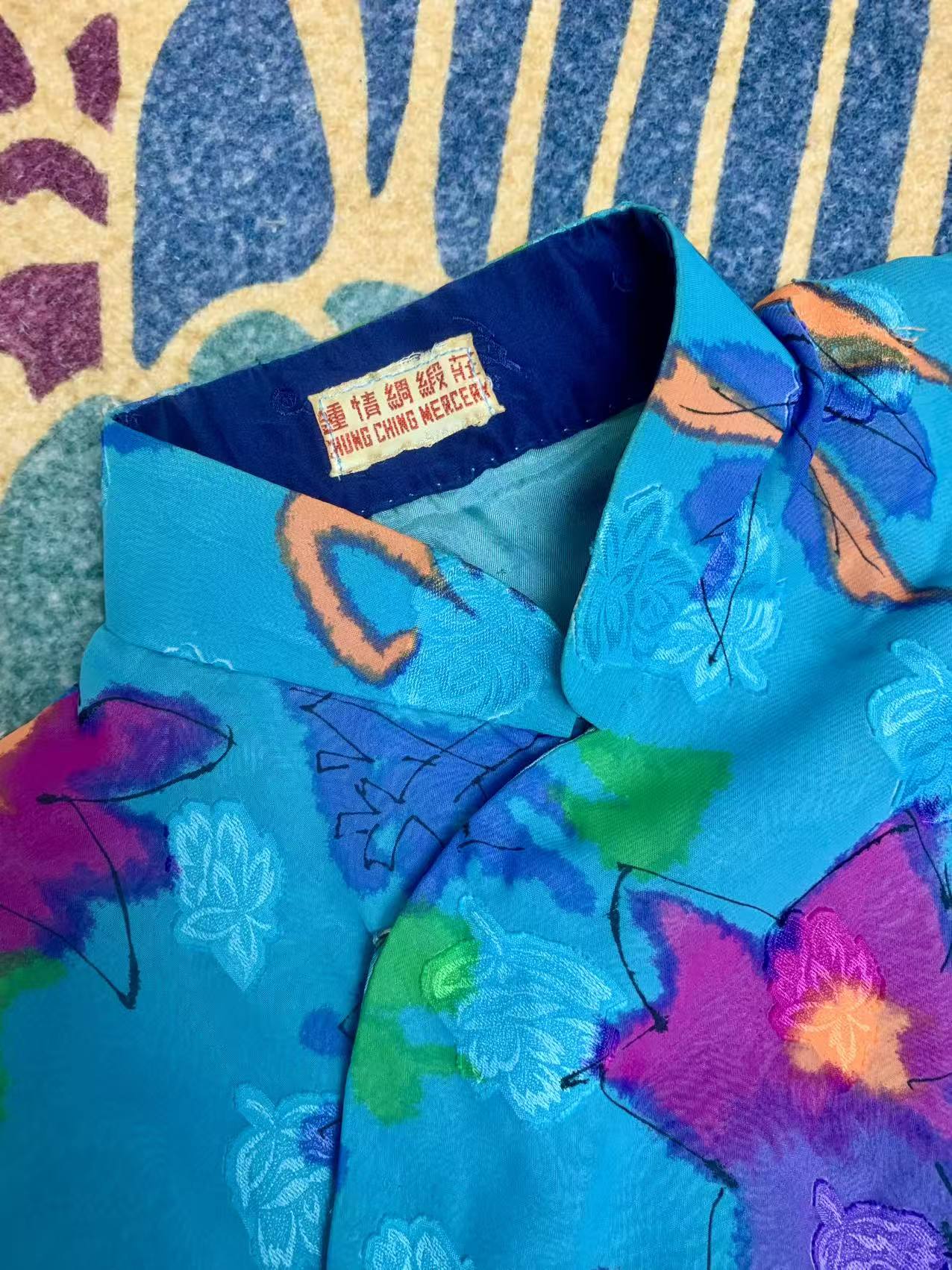
这件诞生于上世纪六十年代台湾的古董旗袍,由“鐘情綢緞莊”出品,其衣领内侧的“鐘情綢緞莊”“CHUNGCHING MERCERY”标签,是时代与匠心的双重印记。它以天蓝色为底,似将江南的晴空裁作衣料,又似把雨后的碧空揉进经纬,让整件旗袍浸染着澄澈的诗意。
图案:童趣手绘的抽象诗行
衣身图案打破传统花卉的写实桎梏,以童趣手绘的笔触,勾勒出抽象的花叶形态——紫色花瓣如蝶翼般舒展,边缘晕染着粉橙的暖光,似是孩童打翻的调色盘,又似莫奈花园里朦胧的光影;橙色卷草纹如灵动的音符,在蓝底上跳跃,与绿色叶片的泼墨式晕染交织,形成“乱花渐欲迷人眼”的活泼韵律。
更妙的是暗纹提花的巧思:细看之下,蓝底中隐现着浅色的花卉暗纹,如雾中看花,与明艳的手绘图案形成“显隐相生”的层次。这种工艺需以提花织机精密编织,再以手绘叠加色彩,每一针、每一笔都藏着匠人的耐心与巧思,让图案既有油画的厚重质感,又不失丝绸的轻盈灵动。
故事:时代褶皱里的东方美学
上世纪六十年代的台湾,正处于传统与现代的交融期。鐘情綢緞莊作为彼时的知名绸缎庄,既承袭了苏杭丝绸的细腻工艺,又吸纳了西方现代艺术的抽象理念。这件旗袍的图案,恰是时代精神的缩影:手绘的童趣,是对“童心未泯”的东方生活美学的回归——正如李渔在《闲情偶寄》中所言“衣以章身,请晰其解”,衣裳不仅是蔽体之物,更是性灵的延伸;而抽象的设计,则暗合了当时西方抽象表现主义的潮流,让东方旗袍在传统形制中,悄然绽放出先锋的艺术光芒。
稀缺:时光淬炼的孤品传奇
如今,这样的古董旗袍已近乎孤品。一方面,鐘情綢緞莊的手绘提花工艺因成本高昂、工序繁复,早已在工业化浪潮中失传;另一方面,六十年代的台湾旗袍虽承袭海派风韵,却因地域文化的独特性,形成了“南派旗袍”的细腻温婉风格,与上海旗袍的华丽、香港旗袍的摩登形成鲜明对比,成为研究东亚服饰史的珍贵样本。
这件旗袍的稀缺性,更在于它“活”的历史感:暗纹提花的肌理里,藏着六十年代台湾丝绸业的技术密码;手绘图案的笔触中,凝固着彼时匠人对“美”的理解;甚至衣料的轻微泛黄,都是时光亲手写下的注脚。正如《天工开物》所言“凡织花文必用嘉湖,出口、出水,皆乾丝为经”,每一寸丝绸都是自然与人文的结晶,而这样的结晶,在当代已难觅踪迹。
结语:穿在身上的艺术史
这件鐘情綢緞莊的旗袍,是流动的画布,是凝固的诗行。它以童趣手绘打破传统的沉闷,以抽象提花重构东方的雅致,更以稀缺的工艺与时代印记,成为可触摸的艺术史。当它轻覆于身,仿佛能听见六十年代台湾街巷的喧嚣,看见匠人伏案手绘的专注,更能感受到东方美学在现代性浪潮中,那份温柔而坚定的坚守。
这便是古董衣的魅力:它不仅是衣裳,更是一段被时光珍藏的、关于美与匠心的传奇。
Measurements / Size Guide:
Bust / Waist / Hips: 90/82/102 cm
Total Length: 113 cm
Detailed Description:
This antique qipao, born in 1960s Taiwan, was produced by the renowned Chung Ching Mercery. The label inside the collar—inscribed with "鐘情綢緞莊" and "CHUNGCHING MERCERY"—serves as a dual hallmark of the era's history and exquisite craftsmanship. Bathed in a sky-blue base, the garment feels as though the clear skies of the Jiangnan region were tailored into fabric, imbuing the piece with a lucid, poetic clarity.
Breaking free from the realistic constraints of traditional floral motifs, the patterns on this qipao utilize childlike, hand-painted brushstrokes to outline abstract botanical forms. Purple petals stretch like butterfly wings, their edges blurred with a warm pinkish-orange glow—reminiscent of a child's overturned palette or the hazy light and shadow of Monet’s garden. Orange scrolling vines leap across the azure background like lively musical notes, intertwining with green leaves rendered in a splash-ink style, creating a playful and vibrant rhythm.
More ingenious is the jacquard weave hidden within: upon closer inspection, light floral patterns emerge from the blue base like flowers seen through mist. This creates a layered effect of "interplay between the visible and invisible." Such a process required precision weaving on a jacquard loom followed by manual hand-painting. Each stitch and stroke conceals the craftsman's patience, giving the pattern the rich texture of an oil painting without losing the ethereal lightness of silk.
In 1960s Taiwan, society existed at the intersection of tradition and modernity. As a leading establishment of its time, Chung Ching Mercery inherited the delicate silk-weaving techniques of Suzhou and Hangzhou while absorbing the abstract concepts of Western modern art.
The patterns on this qipao epitomize the spirit of that era. The whimsical hand-painting represents a return to the Eastern lifestyle aesthetic of "maintaining a childlike heart." As Li Yu wrote in Occasional Notes with Leisurely Feeling, "Clothing is meant to manifest the body; one must understand its meaning." Clothing is not merely a cover but an extension of one’s spirit. Simultaneously, the abstract design aligns with the global trend of Abstract Expressionism, allowing the traditional qipao to blossom with avant-garde artistic brilliance.
Today, antique qipaos of this caliber are nearly peerless. On one hand, the hand-painted jacquard process of Chung Ching Mercery has largely vanished due to high costs and complex procedures. On the other hand, while 1960s Taiwanese qipaos inherited the Haipai (Shanghai-style) charm, they evolved into a unique "Southern Style"—delicate, gentle, and temperate—setting them apart from the opulence of Shanghai or the sharp modernity of Hong Kong.
The rarity also lies in its sense of "living history." The texture of the jacquard weave contains the technical codes of the 1960s Taiwanese silk industry, while the brushstrokes freeze a craftsman's understanding of beauty. Even the slight mellowing of the fabric is a footnote written by time itself. As noted in Tiangong Kaiwu, every inch of such silk is a crystallization of nature and humanity that is almost impossible to find in the modern day.
This Chung Ching Mercery qipao is a fluid canvas and a frozen poem. It breaks traditional dullness with whimsical hand-painting and reconstructs Eastern elegance through abstract jacquard. When worn, it carries the echoes of 1960s Taiwanese streets and the focus of a craftsman at his desk. It is more than a garment; it is a legend of beauty and craftsmanship preserved by time.