深圳溯源
无法加载取货服务可用情况
衣服尺寸:
胸围/腰围/臀围:94/78/96 厘米
衣长:115 厘米
细节描述:
一、纹样解析:织物的浮雕诗学
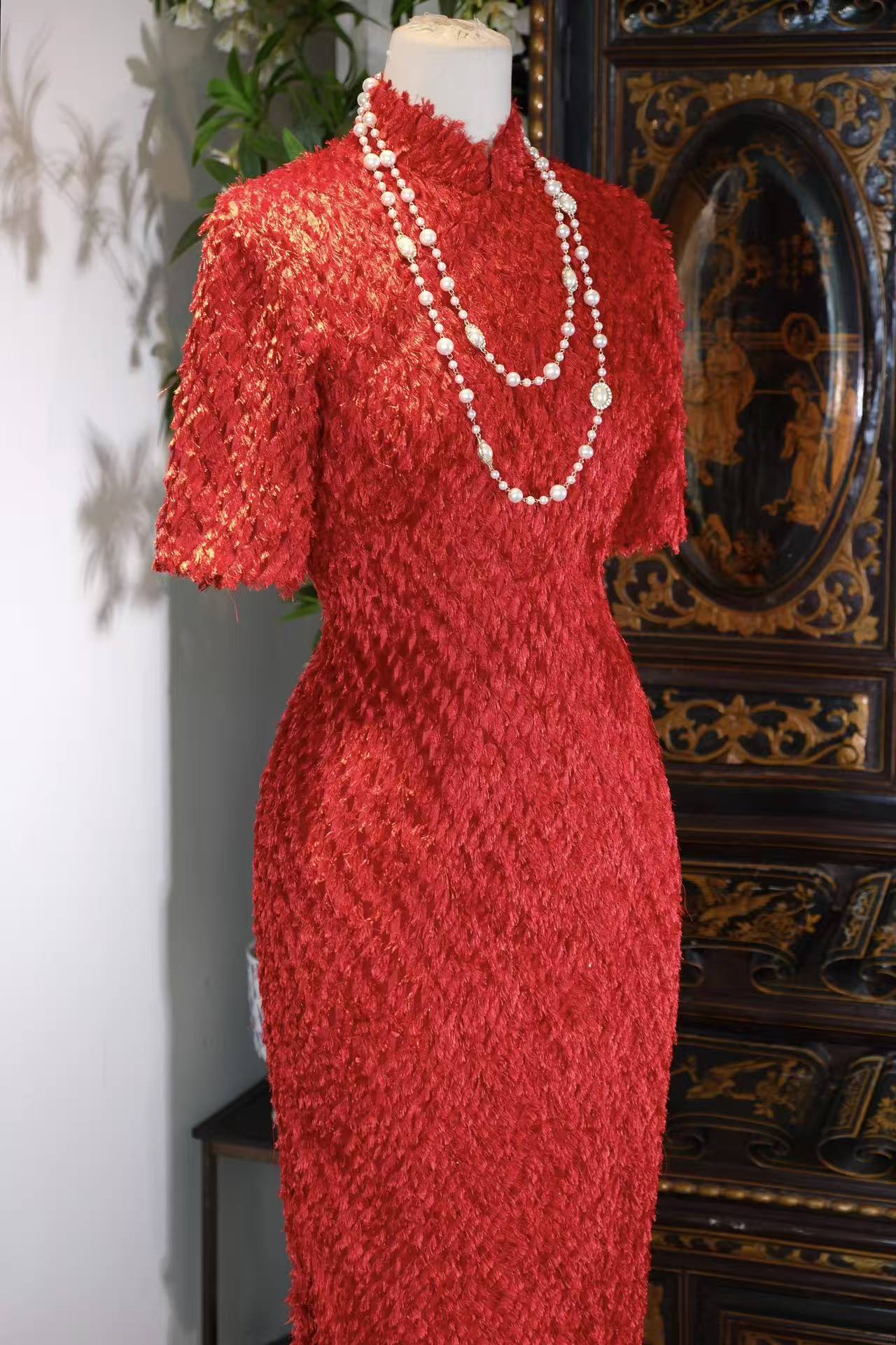
此件旗袍的面料,绝非寻常平面印花或刺绣可比。其纹样是一种高度立体化的抽象肌理,可称之为“浮雕式流苏织锦”。
- 视觉形态:面料表面覆盖着密集、短促、方向不一的红色丝绒状“流苏”或“羽毛”结构。这些并非后期缝缀,而是通过特殊提花织造工艺,使经线或纬线在织物表面形成环状或束状的立体毛圈,再经精细剪绒处理,形成类似“火焰舔舐”或“珊瑚丛生”的视觉效果。在光线下,这些微小的立体结构产生丰富的光影变化,使整件旗袍如燃烧的赤焰,又似深海中摇曳的红珊瑚,充满动态的生命力。
- 图案本质:它摒弃了传统旗袍常见的具象花鸟、龙凤或几何纹样,转而追求一种纯粹的材质美学与抽象表现主义。这种“无图案的图案”,正是其现代性与艺术性的核心——织物本身即是艺术。
二、身世钩沉:六十年代意港合璧的时尚传奇
这件旗袍,是冷战时期东西方时尚暗流交汇的珍贵物证,其诞生地香港,正是那个时代全球纺织业与时尚贸易的“东方十字路口”。
- 意大利设计的面料革命:上世纪六十年代,意大利高级成衣业正经历一场“面料即设计”的革命。设计师如Emilio Pucci、Missoni等,开始将面料本身的肌理、色彩与图案作为设计的核心,而非仅仅作为裁剪的载体。这件旗袍所用的面料,正是意大利纺织厂为满足这种新设计理念而开发的高定级立体织锦。其宽度远超传统中式面料,旨在为设计师提供更大的创作自由度,实现更流畅的剪裁与更宏大的视觉叙事。
- 香港制造的“东方工坊”奇迹:六十年代的香港,凭借其自由港地位与精湛的缝纫工艺,成为承接欧美高级时装订单的“东方工坊”。这件旗袍,正是由意大利设计师提供面料与设计图稿,交由香港顶尖裁缝坊(可能位于中环或尖沙咀的定制店)精工制作。香港裁缝以其无与伦比的立体剪裁技艺,将西方的立体面料,完美转化为贴合东方女性曲线的旗袍廓形——高领、收腰、开衩,每一处线条都如雕塑般精准,既保留了旗袍的东方神韵,又融入了西方的现代审美。
- 稀缺性:此类“意料港制”的古董旗袍存世量极其稀少。原因有三:其一,意大利高定面料成本高昂,产量本就有限;其二,六十年代香港虽为制衣重镇,但能承接此类高定订单的工坊凤毛麟角;其三,历经半个多世纪,此类易损的立体织物能完好保存至今者,堪称凤毛麟角。它不仅是服装,更是一件可穿戴的纺织艺术品,其稀缺性堪比博物馆藏品。
三、艺术风格:东方神韵与西方现代性的交响
这件旗袍的艺术风格,是东方传统工艺精神与西方现代主义美学的完美融合。
- 东方之“韵”:其廓形严格遵循旗袍的经典范式——立领、斜襟、收腰、及踝。这种廓形是对东方女性“含蓄、内敛、曲线美”的极致表达。其红色,更是东方文化中喜庆、吉祥、权力的终极象征。
- 西方之“形”:其面料的抽象立体肌理与赤红配色,则深深烙印着六十年代西方艺术的印记。其“火焰”般的肌理,令人联想到抽象表现主义画家如Jackson Pollock的滴画,充满原始的生命力与动感;其赤红配色,则呼应了波普艺术对大众文化与消费主义的视觉狂欢。这种将西方现代艺术语言“翻译”成东方服饰载体的做法,正是其艺术价值的高妙之处。
- 引经据典:此件旗袍的美学,可与法国时装大师Yves Saint Laurent于1977年推出的“中国系列”相参照。YSL在该系列中,将中国元素(如龙纹、盘扣)与西方剪裁结合,震惊时尚界。而这件六十年代的旗袍,比YSL的“中国风”早了十余年,且更为含蓄与高级——它不是对东方元素的简单挪用,而是将东方的形制与西方的材质、精神进行了深度的化学反应,堪称“未署名的东方高级定制”。
四、结语:赤焰不灭,传奇永存
这件六十年代的意大利设计、香港产古董旗袍,是一件承载着时代密码的时尚圣物。它以“浮雕式流苏织锦”的绝美面料,诉说着冷战时期东西方时尚暗流交汇的传奇;它以东方廓形与西方肌理的完美融合,定义了何为“跨文化高级定制”的典范。
它不仅仅是一件衣服,更是一段凝固的历史,一首织物的史诗,一曲赤焰与流金交织的永恒乐章。拥有它,便是拥有了一段不可复制的时尚传奇。
Measurements / Size Guide:
Bust / Waist / Hips: 94/78/96 cm
Total Length: 115 cm
Detailed Description:
The fabric of this qipao is far beyond the reach of ordinary flat prints or embroidery. Its pattern is a highly three-dimensional abstract texture, which can be described as "Relief-style Tassel Brocade."
Visual Form: The surface of the fabric is covered with dense, short, multi-directional red velvet-like "tassels" or "feathery" structures. These are not secondary embellishments; rather, they are created through a specialized jacquard weaving process where warp or weft threads form loops or tufts on the fabric surface, followed by precise shearing. This results in a visual effect akin to "licking flames" or "branching coral." Under light, these micro-structures produce a rich play of shadow and luster, making the garment appear like a burning flame or swaying red coral—full of dynamic vitality.
Artistic Essence: It abandons the common figurative motifs of flowers, birds, dragons, or phoenixes in favor of a pure material aesthetic and Abstract Expressionism. This "patternless pattern" is the core of its modernity and artistry—the fabric itself is the art.
This qipao is a precious artifact of the cultural undercurrents between East and West during the Cold War. Its birthplace, Hong Kong, was the "Oriental Crossroads" of global textiles and fashion trade during that era.
The Italian Fabric Revolution: In the 1960s, the Italian high-end ready-to-wear industry underwent a revolution where "fabric is design." Designers like Emilio Pucci and Missoni began to treat the texture, color, and pattern of the fabric as the core of the design rather than just a medium for the cut. This qipao utilizes a haute-couture-level 3D brocade developed by Italian mills to meet this new philosophy. Its width far exceeded traditional Chinese fabrics, offering designers greater freedom for fluid tailoring and grand visual narratives.
The "Oriental Atelier" Miracle: In the 1960s, Hong Kong, with its free-port status and exquisite tailoring skills, became the "Oriental Atelier" for European and American high-fashion orders. This piece was crafted using Italian fabric and sketches, entrusted to a top-tier Hong Kong workshop (likely located in Central or Tsim Sha Tsui). These tailors used unparalleled draping techniques to transform Western 3D fabrics into a silhouette that perfectly fits the Oriental female curve—high collar, cinched waist, and precise slits—balancing Eastern charm with Western modernism.
Rarity: Such "Italian-sourced, Hong Kong-made" vintage qipaos are exceptionally rare. There are three reasons: first, the cost of Italian haute couture fabric was exorbitant, and production was limited; second, while Hong Kong was a garment-making hub, only a handful of workshops could handle such complex orders; third, finding such a delicate three-dimensional textile in pristine condition after half a century is a miracle of preservation. It is not just clothing; it is a wearable piece of textile art with rarity comparable to a museum collection.
The artistic style of this qipao is a perfect fusion of the Eastern spirit of traditional craftsmanship and Western Modernist aesthetics.
Eastern "Rhyme": The silhouette strictly follows the classical paradigm—standing collar, diagonal closure, cinched waist, and ankle length. This is the ultimate expression of the "subtle, restrained, and curvaceous" beauty of the Oriental woman. Its red color serves as the ultimate symbol of joy, luck, and power in Eastern culture.
Western "Form": The abstract 3D texture and crimson palette bear the deep imprints of 1960s Western art. The "flame-like" texture brings to mind the drip paintings of Abstract Expressionists like Jackson Pollock, full of primal vitality; the red echoes Pop Art's visual celebration of mass culture and consumerism. Translating Western modern art into an Eastern garment is the height of its artistic value.
Historical Reference: This aesthetic can be compared to Yves Saint Laurent’s 1977 "Chinese Collection." While YSL combined Chinese elements (like dragons and frog buttons) with Western cuts to shock the fashion world, this 1960s qipao predates YSL’s "Chinoiserie" by over a decade. It is even more subtle and sophisticated—it is not a simple appropriation of elements, but a deep chemical reaction between Eastern form and Western material and spirit, an "unattributed Eastern Haute Couture."
This 1960s Italian-designed, Hong Kong-made vintage qipao is a fashion icon carrying the codes of its era. With its exquisite "relief-style tassel brocade," it tells the story of the fusion between East and West during the Cold War. It defines the pinnacle of "Cross-Cultural Haute Couture" through the perfect union of Eastern silhouette and Western texture.
It is not just a garment; it is a segment of frozen history, an epic of fabric, and an eternal movement of crimson flames and flowing gold. To own it is to possess an irreplaceable fashion legend.