深圳溯源
无法加载取货服务可用情况
衣服尺寸:
胸围/腰围/臀围:98/80/100 厘米
衣长:100 厘米
细节描述:
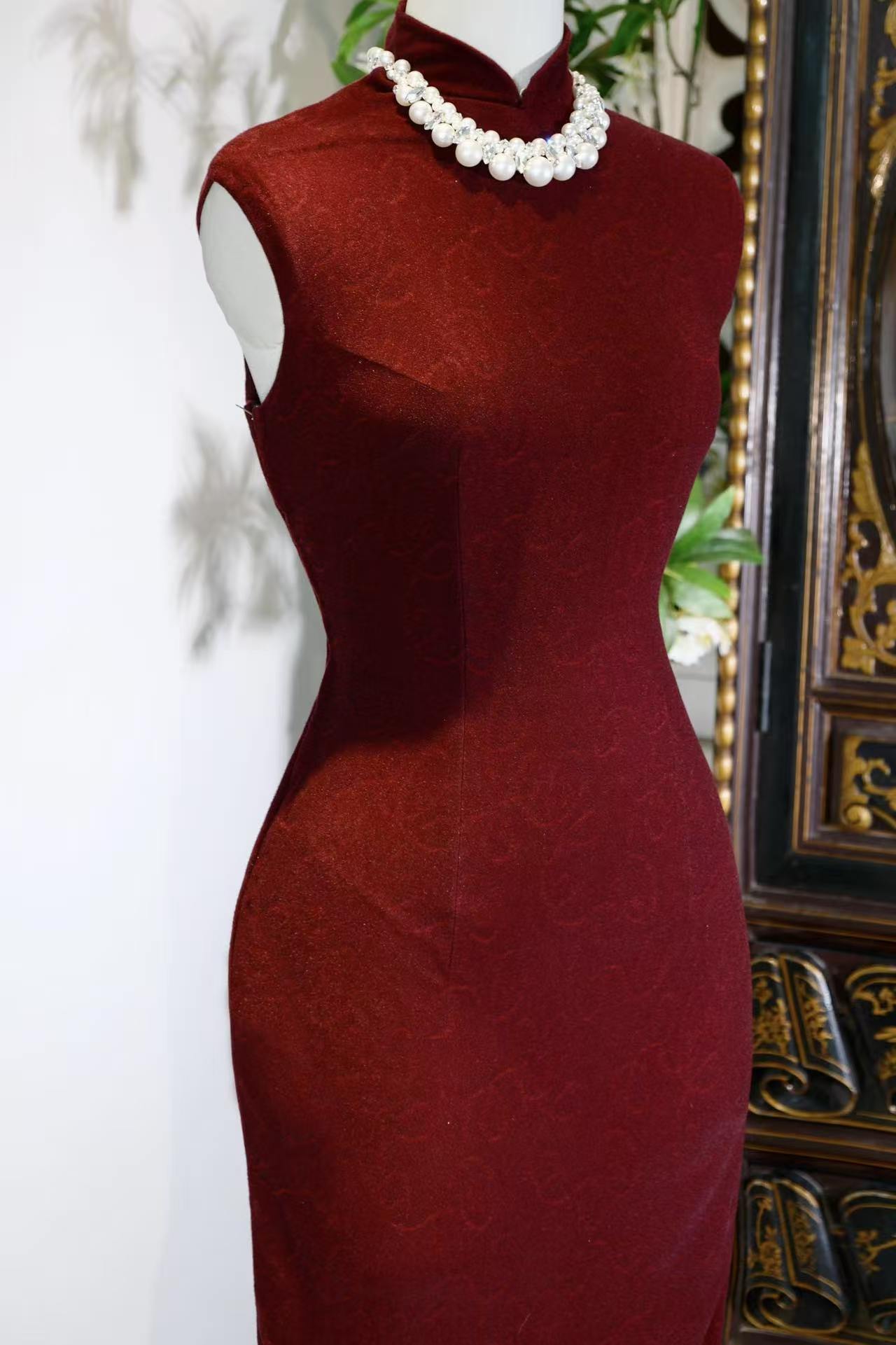
当指尖拂过这件六十年代香港制造的毛呢旗袍,酒红色泽如凝固的晚霞,暗纹在光影中若隐若现——这不仅是件衣物,更是一段被织物封存的时光密码。
一、暗纹里的东方密码
旗袍表面的暗纹并非寻常提花,而是以“云纹”为骨、“缠枝”为韵的复合纹样。细看可见卷曲的云气纹连绵不绝,其间穿插着简化的缠枝莲纹,二者以“S”形曲线交织,形成“云锁莲枝”的意象。这种纹样设计暗合《营造法式》中“纹必有意,意必吉祥”的传统,云纹象征高远与祥瑞,缠枝莲则寓意生生不息,恰是六十年代香港华人社群对故土文化的隐性坚守。
毛呢面料的选择更显匠心。彼时香港作为转口港,进口澳洲羊毛与本土织造工艺结合,使面料兼具挺括与垂坠感。暗纹通过“压纹提花”工艺呈现:先以高温模具在毛呢表面压出浅浮雕般的纹路,再以同色系丝线轻绣轮廓,远看如墨色晕染,近观方见针脚——这种“藏技于朴”的手法,正是海派旗袍“低调奢华”美学的延续。
二、剪裁中的时代褶皱
这件旗袍的廓形藏着六十年代香港的独特气质。无袖设计露出肩线,袖窿弧线精准贴合人体工学,侧缝自腰节向下微张3厘米,形成“微A字”下摆——这种改良既方便行动,又暗合当时香港女性参与社会工作的现实需求。
腰部的省道处理堪称精妙。前后片各设两道公主线,自肩胛骨延伸至臀围,形成“收而不紧”的曲线。这种剪裁借鉴了西方“迪奥 New Look”的立体塑形理念,却以东方“含蓄露肤”的审美重构,正如张爱玲所言:“旗袍是紧身的,但又不是完全贴身的,它要在束缚与自由之间找到平衡。”
三、时光里的港岛回响
六十年代的香港,是东西方文化碰撞的熔炉。这件旗袍的诞生地,或许是上环某间家庭式裁缝铺:师傅用粉笔在毛呢上画出纸样,徒弟踩着“蝴蝶牌”缝纫机,针脚细密如鱼子。彼时香港制衣业正从手工向半机械化过渡,但这件旗袍仍保留着“一人一衣”的手工温度。
四、稀缺性背后的文化标本
如今存世的六十年代港产毛呢旗袍不足千件,这件的稀缺性更在于“三原”:原色、原纹、原剪裁。酒红色历经六十年仍无明显褪色,得益于当时使用的“硫化染料”;暗纹未因穿着而模糊;而未经修改的原始剪裁,则为研究六十年代香港女性体型提供了实物样本。
从艺术风格看,它是“海派旗袍”向“港式旗袍”过渡的典型。较之上海旗袍的繁复刺绣,它更显简约;较之后期香港旗袍的西式化,它又保留着传统纹样与手工细节。这种“中间态”使其成为服装史上的“活化石”,正如艺术史家柯律格所言:“物质文化的价值,往往在于其承载的过渡性记忆。”
当这件旗袍在模特架上舒展,珍珠项链的温润与毛呢的挺括相映成趣,恍惚间可见六十年代香港街头的剪影:穿旗袍的女子走过石板路,高跟鞋与木屐声交错,身后是叮叮车驶过的轨迹。它不仅是件古董衣,更是一首穿在身上的诗,诉说着一个时代的风华与坚守。
Measurements / Size Guide:
Bust / Waist / Hips: 98/80/100 cm
Total Length: 100 cm
Detailed Description:
As fingertips brush against this 1960s Hong Kong-made woolen cheongsam (qipao), the wine-red hue glows like a frozen sunset, and the subtle patterns flicker in the play of light and shadow. This is more than a garment; it is a temporal code sealed within the fabric.
The patterns on the surface are no ordinary jacquard; they are a composite motif with "Cloud Scrolls" as the bone and "Intertwining Vines" as the soul. Upon close inspection, the swirling clouds flow unceasingly, interspersed with simplified lotus vines. The two interweave in "S-shaped" curves, creating the imagery of "Clouds Locking Lotus Vines." This design aligns with the tradition in Yingzao Fashi that "every pattern has a meaning, and every meaning is auspicious." Clouds symbolize high aspirations and luck, while intertwining lotuses represent endless vitality—a subtle cultural anchorage for the 1960s Hong Kong Chinese community.
The choice of woolen fabric reflects even greater ingenuity. During this period, Hong Kong served as a major entrepôt, combining imported Australian wool with local weaving expertise to create a fabric that is both structured and possessed of an elegant drape. The dark motifs were achieved through an "embossed jacquard" process: high-temperature molds first pressed a bas-relief texture into the wool, followed by light embroidery along the outlines using tonal silk thread. From afar, it resembles an ink wash; up close, the stitches reveal themselves. This "hiding skill within simplicity" is a direct continuation of the Shanghai-style aesthetic of "understated luxury."
The silhouette of this qipao captures the unique temperament of 1960s Hong Kong. The sleeveless design exposes the shoulder line with armholes precisely contoured to human ergonomics. The side seams flare slightly by 3 cm from the waist down, forming a "Micro A-line" hem—a modification that facilitated movement and met the practical needs of Hong Kong women entering the workforce.
The darting at the waist is exquisite. Two "Princess seams" on both the front and back panels extend from the shoulder blades to the hips, creating a curve that is "fitted but not tight." This tailoring draws inspiration from the 3D shaping of Dior’s "New Look," yet reconstructs it through an Eastern aesthetic of "reserved exposure." As Eileen Chang remarked: "The qipao is form-fitting, yet not entirely skin-tight; it must find balance between constraint and freedom."
Hong Kong in the 1960s was a melting pot of East and West. This qipao might have been born in a family-run tailor shop in Sheung Wan: a master drawing patterns on wool with chalk while an apprentice worked a "Butterfly" brand sewing machine, producing stitches as fine as fish roe. Though the garment industry was transitioning to semi-mechanization, this piece retains the warmth of "one person, one garment" handcraft.
Today, fewer than a thousand 1960s Hong Kong-made woolen qipaos survive. The rarity of this piece lies in its "Triple Originality": original color, original pattern, and original tailoring. The wine-red remains vibrant after sixty years thanks to the sulfur dyes used at the time; the patterns remain crisp; and the un-altered original cut provides a physical sample for studying the physique of 1960s Hong Kong women.
Artistically, it is a quintessential "living fossil" of the transition from Shanghai-style to Hong Kong-style qipao. It is more minimalist than the heavily embroidered Shanghai predecessors, yet more traditional in its motifs and hand-finished details than later Westernized versions. As art historian Craig Clunas suggested: "The value of material culture often lies in the transitional memories it carries."
When this qipao is draped on a mannequin, the warmth of a pearl necklace contrasts beautifully with the structure of the wool. For a fleeting moment, one sees the silhouette of 1960s Hong Kong: a woman walking across stone-paved streets, the sound of high heels mingling with wooden clogs, while a "Ding Ding" tram rattles past in the background. It is a wearable poem, narrating the elegance and resilience of an era.