深圳溯源
无法加载取货服务可用情况
—— 记一件香港六十年代手绘描金印花古董旗袍
衣服尺寸:
胸围/腰围/臀围:86/76/96 厘米
衣长:106 厘米
细节描述:
在服装史的浩瀚星河中,上世纪六十年代的香港旗袍无疑是最为璀璨的星丛之一。那是一个东西方美学激烈碰撞又完美融合的“黄金时代”。摆在案头的这件旗袍,便是那个流金岁月里最生动的注脚。它不仅是一件衣物,更是一段被丝绸封存的香江往事。
一、 纹样考释:钴蓝与赭黄的交响
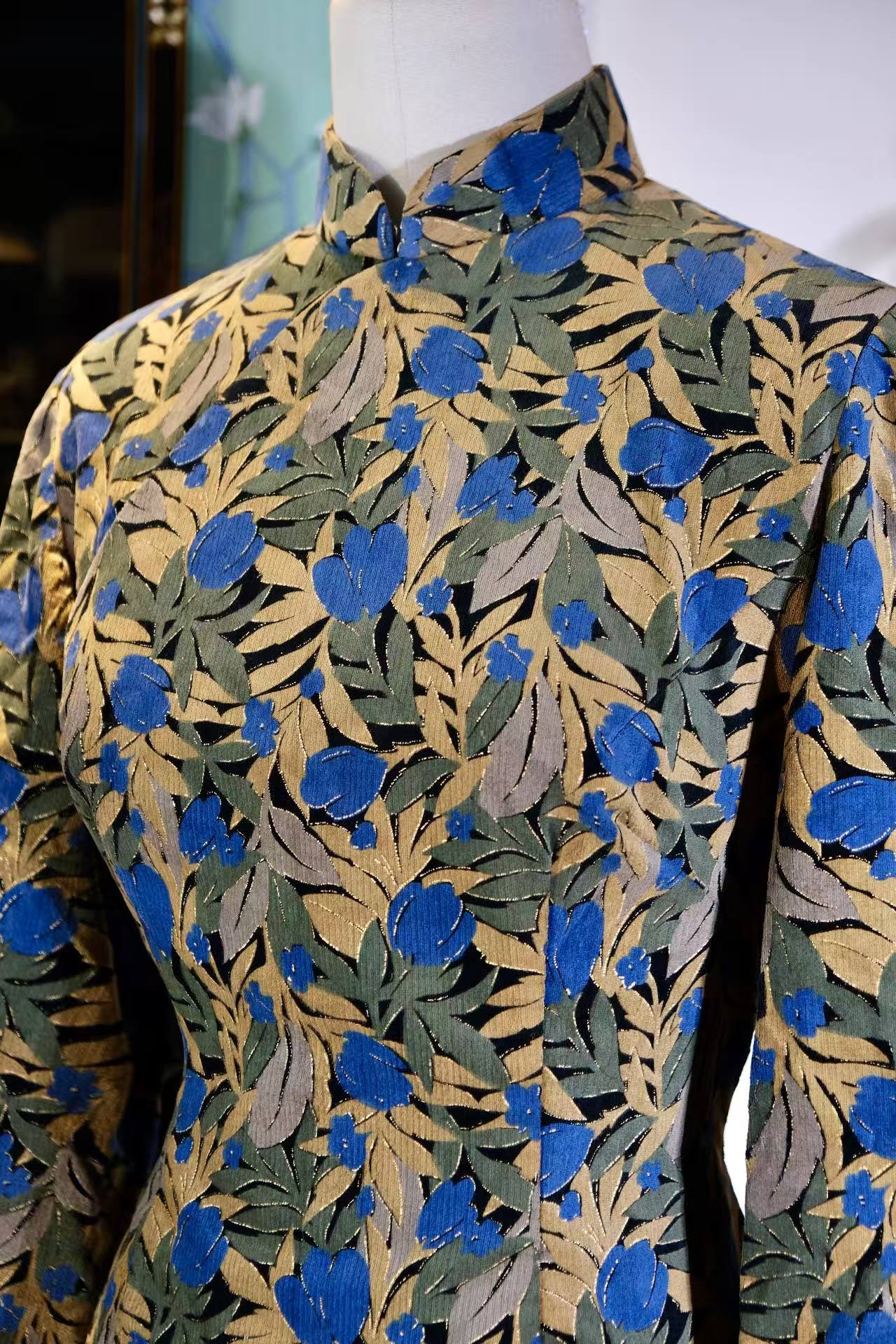
这件旗袍的底料,选用了极具时代特征的印花织物。底色是沉稳而温暖的赭黄,宛如秋日午后的暖阳,又似泛黄的旧宣纸,透着岁月的温润。
其上满铺着繁复的草木纹样,叶片呈墨绿与灰褐交织,展现出岭南植物特有的苍翠与厚重。最引人注目的,是那散落其间的钴蓝色花朵。这种蓝色,浓郁如深海,又似蓝宝石般幽邃,在暖色调的底面上形成了强烈的视觉冲击。花朵形态抽象而写意,既有西方现代艺术的几何感,又保留了东方折枝花鸟的韵味,仿佛是在赭黄的底色上肆意生长的“蓝花楹”,营造出一种“乱花渐欲迷人眼”的繁盛景象。
二、 工艺考释:金线点睛,半印半绘的匠心
这件旗袍的真正灵魂,在于那手绘的描金。这并非通体手绘的工笔重彩,而是六十年代香港旗袍工艺中一种极为高超且稀缺的“改良”技法——“半印半绘,金线点睛”。
在那个机器印花技术初具规模、但手工技艺仍被视为高贵的年代,工匠们运用了“先印后绘”的智慧。底色的花草纹样通过精细的印染工艺确立了整体的色调与氛围,而随后,技艺精湛的画师需以最纯正的金粉或金漆,屏息凝神,沿着花瓣的边缘、叶脉的走向,一笔一划地进行勾勒。
这种工艺的难度在于“对位”。手绘的金线必须精准地覆盖或勾勒出印花的轮廓,稍有偏差,便会显得凌乱。然而,在这件旗袍上,我们看到的却是行云流水般的笔触。金线在钴蓝与赭黄之间游走,不仅将平面的印花图案瞬间“提”了起来,赋予了纹样浮雕般的立体感,更在光影流转间,让整件旗袍泛出流动的华贵光泽。
正如《考工记》所云:“天有时,地有气,材有美,工有巧。”这手绘的金线,便是那画龙点睛的一笔,它打破了印花的沉闷,注入了匠人的体温与呼吸。
三、 稀缺性与艺术风格:不可复制的孤品
在如今的古董旗袍收藏界,全印花的旗袍虽常见,但带有手绘描金工艺的存世量却极少。原因在于,手绘金粉随着岁月的流逝极易氧化脱落,能像这件旗袍一样,历经半个多世纪,金线依然清晰、饱满、熠熠生辉者,实属凤毛麟角。
它不仅是“新艺术运动”自然主义风格在东方的回响,更是香港制衣业从传统手工作坊向现代工业化转型的历史见证。它既有工业时代的秩序美(印花底纹),又有手工艺时代的独特性(手绘金线)。
“衣以载道,物以传情。”
这件旗袍,以赭黄为纸,以钴蓝为墨,以真金为骨。它诉说着六十年代香港名媛在舞池旋转时的风华,也记录着那个时代工匠们对美的极致追求。这是一件值得被博物馆珍藏的艺术品,也是一件值得被传世的孤品。
— Notes on a 1960s Hong Kong Hand-Painted Gilded Print Antique Qipao
Measurements / Size Guide:
Bust / Waist / Hips: 86/76/96 cm
Total Length: 106 cm
Detailed Description:
Within the vast galaxy of costume history, the Hong Kong qipao of the 1960s is undoubtedly one of the most brilliant constellations. It was a "Golden Age" where Eastern and Western aesthetics collided fiercely yet merged perfectly. The qipao presented here is the most vivid footnote to those glinting years; it is not merely a garment, but a segment of old Hong Kong history sealed in silk.
The base material of this qipao features a printed textile highly characteristic of its era. The base color is a steady, warm ochre yellow, akin to the warm sun of an autumn afternoon or aged Xuan paper, radiating the gentle warmth of passing years.
Overlaid upon this are dense, complex botanical motifs. The leaves are an interweaving of dark green and ash brown, showcasing the lushness and weight characteristic of Lingnan flora. Most striking are the cobalt blue flowers scattered throughout. This blue is as rich as the deep sea and as profound as a sapphire, creating a powerful visual impact against the warm-toned background. The floral forms are abstract and expressive, possessing both the geometric sense of Western modern art and the charm of Oriental "broken branch" bird-and-flower painting—as if "jacarandas" were growing wantonly across the ochre base, creating a flourishing scene that "bewilders the eye with a riot of blossoms."
The true soul of this qipao lies in its hand-painted gilding. This is not an all-over hand-painted heavy color piece, but rather a highly sophisticated and scarce "improved" technique within 1960s Hong Kong qipao craftsmanship—"semi-printed, semi-painted, with gilded finishing touches."
In an era when machine printing technology was beginning to scale but hand-craftsmanship was still regarded as noble, craftsmen applied the wisdom of "printing first, painting later." The base botanical patterns established the overall tone and atmosphere through precise dyeing processes. Subsequently, a skilled painter, holding their breath and focusing their mind, would use the purest gold powder or lacquer to trace along the edges of petals and the veins of leaves, stroke by stroke.
The difficulty of this craft lies in "alignment." The hand-painted gold lines must precisely cover or outline the printed contours; the slightest deviation would result in a cluttered appearance. However, on this qipao, we see brushstrokes as fluid as moving clouds. The gold lines traverse between the cobalt blue and ochre yellow, not only instantly "lifting" the flat printed patterns and granting them a relief-like three-dimensionality but also allowing the entire garment to emit a flowing, luxurious luster as light and shadow shift.
As Kao Gong Ji states: "Heaven has its seasons, Earth its vitality, materials their beauty, and craftsmen their skill." These hand-painted gold lines are the finishing touch that breaks the stillness of the print, injecting the warmth and breath of the artisan.
In today’s antique qipao collecting circles, while all-over printed qipaos are common, those featuring hand-painted gilding are extremely rare. This is because hand-painted gold powder easily oxidizes or peels away over time. To find a piece like this—where after more than half a century, the gold lines remain clear, full, and radiant—is truly like finding a "phoenix among feathers."
It is not only an Oriental echo of the naturalism of the Art Nouveau movement but also a historical witness to the Hong Kong garment industry’s transition from traditional handicraft workshops to modern industrialization. it possesses both the beauty of order from the industrial age (the printed base) and the uniqueness of the handicraft era (the hand-painted gold lines).
"Garments carry the Way; objects convey emotion." This qipao uses ochre as its paper, cobalt as its ink, and pure gold as its bone. It narrates the grace of 1960s Hong Kong socialites spinning on the dance floor and records the artisans' ultimate pursuit of beauty. This is a work of art worthy of museum preservation and a unique specimen meant to be passed down through generations.