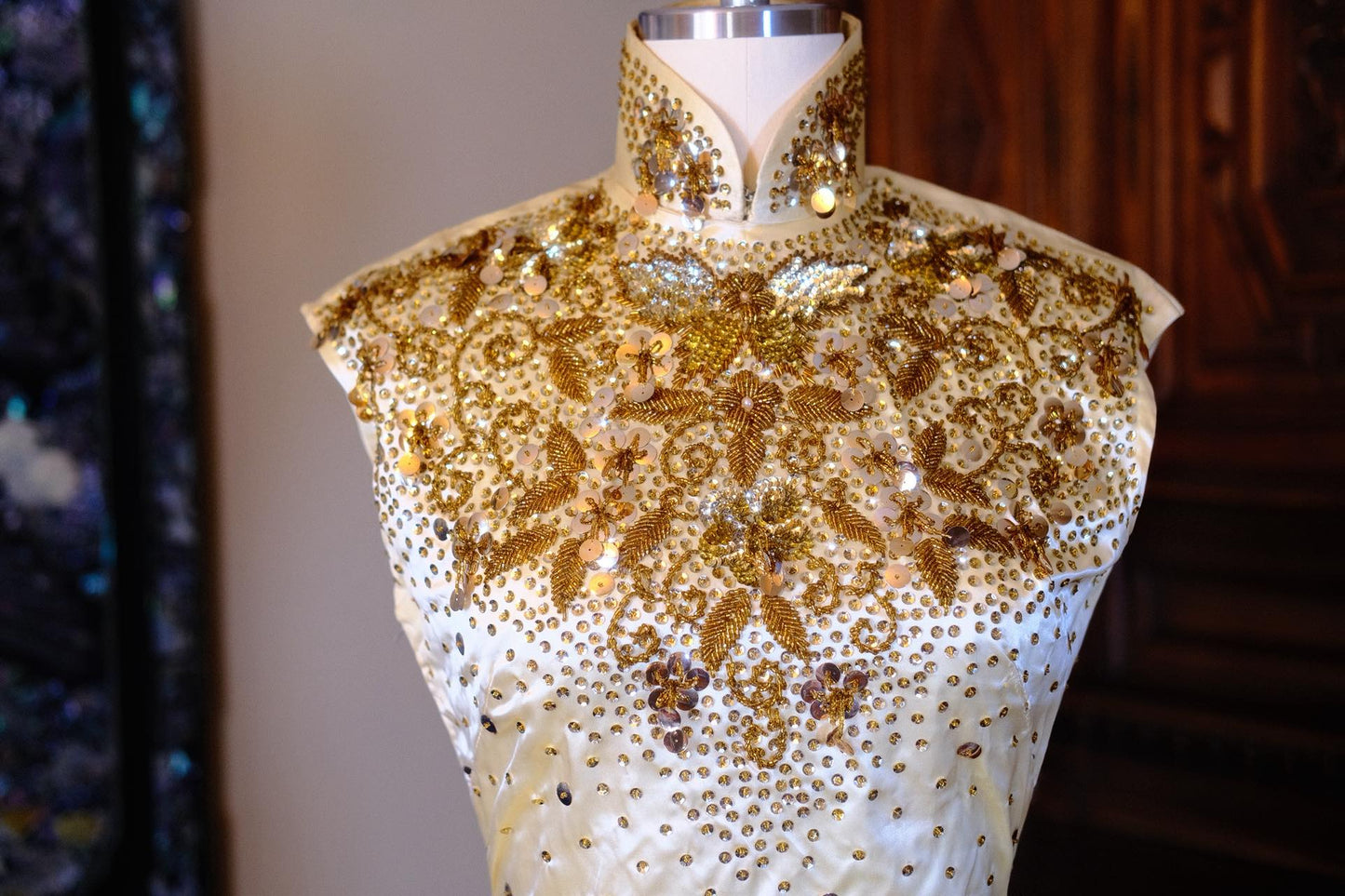
鎏金岁月里的东方绮梦
当指尖抚过这袭香槟金缎面上的万千珠光,仿佛触到了1960年代香港的鎏金岁月。这件诞生于香港的手工潮汕珠绣礼服旗袍,是东方美学与西方剪裁的绝妙碰撞,更是时光沉淀下的稀缺孤品。
衣身以潮汕传统珠绣工艺织就繁华:领口至胸前的金色珠绣如凤凰展翅,叶片纹样以金线串珠层层铺陈,每一片“羽毛”都缀满细碎水晶与珍珠母贝,在光线下流转出虹彩般的光泽;衣身散落的圆珠如星子坠入银河,与胸前的繁复刺绣形成“密不透风,疏可走马”的东方构图美学。这种“重工不重样”的手工技艺,在机械化生产的今天已成绝响——潮汕绣娘需耗时数月,,将珠片、亮片、水晶与丝线编织成流动的画卷,正如《考工记》所言“天有时,地有气,材有美,工有巧”,方得此“四美兼具”的传世之作。
它的故事,藏在香港电影的黄金时代里。1967年,邵氏影业的《香江花月夜》中,郑佩佩身着同款旗袍登场,将东方女性的典雅与摩登演绎得淋漓尽致。彼时的香港,东西方文化交融碰撞,潮汕珠绣这一源自岭南的民间工艺,被赋予了国际化的时尚表达。这件旗袍不仅是戏服,更是时代符号——它见证了邵氏“十二金钗”的风华绝代,也承载着香港作为“东方好莱坞”的辉煌记忆。如今,能在私人藏家手中得见此等保存完好的古董衣,无异于触摸到一段鲜活的历史。
其艺术风格,是“新古典主义”的典范:立领、开衩、修身剪裁延续传统旗袍的婉约,而珠绣的现代几何纹样与亮片的大胆运用,又透出Art Deco的摩登气息。这种“旧瓶装新酒”的创新,恰如林语堂笔下“中西合璧的优雅”,让传统工艺在时代浪潮中焕发新生。稀缺性更不言而喻:潮汕珠绣2008年才被列入国家级非物质文化遗产,而1960年代的香港手工旗袍,因战乱、迁徙与时代变迁,存世量不足百件。这件旗袍的每一道针脚,都是无法复制的时光印记。
当郑佩佩在银幕上转身,珠绣的光泽与她的笑靥交相辉映,那是东方美学的永恒瞬间。而这件古董旗袍,正等待着新的主人,续写它的鎏金故事。
Oriental Dreams in the Gilded Age
As fingertips brush over the myriad of pearlescent lights on this champagne-gold satin, it feels as if one has touched the gilded era of 1960s Hong Kong. This handmade Chaoshan bead-embroidered gala qipao, born in Hong Kong, is a sublime collision between Oriental aesthetics and Western tailoring—a rare, one-of-a-kind masterpiece tempered by time.
The body of the garment weaves a narrative of prosperity through traditional Chaoshan bead embroidery: the golden beadwork from the collar to the chest resembles a phoenix spreading its wings. The leaf patterns are layered with gold-threaded beads, each "feather" adorned with delicate crystals and mother-of-pearl, rippling with iridescent luster under the light. The scattered beads across the dress are like stars falling into the Milky Way, forming an Oriental compositional aesthetic of "denseness that blocks the wind, yet sparseness that allows a horse to gallop" alongside the intricate embroidery on the chest. This "heavy craftsmanship without repetition" has become a lost art in today’s mechanized production—Chaoshan embroideresses would spend months weaving beads, sequins, crystals, and silk threads into a flowing scroll. As stated in Kao Gong Ji (The Artificers' Record): "Heaven has its seasons, earth has its vitality, materials have their beauty, and craftsmanship has its ingenuity." Only through the union of these four can such a "fourfold beauty" masterpiece be achieved.
Its story is hidden within the Golden Age of Hong Kong cinema. In 1967, in the Shaw Brothers' film Hong Kong Nocturne, Cheng Pei-pei appeared on screen in a similar qipao, interpreting the elegance and modernity of the Oriental woman to perfection. At that time, Hong Kong was a melting pot of Eastern and Western cultures. Chaoshan bead embroidery, a folk craft originating from Lingnan, was granted an international fashion expression. This qipao is not merely a costume; it is an era's symbol—witnessing the peerless grace of the Shaw Brothers' "Twelve Golden Girls" and carrying the glorious memory of Hong Kong as the "Hollywood of the East." Today, to find such a well-preserved antique garment in the hands of a private collector is nothing short of touching a piece of living history.
Its artistic style is a paragon of "Neoclassicism": the standing collar, side slits, and slim tailoring continue the graceful restraint of the traditional qipao, while the modern geometric patterns of the beadwork and the bold use of sequins exude the chic atmosphere of Art Deco. This innovation of "new wine in old bottles" is exactly the "elegance of East-meets-West" described by Lin Yutang, allowing traditional craftsmanship to be reborn amidst the tides of the era. Its scarcity goes without saying: Chaoshan bead embroidery was only listed as a National Intangible Cultural Heritage in 2008, and handmade Hong Kong qipaos from the 1960s, due to war, migration, and the changing times, number fewer than a hundred in existence. Every stitch of this qipao is an irreproducible imprint of time.
When Cheng Pei-pei turned on the screen, the luster of the beadwork and her radiant smile complemented each other—an eternal moment of Oriental aesthetics. Now, this antique qipao awaits a new owner to continue its gilded story.