深圳溯源
无法加载取货服务可用情况
衣服尺寸:
胸围/腰围/臀围:92/76/100 厘米
衣长: 100 厘米
细节描述:
一、纹样考:法式蕾丝的东方转译
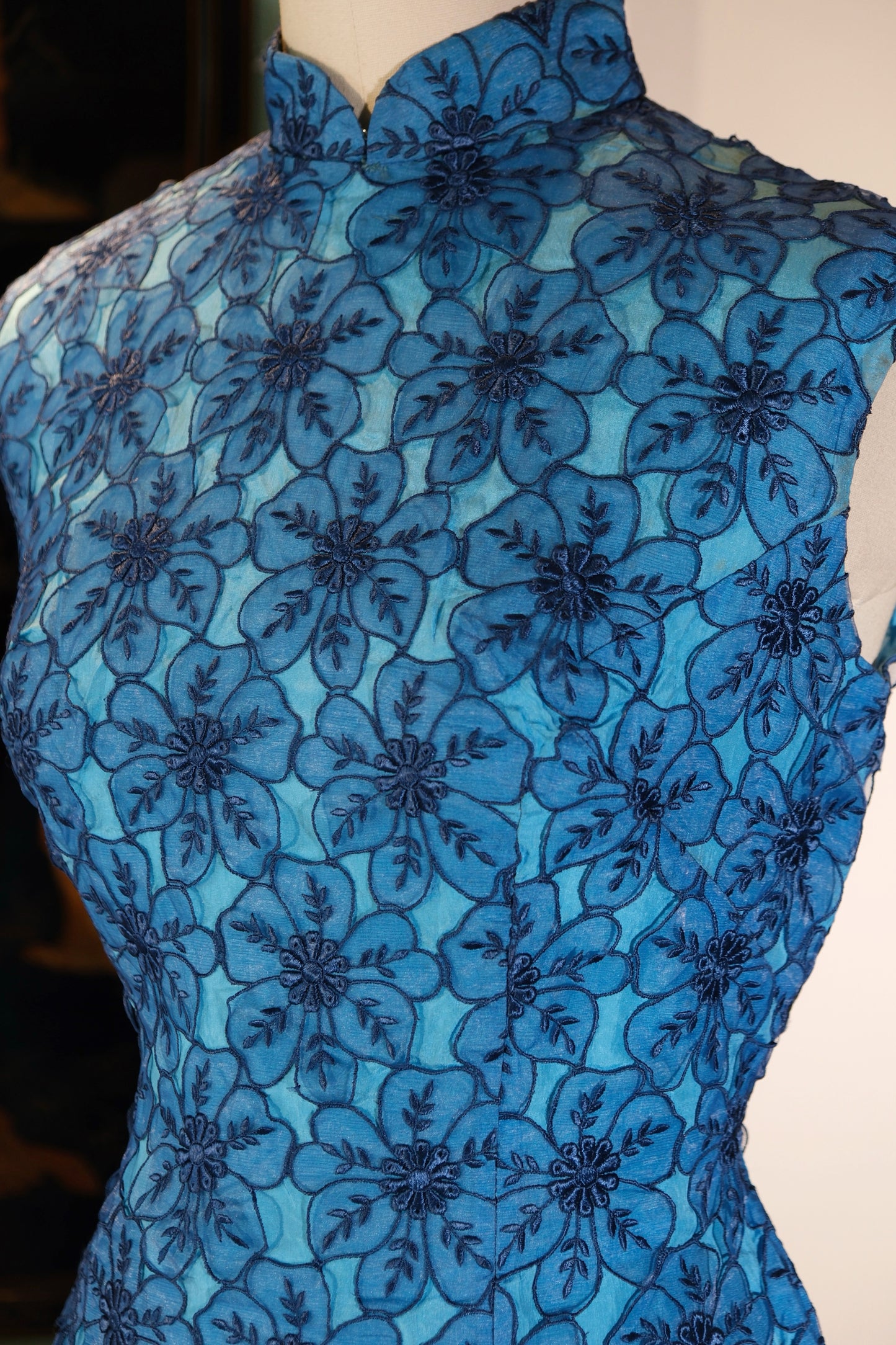
此件旗袍最摄人心魄处,在于其通体覆满的机绣蕾丝纹样。不同于传统苏绣的细腻写实或粤绣的繁复堆叠,此衣选用法国进口的蕾丝面料,以深邃的普鲁士蓝为基底,绣以同色系靛青丝线,构成连绵不绝的抽象花卉图案。
花朵造型取意“团花”,却摒弃了传统牡丹、菊花的具象形态,转而以几何化的五瓣花为核心,花瓣边缘呈波浪状卷曲,花蕊处以细密的锁针绣出星芒纹,暗合《考工记》“天有时,地有气,材有美,工有巧”的造物理念。叶片则以简化的柳叶纹穿插其间,形成“花叶相错,疏密有致”的韵律感。尤为精妙的是,蕾丝底布的网眼结构与刺绣纹样形成虚实对比,光线穿透时,衣身似笼罩一层薄雾,恰如李渔《闲情偶寄》所言“雾里看花,水中望月”,将东方美学的朦胧意境与西方蕾丝的通透质感完美融合。
二、衣史钩沉:冷战时期的时尚密码
这件旗袍诞生于1960年代的台湾,彼时正值全球时尚格局剧变之际。一方面,法国高级时装屋(如迪奥、巴尔曼)的“新风貌”余韵未消,蕾丝、刺绣等工艺成为上流社会的身份象征;另一方面,台湾作为“亚洲四小龙”之一,承接了大量欧美纺织订单,本土旗袍制作亦开始引入进口面料与机器工艺。
据《台湾纺织史》记载,1962年台湾纺织业出口额首次突破亿美元,法国、意大利的蕾丝面料通过香港转口大量涌入。
三、稀缺性证:机器时代的“手工温度”
在古董衣收藏界,六十年代台湾产旗袍的稀缺性常被低估。事实上,彼时台湾旗袍制作正处于“手工向机器过渡”的关键节点:一方面,传统手工刺绣旗袍因成本高昂逐渐式微;另一方面,机器生产的蕾丝旗袍虽效率提升,但因面料进口受限、工艺复杂,产量仍极为有限。据台北故宫博物院纺织组统计,1960-1970年间台湾年产蕾丝旗袍不足5000件,存世至今者更是凤毛麟角。
此件旗袍的稀缺性更体现在细节处理:领口与袖口未做包边,直接以蕾丝原边收口,显露出60年代初期“粗犷实用”的工艺特征。更难得的是,衣身未见明显褪色或破损,蕾丝纹样依旧立体饱满,仿佛将六十年代台北街头的光影与风情,永远定格在了这一抹青蓝之中。
四、艺术风格:从“装饰艺术”到“波普美学”
若以艺术史视角审视,此件旗袍的纹样设计恰处于“装饰艺术”(Art Deco)与“波普艺术”(Pop Art)的交汇点。几何化的花卉造型、重复排列的图案结构,明显受到20年代装饰艺术运动的影响——彼时法国设计师埃米尔-雅克·鲁尔曼(Émile-Jacques Ruhlmann)便常以抽象花卉装饰家具,追求“机械时代的优雅”;而高饱和度的蓝青配色、大胆的色彩对比,则暗合60年代波普艺术对“大众文化符号”的挪用,如安迪·沃霍尔的《花朵》系列,同样以重复的花卉图案挑战传统审美。
这种风格的碰撞,在旗袍上转化为一种独特的“东方波普”气质:蕾丝的通透感消解了图案的厚重感,立领与开衩的传统形制又为现代图案注入古典韵味。正如艺术史家贡布里希所言:“艺术的生命在于不断对话”,这件旗袍正是东西方美学、传统与现代对话的绝佳载体。
五、结语:衣以载道,青蓝永续
这件六十年代台湾产法式蕾丝旗袍,不仅是一件衣物,更是一段凝固的历史。它见证了冷战时期台湾纺织业的崛起,承载了中西文化碰撞的火花,更以稀缺的工艺与独特的艺术风格,成为古董衣收藏中的“青蓝瑰宝”。当我们凝视衣身上那连绵不绝的花卉纹样,仿佛能听见六十年代台北街头的旗袍店中,缝纫机的哒哒声与留声机里的周璇歌声交织回荡——那是属于一个时代的时尚记忆,亦是东方美学在世界舞台上的一次优雅转身。
“青,取之于蓝,而青于蓝。”这件旗袍的青蓝之色,既是面料的固有色,更是文化交融后升华的精神底色。它提醒我们:真正的经典,从不会被时间掩埋,只会在岁月的沉淀中愈发璀璨。
Measurements / Size Guide:
Bust / Waist / Hips: 92/76/100 cm
Total Length: 100 cm
Detailed Description:
The most captivating aspect of this qipao lies in the machine-embroidered lace motifs covering the entire garment. Unlike the delicate realism of traditional Suzhou embroidery or the heavy layering of Cantonese embroidery, this piece utilizes imported French lace fabric. Set against a deep Prussian blue base and embroidered with tonal indigo silk threads, it forms a continuous flow of abstract floral patterns.
The floral shapes draw inspiration from traditional "medallion flowers" (Tuanhua), yet they abandon the representational forms of peonies or chrysanthemums. Instead, they center on a geometric five-petal flower with wave-like curling edges. The stamens are embroidered with dense lock stitches to create a starburst pattern, aligning with the creative philosophy of Kao Gong Ji: "Heaven has its seasons, Earth its vitality, materials their beauty, and craftsmen their skill." Simplified willow-leaf motifs are interspersed between the blooms, creating a rhythmic sense of "interlaced flowers and leaves with balanced density." Most exquisite is the contrast between the mesh structure of the lace base and the embroidered patterns. When light penetrates the fabric, the body seems enveloped in a thin mist, perfectly merging the hazy imagery of Oriental aesthetics with the transparent texture of Western lace—much like Li Yu’s description in Sketches of Idle Leisure: "Viewing flowers through a mist, gazing at the moon in the water."
This qipao was born in 1960s Taiwan, a time of dramatic shifts in the global fashion landscape. On one hand, the "New Look" legacy of French haute couture houses (such as Dior and Balmain) remained influential, making lace and embroidery symbols of high-society status. On the other hand, as one of the "Four Asian Tigers," Taiwan took on massive textile orders from Europe and America, and local qipao makers began incorporating imported fabrics and mechanized processes.
According to the History of Taiwanese Textiles, Taiwan's textile export value exceeded 100 million USD for the first time in 1962, with French and Italian lace fabrics flooding in through Hong Kong transshipments.
In the world of antique garment collecting, the scarcity of 1960s Taiwanese qipaos is often underestimated. In fact, Taiwanese qipao production was then at a critical junction of "transitioning from manual to machine." While traditional hand-embroidered pieces declined due to high costs, machine-produced lace qipaos remained extremely limited due to fabric import restrictions and complex craftsmanship. According to statistics from the Textile Department of the National Palace Museum in Taipei, fewer than 5,000 lace qipaos were produced annually in Taiwan between 1960 and 1970, making surviving examples exceptionally rare.
The scarcity of this piece is further highlighted by its detailing: the collar and cuffs are not piped but finished directly with the raw lace edge, revealing the "rugged and practical" craftsmanship characteristic of the early 60s. Remarkably, the garment shows no significant fading or damage, and the lace patterns remain three-dimensional and full, as if the light and shadows of 1960s Taipei streets have been eternally frozen in this shade of cerulean.
From an art-historical perspective, the pattern design of this qipao sits at the intersection of Art Deco and Pop Art. The geometric floral shapes and repetitive structural arrangement are clearly influenced by the 1920s Art Deco movement—much like French designer Émile-Jacques Ruhlmann, who often decorated furniture with abstract florals in pursuit of "elegance in the machine age." Meanwhile, the high-saturation blue-green palette and bold color contrast align with 1960s Pop Art’s appropriation of "mass culture symbols," reminiscent of Andy Warhol’s Flowers series, which similarly challenged traditional aesthetics through repetitive floral motifs.
This collision of styles translates into a unique "Oriental Pop" temperament on the qipao: the transparency of the lace dissipates the heaviness of the patterns, while the traditional form of the standing collar and side slits injects a classical charm into the modern design. As art historian E.H. Gombrich said: "The life of art lies in constant dialogue." This qipao is a perfect vehicle for the dialogue between Eastern and Western aesthetics, and between tradition and modernity.
This 1960s Taiwanese French lace qipao is not just a piece of clothing; it is a solidified segment of history. It witnesses the rise of the Taiwanese textile industry during the Cold War, carries the sparks of Sino-Western cultural collision, and stands as a "cerulean treasure" in antique collections due to its rare craftsmanship and unique style. Gazing at the continuous floral patterns, one can almost hear the rhythmic clatter of sewing machines in a 1960s Taipei tailor shop blending with the gramophone songs of Zhou Xuan—a fashion memory of an era and an elegant turn for Oriental aesthetics on the world stage.
"Indigo blue is extracted from the indigo plant, yet is bluer than the plant itself." The cerulean color of this qipao is not only the inherent hue of the fabric but the spiritual background color sublimated after cultural fusion. It reminds us that true classics are never buried by time; they only shine more brilliantly through the accumulation of years.