深圳溯源
无法加载取货服务可用情况
衣服尺寸:
胸围/腰围/臀围:80/62/84 厘米
衣长:94 厘米
细节描述:
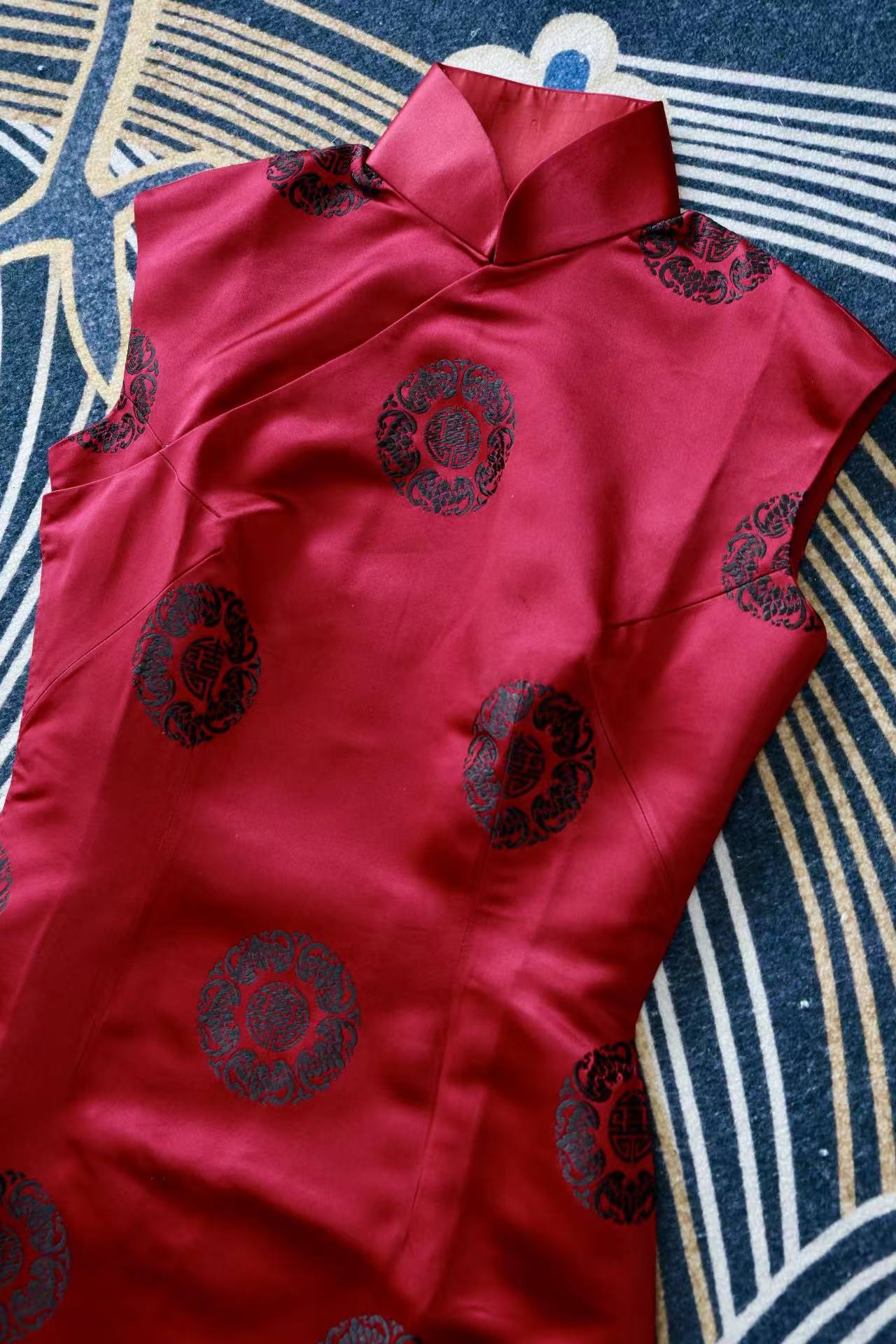
当指尖抚过这件六十年代香港产的古董旗袍,织锦缎特有的凉滑质感仿佛瞬间打通了时光隧道——正红色的缎面上,团寿纹样以提花工艺浮凸而出,每一处纹路都藏着那个黄金年代的工艺密码与香江风华。
一、团寿纹里的东方美学
旗袍上的核心图案为“团寿纹”,这是中国传统吉祥纹样中最具代表性的符号之一。“寿”字经艺术化处理后呈圆形团花状,外围环绕缠枝花卉或云纹,构成“团寿”意象。据《考工记》记载:“天有时,地有气,材有美,工有巧,合此四者,然后可以为良。”这件旗袍的团寿纹恰是“材美工巧”的典范:
- 提花工艺:采用传统木机提花技术,通过经纬线交织形成凹凸纹理,使团寿纹在光线下呈现“远看一团火,近看万点金”的视觉效果。
- 色彩哲学:正红缎面象征喜庆与尊贵,黑色团寿纹则暗合“玄色为贵”的传统礼制,红黑对比既庄重又鲜活,呼应《礼记》“朱绿之饰,所以章贵贱也”的服饰美学。
- 文化隐喻:团寿纹的圆形结构寓意“圆满无缺”,缠枝纹象征“生生不息”,二者结合恰如《诗经》所言“如月之恒,如日之升”,寄托着对生命永恒的祈愿。
二、香江裁缝的黄金时代
上世纪六十年代的香港,是中西文化碰撞的熔炉,也是旗袍工艺的黄金年代。彼时上海裁缝南迁香江,将海派旗袍的精致剪裁与粤式工艺融合,创造出独具特色的“港派旗袍”。这件旗袍正是这一时期的典型产物:
- 剪裁革新:无袖设计与立体收腰剪裁,既保留了传统旗袍的立领、斜襟元素,又融入了西方服饰的修身理念,呼应张爱玲笔下“旗袍是女性第二层皮肤”的时尚宣言。
- 面料稀缺性:织锦缎在六十年代属高档面料,需经“三浸三晒”工艺处理,产量极低。据《香港纺织业史》记载,1960年代香港织锦缎年产量不足千匹,且多用于出口,存世量极为稀少。
- 工艺绝响:提花织机在七十年代后逐渐被电子提花取代,传统木机提花工艺近乎失传。这件旗袍的团寿纹提花,每一针都凝结着匠人的心血,堪称“活着的文物”。
三、古董衣的时空叙事
这件旗袍的稀缺性不仅在于工艺,更在于它承载的历史记忆。六十年代的香港,是李小龙的功夫电影风靡全球的时代,也是邵氏电影公司缔造华语电影黄金期的年代。想象一位身着此旗袍的女子,或许曾穿梭于中环的霓虹灯下,或许曾在利舞台的戏院门前驻足——她的身影,是那个时代香江风华的缩影。
如今,随着古董旗袍收藏热的兴起,六十年代香港产旗袍已成为藏家竞相追逐的对象。而这件团寿提花旗袍,因纹样独特、保存完好,更显弥足珍贵。
四、结语:穿在身上的历史
这件旗袍不仅是一件衣物,更是一部穿在身上的历史。它见证了香江裁缝的匠心独运,承载了东方美学的千年传承,也凝固了六十年代香港的时代风华。当它再次被穿起,仿佛能听见木机提花的“咔嗒”声,看见香江岸边的灯火辉煌——这,便是古董衣的魅力:让历史在衣褶间重生,让文化在经纬中永恒。
Measurements / Size Guide:
Bust / Waist / Hips: 80/62/84 cm
Total Length: 94 cm
Detailed Description:
As fingertips brush against this vintage 1960s Hong Kong-made qipao, the uniquely cool and supple texture of silk brocade seems to bridge a temporal rift. Upon a crimson satin ground, the Circular Shou (Longevity) motifs emerge through jacquard weaving—each thread concealing the artisanal codes and the storied elegance of Hong Kong’s golden era.
The central motif, the "Circular Shou", is one of the most iconic symbols of traditional Chinese auspicious patterns. The character for "Longevity" is artistically stylized into a circular floral form, surrounded by intertwining vines or cloud scrolls. As noted in Kao Gong Ji: "Heaven has its seasons, Earth its vital energy, materials their beauty, and craftsmanship its ingenuity. The union of these four results in excellence." This qipao’s motif is a paragon of such "material beauty and ingenious craft":
Jacquard Craftsmanship: Utilizing traditional wooden-loom jacquard technology, the interlacing of warp and weft creates a relief-like texture. This allows the motif to present a visual effect described as "a ball of fire from afar, ten thousand flecks of gold up close" under shifting light.
Color Philosophy: The crimson satin symbolizes celebration and nobility, while the black motifs subtly align with the traditional prestige of Xuan (the deep black of the heavens). This red-black contrast is both solemn and vivid, echoing the aesthetic in the Book of Rites: "The ornamentation of vermilion and green distinguishes the noble from the common."
Cultural Metaphor: The circular structure of the motif signifies "perfection and wholeness," while the intertwining vines represent "endless vitality." Together, they evoke the Classic of Poetry: "As the moon constant, as the sun rising," embodying a prayer for the eternity of life.
1960s Hong Kong was a melting pot of Eastern and Western cultures and the zenith of qipao craftsmanship. During this period, Shanghainese tailors migrated south to Hong Kong, fusing the exquisite tailoring of the Haipai (Shanghai) style with Cantonese techniques to create the distinctive "Hong Kong Style Qipao."
Tailoring Innovation: The sleeveless design and 3D cinched-waist cut preserve the traditional standing collar and diagonal lapel while integrating Western principles of form-fitting silhouettes. It echoes Eileen Chang’s fashion manifesto: "The qipao is a woman’s second skin."
Material Scarcity: In the 1960s, silk brocade was a premium fabric requiring the "triple-soaking and triple-drying" process, resulting in extremely low yields. Records from the History of the Hong Kong Textile Industry indicate that annual production of such brocade was less than a thousand bolts, most of which were for export, making surviving pieces exceedingly rare.
The Echo of a Lost Craft: After the 1970s, traditional wooden jacquard looms were gradually replaced by electronic ones. The craftsmanship behind this qipao’s motifs—where every stitch condenses the artisan's soul—represents a nearly extinct art, making it a "living artifact."
The scarcity of this qipao lies not only in its craft but in the historical memory it carries. 1960s Hong Kong was the era when Bruce Lee’s martial arts films swept the globe and the Shaw Brothers Studio forged the golden age of Chinese cinema. Imagine a woman in this qipao, perhaps gliding through the neon lights of Central or pausing before the Lee Theatre—her silhouette is a microcosm of Hong Kong’s elegance.
With the rising fervor for vintage qipao collecting, 1960s Hong Kong-made pieces have become highly sought-after. This Circular Shou jacquard piece, with its unique pattern and pristine condition, is a rare treasure among treasures.
This qipao is more than a garment; it is a wearable history. It witnesses the ingenuity of Hong Kong tailors, carries a millennium of Oriental aesthetic tradition, and freezes the era-defining spirit of 1960s Hong Kong. When worn again, one can almost hear the rhythmic "clack" of the wooden loom and see the brilliant lights along the Hong Kong harbor. This is the charm of vintage clothing: letting history be reborn in the folds of the fabric and allowing culture to achieve eternity within the warp and weft.