深圳溯源
无法加载取货服务可用情况
衣服尺寸:
胸围/腰围/臀围:94/80/104 厘米
衣长:102 厘米
细节描述:
一、衣上繁花:一幅流动的春日画卷
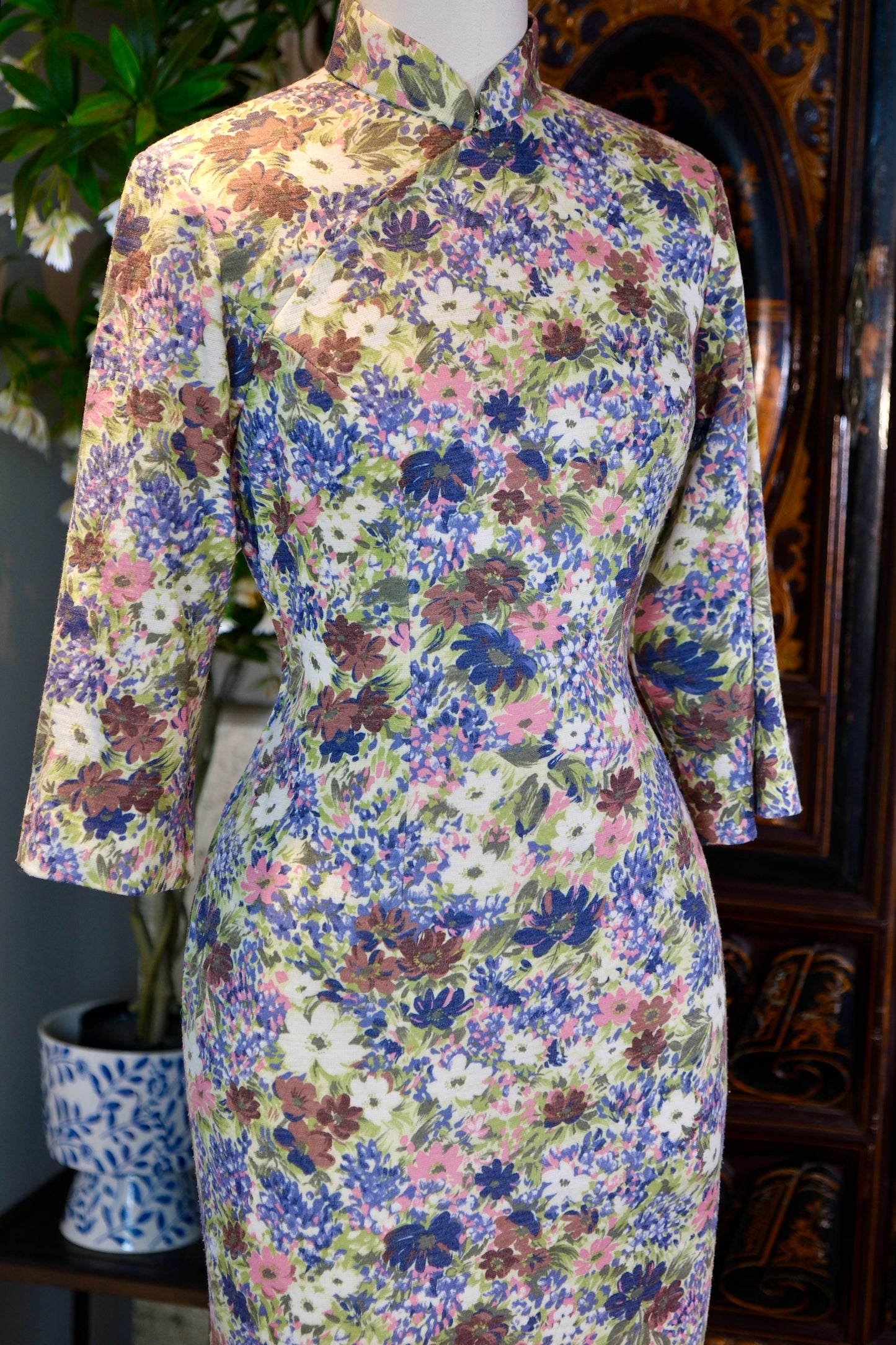
这件上世纪六十年代香港产的古董旗袍,以针织面料为底,通体覆满繁密而生动的印花图案,宛如将一座江南园林的春日盛景织入经纬。
- 色彩交响:底色为温润的米白,似宣纸般柔和,其上绽放着靛蓝、粉紫、赭红、嫩绿交织的花簇——靛蓝如暮色中的绣球,粉紫似初绽的丁香,赭红若秋海棠的残瓣,嫩绿则如新抽的柳芽,色彩层次丰富却不杂乱,恰如《长物志》所言“随方制象,各有所宜”,在方寸衣料间营造出“乱花渐欲迷人眼”的视觉韵律。
- 纹样意趣:花卉以写实与写意结合的手法呈现,既有牡丹的雍容、菊花的清雅,亦有不知名野花的烂漫,枝叶穿插其间,形成“花中有花,叶里藏花”的繁复构图。这种“满铺式”印花在六十年代香港旗袍中尤为典型,既承袭了民国旗袍的装饰性,又融入西方现代设计的平面构成感,暗合张爱玲笔下“生命是一袭华美的袍”的意象——袍上繁花,既是世俗的热闹,亦是文人式的孤高。
二、时光针脚:一件旗袍的香江往事
这件旗袍诞生于上世纪六十年代的香港,彼时正值东西方文化激烈碰撞的黄金年代。
- 时代剪影:六十年代的香港,经济腾飞与市井烟火并存,女性开始走出家门,既需应对社交场合的体面,亦追求日常穿着的舒适。针织面料的运用,正是这一需求的产物——相较于传统丝绸的娇贵,针织的弹性与垂坠感更贴合身体曲线,行动间自带“行到水穷处,坐看云起时”的从容。而印花图案的繁密,则暗合了当时香港社会对“繁华”的渴望,每一朵花都是对未来的期许。
- 工艺密码:旗袍的剪裁保留了传统“省道”工艺,腰部收省贴合身形,领口、袖口与开衩处的滚边细致工整,针脚细密如发,可见当年裁缝的匠心。尤为难得的是,针织面料在六十年代的香港尚属新兴材质,能将其与传统旗袍形制完美结合,足见设计者的巧思——这不仅是服装,更是一段“旧时王谢堂前燕,飞入寻常百姓家”的技术革新史。
三、艺术孤本:稀缺性背后的文化价值
在古董旗袍的收藏体系中,这件针织印花旗袍堪称“凤毛麟角”,其稀缺性源于三重维度:
- 材质之稀:六十年代香港旗袍多以丝绸、锦缎为主,针织面料因成本高、工艺难,仅少量高端定制采用。历经半个多世纪,针织面料易老化、变形,能完整保存至今者,十不存一。
- 风格之绝:其印花图案融合了东方传统花鸟画的意境与西方波普艺术的色彩张力,既非纯粹的“中式复古”,亦非简单的“西式模仿”,而是香港本土文化“和而不同”的具象化表达,正如学者李欧梵所言:“香港文化是一种‘浮城’美学,在传统与现代的夹缝中开出奇异的花。”
- 历史之证:这件旗袍是六十年代香港女性生活状态的“活化石”——它见证了殖民地的繁华与焦虑,记录了女性从“深闺”到“街头”的身份转变,更承载了一代人对“美”的执着追求。每一处针脚、每一朵印花,都是时光的刻痕,正如《诗经》所云:“青青子衿,悠悠我心”,衣虽旧,而风华不减。
四、结语:穿在身上的历史诗学
这件旗袍,是六十年代香江的一缕风,是针织与印花的交响,是传统与现代的对话。它不只是一件衣服,更是一段被织物封存的时光——当你凝视它,仿佛能看见维多利亚港的灯火、听见裁缝铺里的剪刀声、触碰到那个年代女性指尖的温度。正如本雅明所言:“真正的艺术品,是历史的寓言。”而这件旗袍,正是香江历史最温柔的寓言。
Measurements / Size Guide:
Bust / Waist / Hips: 94/80/104 cm
Total Length: 102 cm
Detailed Description:
This vintage Qipao, crafted in 1960s Hong Kong, uses a knitted fabric base entirely covered with dense and vivid printed patterns, as if weaving the springtime splendor of a Jiangnan garden into its warp and weft.
A Color Symphony: The base is a warm cream-white, as soft as Xuan paper, upon which clusters of indigo, dusty purple, ochre-red, and tender green bloom. The indigo resembles hydrangeas in the twilight, the purple like early-bloomed lilacs, the ochre-red like the petals of a begonia, and the green like newly sprouted willow shoots. The color layers are rich yet orderly, echoing the Treatise on Superfluous Things: "Shapes are made according to the space, each fitting its purpose," creating a visual rhythm of "turbulent flowers beginning to dazzle the eye" within the fabric.
Motif Artistry: The florals are presented through a blend of realistic and freehand styles—there is the opulence of the peony, the elegance of the chrysanthemum, and the wild charm of unknown blossoms. The branches intersperse to form a complex composition of "flowers within flowers, blossoms hidden in leaves." This "all-over" print was typical of 1960s Hong Kong Qipaos, inheriting the decorativeness of the Republican era while integrating the planar composition of Western modern design. It aligns with the imagery from Eileen Chang’s writing: "Life is a gorgeous gown"—the blooms on the gown represent both secular bustle and scholarly solitude.
This Qipao was born in 1960s Hong Kong, a golden age of intense collision between Eastern and Western cultures.
Silhouette of an Era: In 1960s Hong Kong, economic takeoff coexisted with the vibrancy of market life. Women began to step out of the domestic sphere, needing a balance between the dignity of social occasions and the comfort of daily wear. The use of knitted fabric was a product of this need—unlike delicate traditional silk, the elasticity and drape of knitwear fit the body's curves more comfortably, offering a sense of "strolling to the water's source and sitting to watch the rising clouds." The density of the floral prints mirrored the Hong Kong society's yearning for "prosperity" at the time; every flower was a hope for the future.
Craftsmanship Codes: The tailoring retains traditional darting techniques, with waist darts contouring the silhouette and meticulous piping at the collar, cuffs, and slits. The stitches are as fine as hair, revealing the tailor’s ingenuity. Notably, knitted fabric was an emerging material in 1960s Hong Kong; combining it perfectly with the traditional Qipao form shows the designer’s brilliance—this is not just clothing, but a history of technical innovation where "swallows of the past fly into the homes of ordinary people."
In the collection system of vintage Qipaos, this knitted print piece is a "phoenix feather and unicorn horn," with its rarity stemming from three dimensions:
Material Rarity: Most 1960s Hong Kong Qipaos were made of silk or brocade. Knitted fabric was used only in limited high-end customizations due to high costs and technical difficulty. After half a century, knitted fabrics age and deform easily; barely one in ten has survived in complete condition.
Style Uniqueness: Its print pattern merges the mood of traditional Oriental flower-and-bird painting with the color tension of Western Pop Art. It is neither pure "Chinese retro" nor simple "Western imitation," but a concrete expression of Hong Kong’s "harmony in diversity" culture. As scholar Leo Ou-fan Lee noted: "Hong Kong culture is a 'Floating City' aesthetic, blooming strangely in the gap between tradition and modernity."
Historical Witness: This Qipao is a "living fossil" of the lives of 1960s Hong Kong women—it witnessed the prosperity and anxiety of the colony, recorded the identity shift of women from the "inner chambers" to the "streets," and carried a generation's persistent pursuit of "beauty." Every stitch and every flower is a mark of time. As the Book of Songs says: "Green is your collar, long is my longing"—though the garment is old, its grace remains undiminished.
This Qipao is a breeze from 1960s Hong Kong, a symphony of knit and print, and a dialogue between tradition and modernity. It is more than just a piece of clothing; it is a fragment of time sealed in fabric. Gazing upon it, one can almost see the lights of Victoria Harbour, hear the shears in the tailor shop, and touch the warmth of a woman’s fingertips from that era. As Walter Benjamin said: "A true work of art is a historical allegory." And this Qipao is the gentlest allegory of Hong Kong’s history.