深圳溯源
无法加载取货服务可用情况
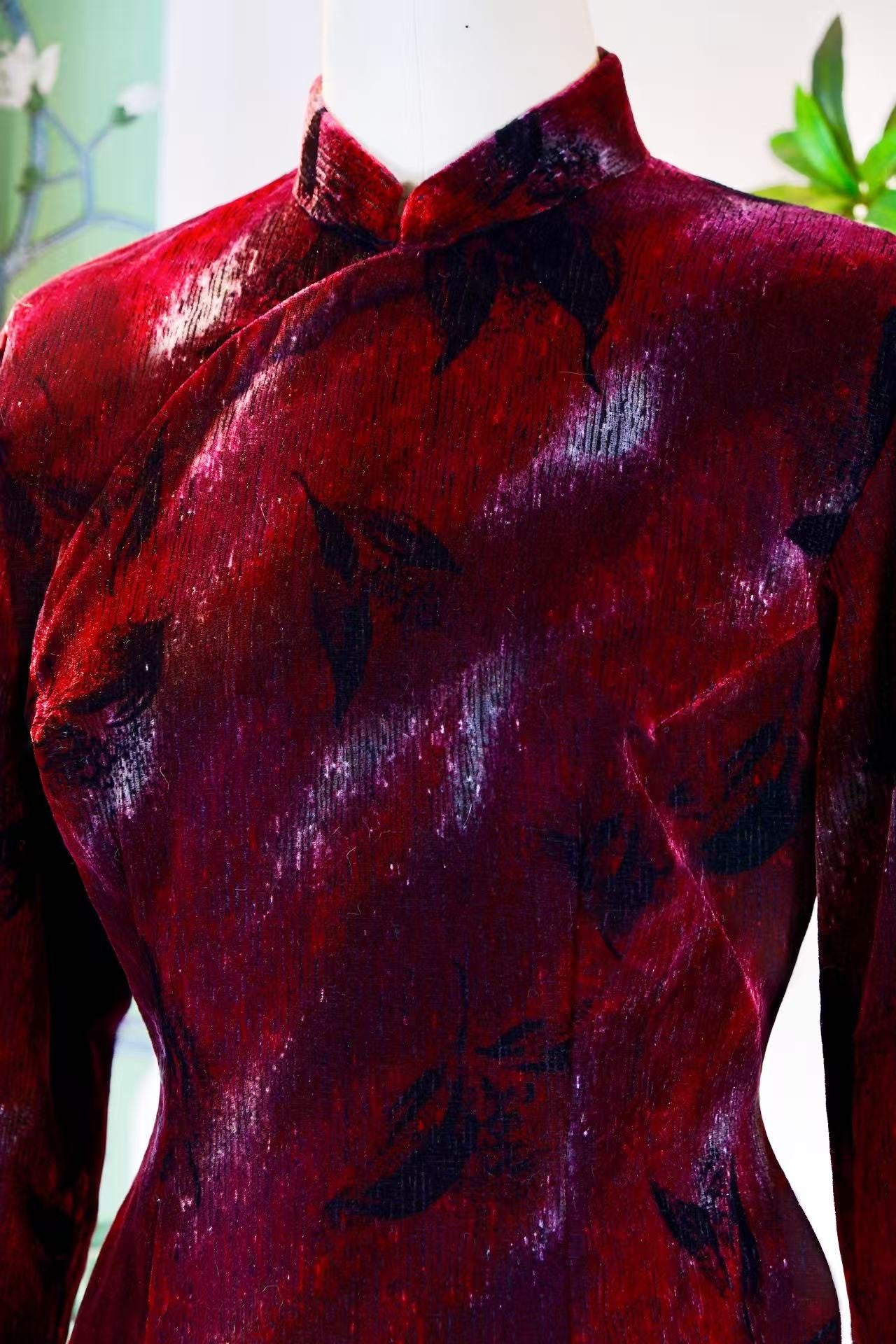
分享一件上世纪六十年代香港手绘丝绒古董旗袍:
这件藏于香江烟云中的古董旗袍,以酒红丝绒为底,
树叶图案的笔触带着宋人院体画的遗韵,写实中见写意:
其稀缺性更藏于工艺的不可复制性:香港制衣作坊的手绘匠人,
当手指抚过丝绒的竖条纹,触到手绘树叶微微凸起的墨痕,
This vintage cheongsam, shrouded in the mists of Hong Kong, uses wine-red silk velvet as its ground, subtly interwoven with heather grey silk threads (花灰丝线) that seem to drift like evening haze. The vertical striped texture shifts in light and shadow, aligning with the sentiment in the Rites of Zhou: Examiner of Works that "colors mingle: the East is called green, the South is called red..." fusing the opulence of velvet with the simple elegance of silk into a contradictory harmony. The most captivating feature, however, is the hand-painted leaf pattern covering the surface—ink-colored leaves are scattered irregularly, some spreading like palms, others slender as willow, with veins defined by deep ink and edges naturally blended to create a gradient. It is as if the most agile scene from an autumn forest has been captured and tailored into the fabric.
The brushstrokes of the leaf pattern carry the enduring grace of Song Imperial Academy painting (宋人院体画), exhibiting the freehand spirit within the realism: the leaf shapes are not strictly symmetrical but are artfully dense and sparse. This aligns with the compositional theory of "three distances" (三远) from Lofty Message of Forests and Streams (林泉高致): "Gazing up from below to the mountain peak is called 'high distance'; peering from the front of the mountain to the back is called 'deep distance.'" The layered and scattered arrangement of the leaves subtly reflects this principle of spatial depth, where nearby leaves are full and clear, and distant ones are blurred with light ink wash. The edges of some leaves are slightly curled, outlined with light ink to show withered, mottled patches, resembling the natural folds after frost. This echoes the Chinese structure of the cheongsam’s stand collar and diagonal closure, subtly aligning with the elegance of "stringing the autumn orchids for my girdle" from the Songs of Chu, condensing the Oriental aesthetics of "purity, elegance, and detachment" (清、雅、逸) onto a small piece of cloth.
Its scarcity is further embedded in the irreplicability of the craftsmanship: the hand-painting artisans in Hong Kong workshops used brushes dipped in mineral pigments to outline the leaves stroke by stroke on the velvet, requiring precise control over the dye's permeability. The color had to avoid bleeding into the velvet pile while retaining the fine strokes of the leaf veins. This "weaving + hand-painting" composite technique was already niche in the 1960s due to its time-consuming nature, and it is now an ultimate lost art. Even rarer is the base material: the wine-red velvet mixed with heather grey silk threads required precise modulation of the red-to-grey ratio during warp and weft interweaving, ensuring the vertical stripes look both luxurious and refined. This relentless pursuit of color and texture is a microcosm of the "East-meets-West" aesthetic of post-war Hong Kong Chinese fashion: it retains the traditional form of the cheongsam (stand collar, diagonal closure, cinched waist) but uses Western velvet fabric and hand-painting to reconstruct the expression, serving as a material testament to the cultural fusion of that special era.
When a finger traces the velvet's vertical stripes and touches the slightly raised ink traces of the hand-painted leaves, one can almost feel the dawn of 1960s Hong Kong: in a Central district tailor shop, the artisan is mixing pigments by the floor-to-ceiling window, while the distant whistles of Victoria Harbour ferries mingle with the humming of the loom. This cheongsam is not merely a garment but a solidified scroll of time—it uses the opulence of velvet, the elegance of silk thread, and the vitality of hand-painted leaves to narrate the perseverance and transformation of Oriental aesthetics under the impact of modernity. Its artistic value and historical scarcity warrant a definitive place in the history of vintage fashion.