深圳溯源
无法加载取货服务可用情况
衣服尺寸:
胸围/腰围/臀围:96/84/106 厘米
衣长:113 厘米
细节描述:
一、衣上纹样:凤羽卷草间的东方密码
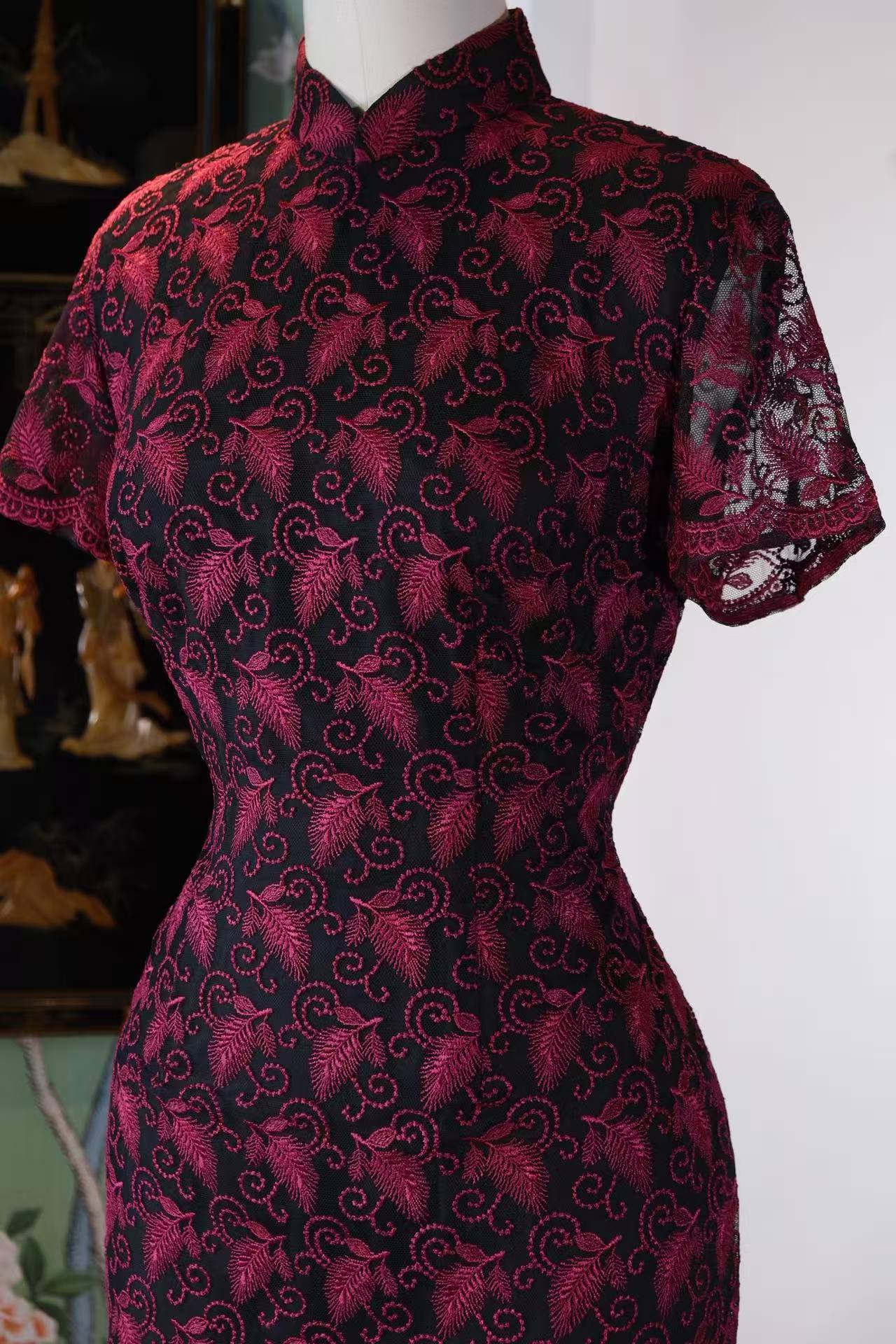
这件旗袍以黑色为底,通体覆以深红色机绣蕾丝,纹样以“凤羽卷草”为核心意象——凤羽舒展如扇,叶脉纤毫毕现,卷草纹则似流云蜿蜒,二者交织成连续的几何韵律。
蕾丝的镂空工艺让底布若隐若现,远观如暗夜中浮动的红霞,近看则可见针脚细密如织,每一片凤羽的边缘都以“回针绣”收边,卷草的曲线处则用“锁链绣”勾勒,机绣的精准与手绣的灵动在此达成微妙平衡。这种“以机代工”的工艺,正是1960年代台湾纺织业“传统与现代交融”的缩影。
二、古董衣的故事:宝岛霓裳的时代印记
1960年代的台湾,旗袍仍是女性社交场合的“体面符号”,但面料与工艺已悄然变革。彼时台湾纺织业正值“黄金十年”,进口人造丝与本土机绣技术结合,催生了这批“新派旗袍”——既保留立领、斜襟、收腰的传统剪裁,又以蕾丝、亮片等现代面料打破沉闷。
这件旗袍的主人,或许是台北城中一位“穿旗袍上班的新女性”:她在外资公司做文员,周末去西门町看电影,旗袍的黑红配色既显端庄,又不失活泼;蕾丝的透气性适合台湾的亚热带气候,而机绣的耐用性则符合“一件旗袍穿三年”的务实心态。如今,这类旗袍存世量不足千件,因当年多被“穿旧即弃”,能完整保留蕾丝无破损、颜色无褪变者,堪称“时代标本”。
三、艺术风格与稀缺性:从“实用美学”到“收藏孤品”
从艺术史视角看,这件旗袍体现了1960年代台湾设计的“折衷主义”:纹样上,凤羽卷草是明清织绣的经典母题(如故宫藏《乾隆帝后妃嫔像》中的服饰纹样),但机绣的规模化生产让其从“贵族专属”走向“市民日常”;色彩上,黑红对比既符合中国传统“玄赤为尊”的礼制(《周礼·考工记》:“黑与赤谓之玄”),又暗合1960年代全球流行的“波普艺术”撞色美学;工艺上,机绣蕾丝的出现,标志着东方服饰从“手工定制”向“工业化量产”的转型,是研究战后亚洲纺织史的重要实物。
稀缺性更体现在“三重不可复制”:一是面料不可复制——1960年代台湾产的机绣蕾丝因原料配方与工艺参数失传,今已无法复刻;二是时代语境不可复制——彼时台湾女性的“旗袍情结”与“现代性追求”的矛盾心态,凝结在每一道针脚里;三是保存状态不可复制——历经六十年,蕾丝未脆化、颜色未氧化,这样的品相在古董衣市场中“百不存一”。
四、结语:穿在身上的历史
这件旗袍不是博物馆里的“静态展品”,而是“会呼吸的历史”——当你触摸它的蕾丝,指尖会感受到1960年代台湾纺织女工的体温;当你凝视它的纹样,眼中会浮现那个时代女性“在传统与现代间行走”的身影。它告诉我们:真正的古董衣,从来不是“过时的衣服”,而是“凝固的时代精神”。
Measurements / Size Guide:
Bust / Waist / Hips: 96/84/106 cm
Total Length: 113 cm
Detailed Description:
I. Patterns on Fabric: Oriental Codes Amidst Phoenix Feathers and Scrolling Grass This qipao features a black base entirely overlaid with deep red machine-embroidered lace. The patterns center on the imagery of "Phoenix Feathers and Scrolling Grass"—the feathers spread like fans with every vein visible, while the scrolling grass winds like flowing clouds, the two interweaving into a continuous geometric rhythm.
The hollowed-out lace allows the base fabric to peek through; from a distance, it looks like floating crimson clouds in a dark night, while up close, one can see stitches as dense as weaving. Each feather's edge is finished with a "backstitch," and the curves of the scrolling grass are outlined with "chain stitching." Here, the precision of machine embroidery and the fluidity of handwork achieve a delicate balance. This "machine-led craftsmanship" is a microcosm of the "fusion of tradition and modernity" in Taiwan’s textile industry during the 1960s.
II. The Story of the Antique Garment: A Generational Mark of Island Raiment In 1960s Taiwan, the qipao remained a "symbol of decency" for women in social settings, but fabrics and techniques were quietly evolving. During the "Golden Decade" of Taiwan's textile industry, imported rayon combined with local machine-embroidery technology to produce these "New-Style Qipaos"—retaining traditional cuts like the standing collar, diagonal closure, and cinched waist, while breaking the monotony with modern materials like lace and sequins.
The owner of this qipao might have been a "new woman who wore qipaos to work" in Taipei: perhaps a clerk at a foreign company who went to Ximending to see movies on weekends. The black-and-red palette was both dignified and lively; the breathability of the lace suited Taiwan's subtropical climate, and the durability of machine embroidery met the pragmatic mindset of "wearing one qipao for three years." Today, fewer than a thousand such qipaos survive. Because many were discarded once worn out, a piece preserved with intact lace and unfaded color is truly an "epochal specimen."
III. Artistic Style and Scarcity: From "Pragmatic Aesthetics" to "Collectible Rarity" From an art history perspective, this qipao embodies the "eclecticism" of 1960s Taiwanese design. In terms of pattern, the phoenix feather and scrolling grass are classic motifs of Ming and Qing embroidery (seen in imperial portraits like those of Emperor Qianlong’s consorts), but machine production brought them from "aristocratic exclusivity" to "civic daily life." In terms of color, the black-red contrast conforms to the traditional Chinese ritual of "Xuan and Chi as supreme" (The Rites of Zhou: Record of Artificers states: "Black and red are called Xuan"), while also echoing the high-contrast aesthetics of global "Pop Art" popular in the 1960s. Technically, the emergence of machine-embroidered lace marks the transition of Oriental clothing from "hand-tailored" to "industrial mass production," serving as a vital artifact for studying post-war Asian textile history.
Its scarcity is reflected in "triple irreproducibility": first, the material is irreproducible—the specific raw material formulas and technical parameters of 1960s Taiwanese lace are lost and cannot be replicated today; second, the historical context is irreproducible—the contradictory mindset of Taiwan's women between their "qipao complex" and "pursuit of modernity" is condensed in every stitch; third, the state of preservation is irreproducible—after sixty years, lace that hasn't become brittle and color that hasn't oxidized is a "one-in-a-hundred" find in the antique clothing market.
IV. Conclusion: History Worn on the Body This qipao is not a "static exhibit" in a museum, but "breathing history." When you touch its lace, your fingertips feel the warmth of 1960s Taiwanese textile workers; when you gaze at its patterns, you see the silhouettes of women from that era "walking between tradition and modernity." It tells us: true antique clothing is never just "outdated clothes," but "solidified spirit of the times."