深圳溯源
无法加载取货服务可用情况
《鎏金岁月:六十年代织金钉珠礼服裙考释》
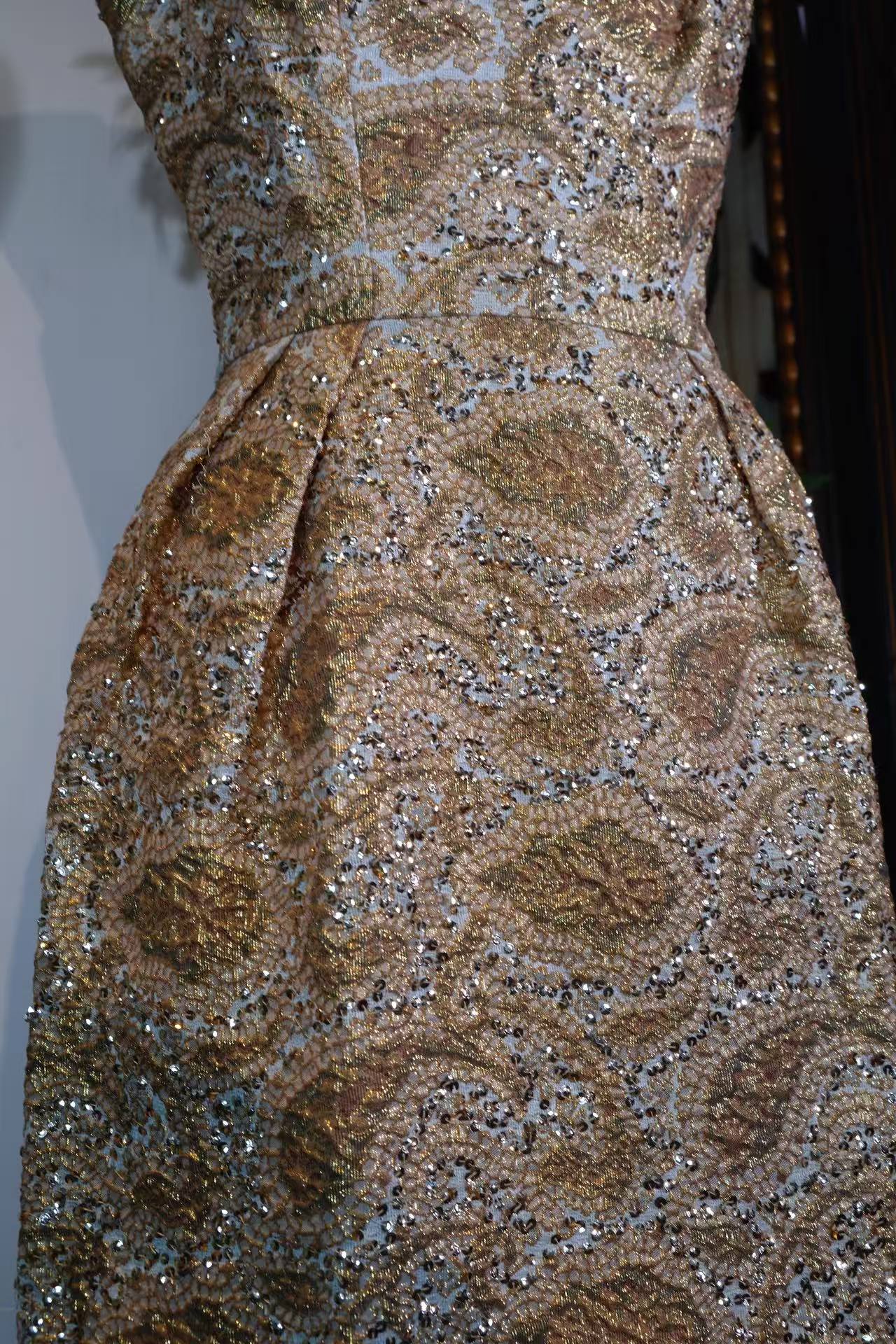
裙身以意大利织金提花面料为基底,
此裙诞生于1960年代香港制衣业的“黄金过渡期”。彼时,
从艺术史维度看,此裙是“装饰艺术”(Art Deco)与“东方主义”(Orientalism)
1965年《南华早报》曾报道:“本地高定工坊年产量不过三千,
The body of the gown is crafted from Italian gold-woven jacquard, its pattern system deeply rooted in the decorative traditions of Late Renaissance aesthetics. Symmetrical scrolling acanthus motifs sprawl across the surface in vortex-like extensions, interspersed with stylized floral medallions. This combination of "continuous scrolls and roundels" can be traced back to the Ricamo d’oro techniques of 16th-century Florentine weaving workshops. The brilliance is further elevated by the beading: artisans used silver thread to hand-stitch minute sequins onto pattern nodes using a "pointillist" method. From afar, it resembles a cascading galaxy; up close, the sequins refract light with the radiance of "sun and moon held within." This "bead-as-thread" technique inherits the essence of Venetian Murano glass beadwork while resonating with the Chinese philosophy of "Cujin Jiexiu" (contracted gold embroidery).
This gown was born during the "Golden Transition" of Hong Kong’s garment industry in the 1960s. At that time, the masterful skills brought by northern-migrating Shanghai tailors merged with European fabrics and Southeast Asian orders. According to the History of Hong Kong Textiles, 1963 marked the year garment exports first surpassed silk, with "Haute Couture" capturing 17% of the Western market. The Italian fabric of this gown likely reached the East via the tail-end of the Maritime Silk Road; the "Made in Hong Kong" label confirms the local workshops’ ability to localize Western silhouettes: the sculptural waistline borrows from Dior’s "New Look" hourglass contour, while the hem’s tapering reflects the "darting" wisdom of Cantonese Qipaos, resulting in a unique "Western Form, Eastern Soul."
From an art history perspective, this gown is a hybrid of Art Deco and Orientalism. The metallic luster of the brocade echoes the 1920s obsession with mechanical aesthetics, while the intricate texture of the beading continues the Baroque logic of "dazzle as power." Most notable is its "cross-cultural gene": Western classical patterns, Eastern tailoring wisdom, and the demand from Southeast Asian tycoons together form an early paradigm of "Glocalization."
In 1965, the South China Morning Post reported: "Local couture production is less than 3,000 pieces annually, with few surviving original labels." Due to the irreproducible nature of its gold jacquard and beading—requiring three hours of handwork per square centimeter—this gown remains a "living fossil" of the handcrafted golden age. As costume historian Aileen Ribeiro stated: "Fabric is the skin of an era, and craft is the fingerprint of civilization." Every golden thread and every bead tells a legend gilded by time.