深圳溯源
无法加载取货服务可用情况
衣服尺寸:
胸围/腰围/臀围:88/72/96 厘米
衣长:93 厘米
细节描述:
—— 一件行走的“维多利亚情书”与“东方摩登图鉴” 图案解码:色彩的交响与笔触的呼吸
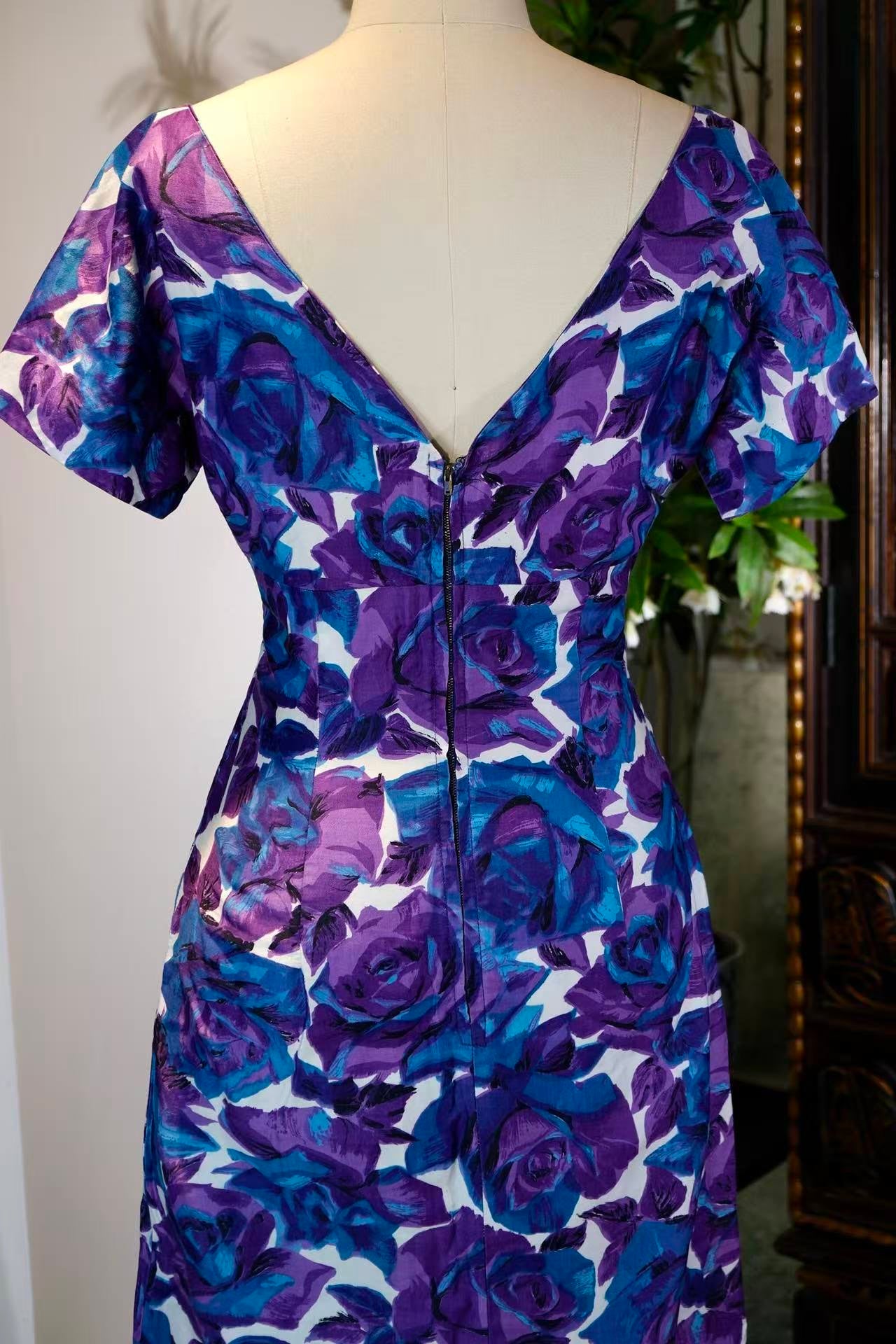
这件连衣裙最令人屏息的,是其布面上那铺天盖地的手绘玫瑰图案。
- 色彩美学:设计师大胆地运用了钴蓝与深紫的撞色组合。
- 笔触工艺:仔细观察每一朵玫瑰的花瓣边缘, 古董衣志:香江浮世绘与身份的隐喻
这件连衣裙诞生于1950年代的香港,那是一个特殊的年代。
- 剪裁的隐喻:裙身采用了经典的50年代“沙漏型”剪裁(
- 时代的见证:在那个物资尚不充裕的年代, 引经据典:衣香鬓影里的文学回响
若要为这件裙子寻找文学注脚,
这件紫蓝玫瑰裙,正是这样一出“袖珍戏剧”:
- 它的热烈与张扬,像极了《倾城之恋》
- 它的色彩搭配,又暗合了《红楼梦》中“都道是金玉良缘,
在那个年代,女性的衣着不仅是蔽体之物, 艺术风格与稀缺性:不可复制的孤品
- 艺术风格:
- 稀缺性:手绘工艺在工业化高度发达的今天已近乎绝迹。
结语:
它不仅仅是一件衣服,它是凝固的时光,是穿在身上的历史。
Measurements / Size Guide:
Bust / Waist / Hips: 88/72/96 cm
Total Length: 93 cm
Detailed Description:
— A Walking "Victorian Love Letter" and "Oriental Modernist Compendium"
The most breathtaking element of this dress is the overwhelming expanse of hand-painted roses across the fabric.
Color Aesthetics: The designer boldly utilized a striking contrast of cobalt blue and deep violet. The cobalt blue resembles the deep night sea of Victoria Harbour—chilly and mysterious—while the deep violet mimics tuberose blooming at dusk, rich and regal. Against the crisp white base, these two cool tones preserve the passion of Western Romanticism while evoking the ethereal "white space" of Oriental ink painting.
Brushwork Craftsmanship: Observing the edges of each rose petal, one can see distinct hand-painted strokes. This is not the mechanical repetition of the industrial age, but the deliberate pouring of an artist’s soul onto the fabric. The petals feature clear gradients and balanced ink density, making every blossom appear to sway in the wind. This "Xieyi" (freehand) technique grants the entire garment a unique vitality.
This dress was born in 1950s Hong Kong—a truly extraordinary era. Post-war Hong Kong retained its deep Lingnan roots while absorbing a massive influx of capital and talent from Shanghai and beyond, becoming the "Pearl of the Orient" where East met West.
The Metaphor of Tailoring: The silhouette adopts the classic 1950s "Hourglass Silhouette." The cinched waistline fits the feminine curve perfectly, showcasing the burgeoning independence and confidence of women at the time. Meanwhile, the elegant boat neck and puffed bubble sleeves are an homage to the post-war "New Look" fashion—dignified yet playful.
Witness to an Era: In an age where resources were not yet abundant, a dress featuring such extensive hand-painting and lightweight, translucent material was no ordinary daily attire. It belonged to the socialites, wives of wealthy merchants, or the elegant "it-girls" of the day. To wear it was to declare one’s place at the "modern" pole of that historic, bustling Hong Kong.
If one were to seek a literary footnote for this dress, Eileen Chang’s depictions of Shanghai and Hong Kong are perfect. She famously remarked: "To those who cannot speak, clothes are a language; what one carries with them is a pocket drama."
This violet-blue rose dress is exactly such a "pocket drama":
Its passion and flamboyance mirror the refinement and stubbornness Bai Liusu maintained amidst war in Love in a Fallen City.
Its color palette echoes a sense of rebellion and deep affection found in Dream of the Red Chamber—using cool blues and purples to interpret passionate roses is a form of restrained romance, a solitary pride hidden behind prosperity.
Aesthetic Style: It perfectly fuses Western romantic floral themes with Eastern freehand painting techniques. It possesses the heavy color sense of Western oil painting alongside the delicate linework of Chinese Gongbi (fine-brush) art—a peak manifestation of "East meets West" aesthetics.
Scarcity: In today’s highly industrialized world, hand-painting craftsmanship has nearly vanished. Fifty years ago, the artist mixed ink, outlined, and washed colors entirely by feel; thus, every finished piece is an original. That this dress has survived over half a century with its fabric intact and colors unfaded is, in itself, a miracle.
Conclusion: This is more than a garment; it is frozen time and wearable history. When you put it on, you are not wearing fabric, but the sea breeze and night sky of 1950s Hong Kong, and the beauty and resilience that generation of women allowed to bloom amidst a changing world.