深圳溯源
Couldn't load pickup availability
衣服尺寸:
胸围/腰围/臀围:96/96/108 厘米
衣长:99 厘米
细节描述:
一、图案描述
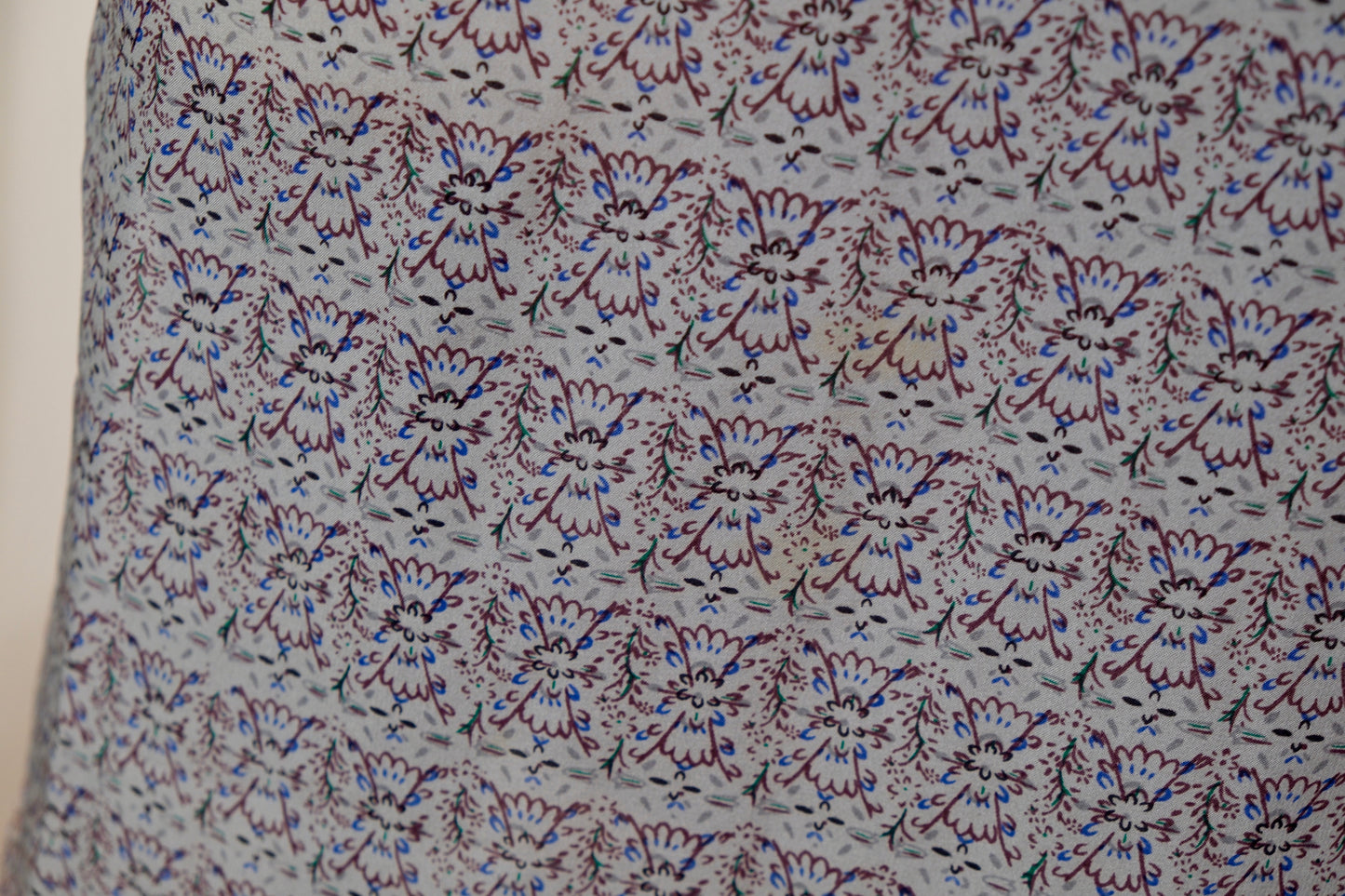
这件六十年代台湾产古董旗袍,面料图案极具时代美学特征。其主体为浅灰底色,其上以蓝、紫双色丝线,通过提花工艺织就连续几何花卉纹样。
纹样单元呈对称式四方连续排列,每朵花卉由细密线条勾勒出花瓣轮廓,中心点缀微小圆点,仿若花蕊,兼具抽象与具象之美。花卉间以纤细枝蔓相连,形成规整的横向条带状布局,既保留传统纹样的秩序感,又暗合六十年代现代设计的简约倾向。
这种图案风格,既承袭了民国时期旗袍纹样的细腻,又融入了战后台湾纺织业对西方几何美学的借鉴,呈现出“传统为骨,现代为韵”的独特气质,与同时期大陆旗袍的浓墨重彩形成鲜明对比。
二、古董衣的故事与艺术风格
(一)时代印记:战后台湾的“海派遗韵”
六十年代的台湾,正处于文化交融的特殊时期。1949年后,大量上海裁缝师随迁至台,将海派旗袍的精髓——修身剪裁、细腻面料——与台湾本土纺织技术结合,催生出独具特色的“台式海派”风格。
(二)艺术风格:低调的奢华
与民国时期旗袍的繁复刺绣不同,这件古董衣的美学核心在于“以简驭繁”。面料选用台湾产的“人造丝混纺”,表面带有微妙的光泽感,却无真丝的娇贵;图案虽密集,却因色彩的低饱和度(灰、蓝、紫均为莫兰迪色系)而显得温婉内敛,恰如六十年代台湾知识女性的气质——知性、克制,却暗藏锋芒。
这种风格与同时期西方“新风貌”(New Look)的华丽形成对照,反而更贴近张爱玲在《更衣记》中所言:“旗袍的作用是贴身,要显出身体的轮廓,却又不露骨。”它不追求视觉的冲击,而是通过面料的肌理、图案的韵律,传递出一种“穿在身上的文化记忆”。
(三)稀缺性:不可复制的历史孤品
古董旗袍的稀缺性,不仅在于其年代久远,更在于其承载的“工艺断代”。六十年代台湾的纺织业虽已机械化,但这件旗袍的裁剪仍保留了“量体裁衣”的手工痕迹——衣身侧缝的弧度、袖窿的贴合度,均需裁缝师凭借经验手工调整,与今日流水线生产的“均码”旗袍有着本质区别。
此外,其面料图案为当年台湾纺织厂的“限定款”,随着工厂转型早已停产。正如服装史学者Valerie Steele在《China Chic》中所言:“古董旗袍的价值,不在于它是一件衣服,而在于它是一个时代的‘物质载体’。”这件旗袍,便是战后台湾社会文化变迁的“活化石”,其稀缺性不仅在于存世量少,更在于它无法被现代工艺完全复刻。
三、结语
这件六十年代台湾产古董旗袍,是历史与美学的双重结晶。它的图案是时代的密码,它的剪裁是文化的缩影,它的稀缺性是时间的馈赠。正如清代李渔在《闲情偶寄》中所言:“衣以章身,请晰其解。章者,著也,非文采之谓也。”它不追求浮华的文采,却以低调的姿态,诉说着一个时代的优雅与坚韧。
若你有幸拥有它,便如同握住了一段被时光封存的记忆——那是六十年代台湾街头的梧桐树影,是茶馆里飘出的茉莉花香,是那个年代女性对“美”的执着与坚守。
Measurements / Size Guide:
Bust / Waist / Hips: 96/96/108 cm
Total Length: 99 cm
Detailed Description:
[I. Iconographic Description: The Visual Poetics of Geometric Jacquard] The textile blueprint of this 1960s Taiwanese-made antique Qipao masterfully archives the defining aesthetic paradigms of its epoch. Utilizing a muted, sophisticated ash-gray ground as its foundation, the textile leverages premium indigo and violet threads to engineer continuous geometric floral motifs entirely through a structural jacquard weaving process.
The iconographic units are meticulously choreographed in a symmetrical, four-way continuous grid layout. Each abstract blossom is defined by razor-sharp, densely woven lines that contour the petals, centered by microscopic woven dots that mimic delicate pistils—striking an exquisite balance between abstraction and literal representation. The blossoms are interlocked by slender, winding vines to establish a disciplined, horizontal banded composition. This design successfully preserves the structural order of ancestral motifs while directly referencing the minimalist movements dominating 1960s international modern design.
Sartorially, this graphic style faithfully inherits the microscopic delicacy typical of Republican-era Qipao patterns, while absorbing the Western geometric avant-garde introduced during the post-war expansion of Taiwan's textile industrial sectors. It presents an exceptional cultural signature defined as "ancestral lineage acting as the bone, modernism acting as the soul," standing in stark, intellectual contrast to the heavily saturated, hyper-ornamental Qipaos produced in mainland China during the contemporaneous era.
[II. Sartorial Chronicle and Artistic Philosophy]
1. Historical Blueprint: Post-War Taiwan’s "Migrant Shanghainese Legacy" The 1960s marked a profound crucible of cross-strait cultural convergence for Taiwan. Following the geopolitical shifts of 1949, an elite vanguard of master tailors from Shanghai migrated to the island. They seamlessly transplanted the absolute marrow of Haipai (Shanghainese-style) haute couture—specifically its uncompromising body-conscious pattern-making and premium textile selection—and wedded it to Taiwan’s emerging domestic weaving technologies, giving birth to a highly distinct "Taiwanese-Shanghainese Hybrid" (Tai-Shi Hai-Pai) aesthetic.
2. Artistic Style: The Monologue of Understated Luxury Diverging sharply from the dense, heavy hand-embroiders of the early Republican era, the aesthetic core of this antique masterpiece operates on the philosophical ideal of "governing complexity through absolute restraint." The textile utilizes a premium mid-century Taiwanese rayon-blend weave, which yields a subtle, fluid architectural luster across its surface without carrying the fragile, high-maintenance vulnerability of pure silk. Although the pattern density is exceptionally high, the garment achieves a profoundly warm and gentle composure through its low-saturation palette (where gray, indigo, and violet align perfectly with what modern curators define as the Morandi color spectrum). This exact visual restraint mirrors the posture of 1960s Taiwanese female intellectuals—highly educated, deeply disciplined, yet harboring a quiet, razor-sharp independence.
This specific philosophy stands as a brilliant Eastern counter-narrative to the theatrical opulence of the Western "New Look" movement from the same era. Instead, it aligns seamlessly with Eileen Chang's celebrated observation in Chronicle of Changing Clothes: "The function of the Qipao is to hug the skin, tracing the fluid architecture of the body without slipping into overt exposure." It deliberately rejects superficial visual shock; instead, through the physical topography of the jacquard weave and the cadence of its geometry, it delivers a profound piece of "wearable cultural memory."
3. Rarity: The Archival Asset Disrupted by Time The asset value of an antique Qipao transcends its temporal age, anchoring itself fundamentally within what fashion historians term "technological斷代 (the structural extinction of craft)." While Taiwan's textile industries were rapidly mechanizing during the 1960s, the tailoring of this specific garment heavily preserves the manual signatures of elite bespoke dressmaking. The calculated curvature of the side seams and the ergonomic fit of the armholes could only be executed through the intuitive spatial judgment of a master tailor adjusting for a specific living body—standing in complete opposition to the flat, homogenized sizing of contemporary assembly-line manufacturing.
Furthermore, this geometric jacquard pattern was engineered as a strict "limited-run commission" by mid-century Taiwanese mills, which have long since ceased operations due to industrial restructuring. As the preeminent fashion historian Valerie Steele brilliantly summarized in China Chic: "The value of an antique Qipao rests not upon its utility as apparel, but upon its reality as the physical material vehicle of an epoch." This garment operates as a living fossil of post-war Taiwanese sociological transformation; its absolute rarity resides not merely in its minuscule survival rate, but in the reality that it cannot be replicated by modern industrial technologies.
Epilogue: A Structural Poem of Time Made Wearable This 1960s Taiwanese antique Qipao stands as a monumental crystal of history and aesthetics. Its geometry operates as a cultural cipher; its pattern-making acts as an archive of migration; and its rarity is a supreme gift from the passage of time. As the Qing Dynasty scholar Li Yu masterfully penned in The Sketches of Idle Pleasure (Xianqing Ouji): "Apparel functions to manifest the internal truth of the self. This manifestation resides in clarity of character, never within the vulgar display of mere ornamentation." This masterpiece completely bypasses superficial flamboyance, choosing instead an understated posture to articulate the elegance and resilience of a vanished era.
To be the custodian of this garment is to hold a capsule of time itself—it isolates and preserves the rustle of wisteria and plane trees across 1960s Taipei streets, the faint drift of jasmine tea escaping from a mid-century salon, and that unyielding aesthetic devotion held by the women of that golden age.