深圳溯源
Couldn't load pickup availability
衣服尺寸:
胸围/腰围/臀围:100/88/108 厘米
衣长:100 厘米
细节描述:
这件旗袍,是60年代香港“东方好莱坞”黄金岁月的缩影,它大胆地将西方波普艺术与东方传统剪裁相融合,是那个时代摩登女性精神的绝佳体现。
视觉描述:暗夜里的波普狂欢
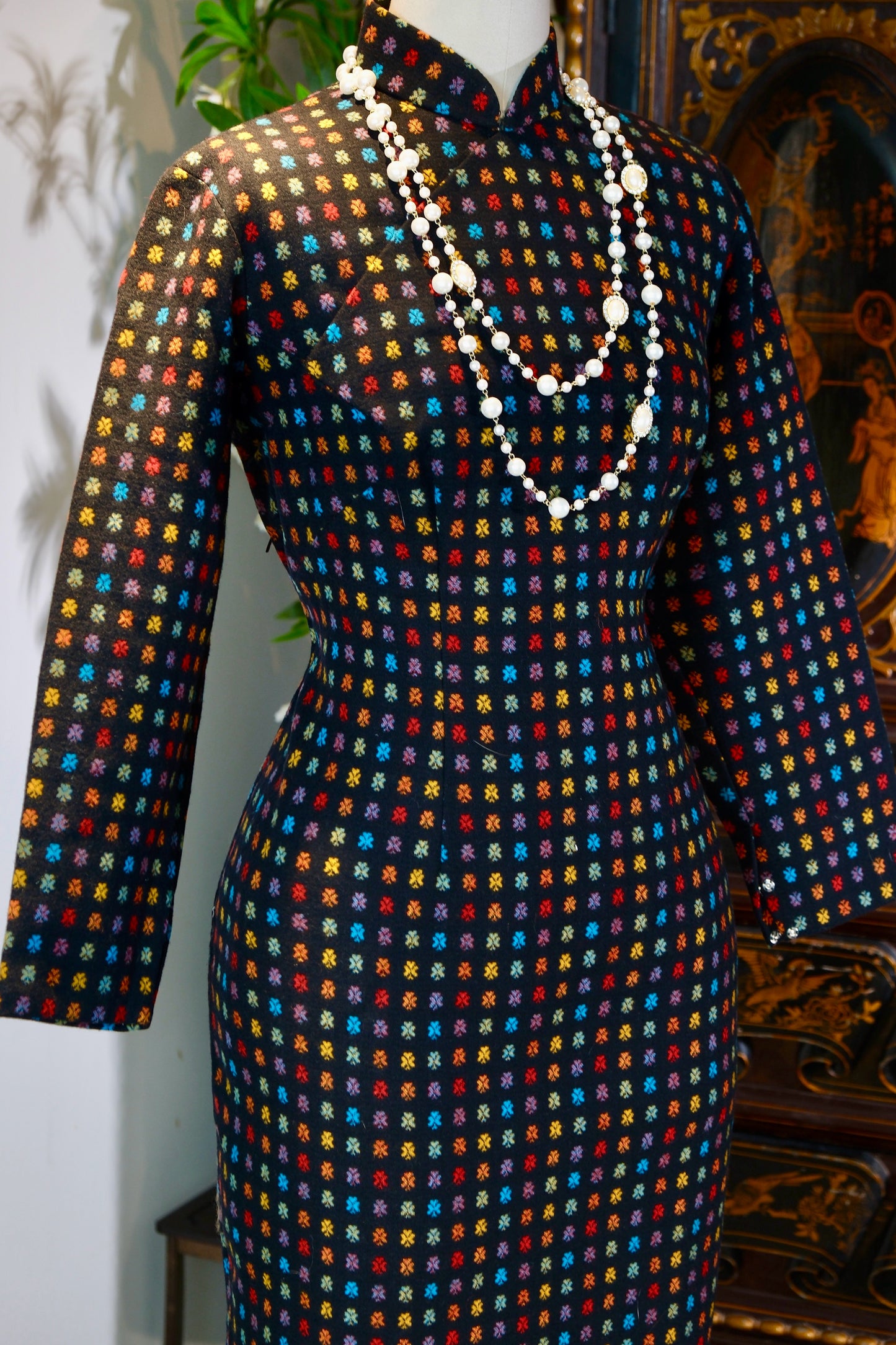
这件旗袍的底色是深邃的暗夜黑,仿佛为即将到来的视觉盛宴铺就了最完美的幕布。其上,密密麻麻地铺陈着无数色彩斑斓的十字花形图案。这些图案并非传统的牡丹或梅兰竹菊,而是以红、橙、黄、绿、青、蓝、紫等彩虹般的色彩,整齐划一又充满活力地排列着。
这种几何化、重复性的图案设计,正是20世纪60年代风靡全球的波普艺术风格的典型体现。它打破了传统旗袍图案的含蓄与写意,以一种近乎“像素化”的现代语言,宣告着工业时代的到来和大众文化的兴起。每一个小小的十字花,都像是一个跃动的音符,在黑色的五线谱上,共同奏响了一曲属于那个年代的摩登乐章。
时代故事:港风初起的黄金岁月
这件旗袍诞生于20世纪60年代的香港。彼时,香港正处于经济腾飞的初期,西方文化随着贸易和电影大量涌入,与本地的传统文化激烈碰撞、交融。正如学者李欧梵在其著作《上海摩登》中所描述的都市文化变迁,香港在某种程度上承接并发展了上海的“摩登”衣钵,并融入了更国际化的视野。
当时的香港女性,不再满足于旧式的宽大袍服,她们渴望展现独立、自信的现代女性形象。于是,剪裁更为修身、更能凸显身体曲线的旗袍成为了她们的首选。而这件旗袍,正是那个时代的产物。它不仅是一件衣服,更是一个时代的符号。它见证了香港从一个小渔港向世界大都会的蜕变,也见证了东方女性审美意识的觉醒。
它的稀缺性,不仅仅在于其年代久远,更在于它完美地捕捉并凝固了那个特定历史时期的文化精神。它是“东方好莱坞”黄金岁月的缩影,是东西方文化在服装领域一次成功的“混血”。如今,这样的古董旗袍,每一件都是可遇而不可求的孤品,是穿在身上的流动历史。
艺术风格:东西方美学的碰撞与融合
从艺术风格上看,这件旗袍是典型的中西合璧之作。
- 西式剪裁与东方神韵:它采用了经典的旗袍立领和斜襟设计,保留了东方服饰的含蓄与典雅。但修身的剪裁、流畅的腰线,则明显借鉴了西方的立体剪裁技术,旨在展现女性的曲线美。这种“中学为体,西学为用”的设计思路,是当时香港服装设计的一大特色。
- 波普艺术与民族图腾:其图案设计是整件衣服的灵魂。它将西方波普艺术中常见的重复、几何、高饱和度色彩等元素,巧妙地运用在了东方的服饰载体上。这些看似简单的十字花形,在东方文化中,有时也被视为一种吉祥的符号,寓意着十字街头、四通八达。因此,这件旗袍在视觉上虽然是现代的、西化的,但在文化内核上,依然保留了一丝东方的意蕴。
- 材质的现代性:羊毛混纺面料的使用,也体现了那个时代的现代性。相较于传统的丝绸、棉麻,混纺面料更具挺括感,也更容易打理,适应了现代都市女性快节奏的生活方式。
总而言之,这件60年代的香港产波普风格羊毛混纺古董旗袍,是一件集历史价值、艺术价值和稀缺性于一身的珍品。它如同一部微缩的时尚史,向我们诉说着那个充满活力与变革的年代的故事。
Measurements / Size Guide:
Bust / Waist / Hips: 100/88/108 cm
Total Length: 100 cm
Detailed Description:
[I. Visual Chronography: A Pop Art Carnival Across the Midnight Ground] The structural foundation of this Qipao is defined by a deep, enigmatic midnight black ground, serving as a flawless proscenium arch for the visual symphony about to unfold. Densely blanketed across its surface are countless kaleidoscopic cross-shaped floral motifs. Breaking sharply away from ancestral motifs like peonies or the traditional "Four Gentlemen" (plum, orchid, bamboo, chrysanthemum), these patterns leverage a brilliant rainbow spectrum—red, orange, yellow, green, teal, indigo, and violet—arranged in a disciplined, hyper-geometric, and vibrant continuous matrix.
This highly geometric, repetitional layout serves as a pristine material manifest of the Pop Art and Op Art movements that swept global culture during the 1960s. It completely shatters the historical reserve and calligraphic line-work of early Qipao textiles, choosing instead a near-"pixelated" modernist vocabulary to announce the arrival of the high-industrial era and the ascendancy of mass culture. Each micro-cross functions as a syncopated musical note leapfrogging across a black staff, together conducting a brilliant, rhythmic modern concerto unique to that Golden Age.
[II. The Chronicle: The Golden Epoch of Hong Kong's Emerging Tide] This Qipao was birthed during the 1960s in Hong Kong—a seismic historical crucible defined by rapid post-war economic takeoff. During this era, Western avant-garde culture flooded the island through cinematic and free-trade channels, clashing and fusing violently with indigenous lineages. Just as cultural historians have tracked the modern metamorphoses of Far Eastern urban centers, Hong Kong elegantly inherited and evolved the "modernist" mantle of pre-war Shanghai, enriching it with a radically globalized, maritime horizon.
Contemporaneous Hong Kong women were no longer content with the loose, concealing drapes of previous generations; they fiercely demanded a sartorial medium that mirrored their autonomy, confidence, and burgeoning modern identity. Consequently, the hyper-tailored, body-conscious Qipao emerged as their definitive uniform. This garment stands as a pure distillation of that mid-century zeitgeist. It is far more than apparel; it is a physical socio-cultural totem. It bore direct material witness to Hong Kong's epic metamorphosis from a regional colonial port into a premier global megalopolis, archiving the clear awakening of modern Eastern female aesthetic consciousness.
Its curatorial rarity stems not merely from its temporal distance, but from its absolute capacity to freeze the cultural marrow of that specific historical crossroad. It serves as a miniature capsule of Hong Kong's "Oriental Hollywood" golden age—a triumphant, high-stakes "hybridization" of East and West within the textile realm. Today, such genuine archival specimens are scarce anomalies globally; they are pieces of fluid history made wearable.
[III. Artistic Style: The Crossroads of Eastern and Western Aesthetic Paradigms] Sartorially, this Qipao stands as a textbook masterpiece of Sino-Western eclecticism.
Western Architecture, Eastern Soul: The garment rigorously preserves the classical mandarin collar and asymmetrical right-side closure (Xiejin), anchoring the traditional reserve and decorum of Eastern dress. Concurrently, its aggressive waist cinch and ergonomic armhole engineering draw heavily from Western high-fashion pattern-making, prioritizing the natural curvature of the female form. This design methodology embodies the mid-century Hong Kong design philosophy of "Eastern lineage acting as the core, Western methodology executing the form."
Pop Art Encounters Ancestral Totems: The pattern configuration represents the absolute soul of the garment. It synthesizes Pop Art hallmarks—repetition, geometry, and hyper-saturated color fields—onto an unmistakably Eastern textile canvas. Intriguingly, these seemingly simple cross-motifs resonate subtly with ancestral Chinese iconography, where the cross (Shi-Zi) historically symbolized crossroad connectivity and auspicious paths open in all four directions. Thus, while the visual linguistic is vibrantly modern and Westernized, the structural core preserves a quiet Eastern cadence.
Modernity of the Medium: The strategic deployment of a tailored wool blend further registers the garment's mid-century modern utility. Contrasted with the fragile maintenance of pure silk or the rustic drape of linen, a premium wool blend yields superior structural stiffness, crisp silhouette memory, and immense resilience—perfectly aligning with the accelerated lifestyle velocity of modern metropolitan career women.
In conclusion, this 1960s Hong Kong pop-style wool-blend antique Qipao is a monumental collector's asset that unifies historical archiving, design virtuosity, and extreme rarity. It functions as a micro-history of modern fashion, articulating the boundless vitality and transformative daring of a legendary era.