深圳溯源
Couldn't load pickup availability
衣服尺寸:
胸围/腰围/臀围:94/80/100 厘米
衣长:134 厘米
细节描述:
【引言:时光的琥珀】
张爱玲曾言:“衣服是一种言语,随身带着一种袖珍戏剧。”这件诞生于1960年代的旗袍,便是一出关于繁华、摩登与极致工艺的无声戏剧。它不仅是一件衣裳,更是那个黄金时代留给我们的物质文化遗产,封存了半个多世纪前的香江夜色与罗马风情。
【面料与工艺:跨越重洋的奢华对话】
此衣最珍贵之处,在于其面料的殊胜来源与繁复工艺的结合。
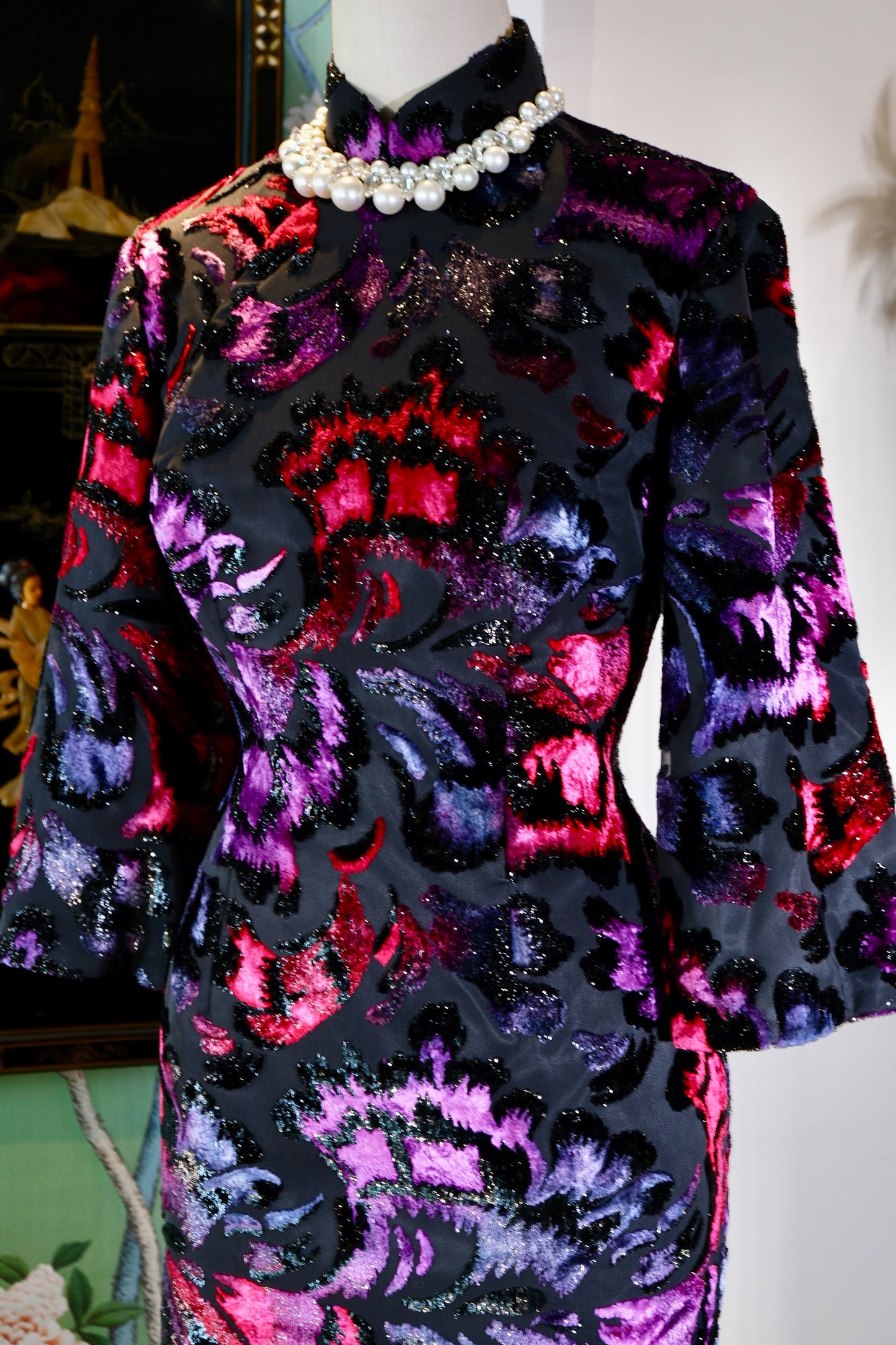
- 意大利进口烧花丝绒: 底料选用的是上世纪中叶欧洲顶级的丝绒织物。通过高难度的“烧花”工艺,在厚重的丝绒上腐蚀出通透的纹理,使得黑色的底色如夜空般深邃,而花纹处则呈现出浮雕般的立体感。这种面料在当时极为昂贵,非豪门巨贾不能拥有。
- 织金葱与手绘晕染: 在丝绒的基础上,工匠巧妙地织入了金银葱线,随着光线流转,衣物表面泛起若隐若现的星芒。更为绝妙的是后期的“手绘晕染”工序,这并非机器印染所能企及。画师以笔代针,将颜料层层叠加于丝绒之上,使得色彩过渡如水墨般自然,既有油画的浓郁,又有国画的灵动。
【图案描述:暗夜盛开的巴洛克牡丹】
观其纹样,这是一幅极具视觉冲击力的画卷。
- 色彩美学: 整体色调以神秘的玄黑为底,衬托着魅惑紫与胭脂红。紫色在中国传统色中象征“紫气东来”的尊贵,而在西方色彩心理学中则代表神秘与高贵;红色的介入,如同暗夜中燃烧的火焰,打破了沉闷,注入了热烈的生命力。
- 形态意象: 图案并非传统的具象花鸟,而是呈现出一种抽象表现主义的风格。巨大的花卉团簇(形似牡丹或芍药)在衣身上肆意蔓延,花瓣边缘经过晕染处理,仿佛正在呼吸、生长。这种设计风格深受当时西方流行的波普艺术与抽象表现主义影响,却又保留了中国传统服饰对“圆满”、“富贵”的图腾崇拜。这是一种“中西合璧”的极致体现——用西方的抽象笔触,描绘东方的富贵花魂。
【剪裁与形制:海派风情的最后辉煌】
从形制上看,这是典型的六十年代“海派”改良旗袍。
- 西式立体剪裁: 不同于清代旗袍的平面裁剪,这件衣服采用了完全的西式省道设计(Darts),精准地勾勒出女性的胸、腰、臀曲线,正如林语堂所言,旗袍是“最合乎中国女性身段的服装”。
- 七分喇叭袖: 袖口采用了当时极时髦的七分微喇设计,既露出了手腕最纤细的部分,又在举手投足间增加了动态的美感,完美平衡了端庄与妩媚。
【历史价值与稀缺性:不可复制的孤品】
在服装史的维度上,这件旗袍具有极高的研究价值。
- 时代的绝唱: 六十年代后,随着成衣工业的兴起和廉价化纤面料的普及,这种耗时耗工、依赖手工绘制的真丝丝绒旗袍逐渐退出历史舞台。它是“慢时尚”时代的遗珠。
- 保存状况: 丝绒面料极难保存,易倒绒、易虫蛀。而这件藏品历经六十载岁月,色泽依然鲜亮如初,金葱未断,丝绒未秃,实属凤毛麟角。
【结语】
这不仅是一件衣服,它是穿在身上的《花样年华》,是凝固的爵士乐。它等待着那位懂得欣赏它灵魂的主人,在某个灯火阑珊的夜晚,再次唤醒那段流光溢彩的旧梦。
“锦衣雪华玉颜色,磬口檀心物外情。” —— 唯有这样的稀世珍品,才配得上这句古诗的注脚。
Measurements / Size Guide:
Bust / Waist / Hips: 94/80/100 cm
Total Length: 134 cm
Detailed Description:
Eileen Chang once wrote, "Clothing is a form of speech; it carries with it a pocket-sized drama." This qipao, born in the 1960s, is a silent drama of opulence, modernity, and ultimate craftsmanship. It is not merely a garment, but a piece of material cultural heritage left to us from a golden era, sealing within its threads the mid-century nightscapes of Hong Kong and the romantic flair of Rome.
The most precious element of this piece lies in the combination of its exceptional fabric origins and highly complex production techniques:
Imported Italian Devoré Velvet: The base fabric utilizes top-tier mid-century European velvet textiles. Through a high-difficulty devoré (burnout) process, a sheer texture is etched onto the heavy velvet. This renders the black background as deep as the night sky, while creating a relief-like, three-dimensional effect on the patterns. This fabric was extraordinarily expensive at the time, accessible only to the ultra-wealthy.
Woven Gold-and-Silver Lame (Zuojin Cong) & Hand-Painted Gradients: Within the velvet, artisans masterfully wove shimmering gold and silver lamé threads, causing a subtle, starlit glow to ripple across the surface under varying light. More exquisite still is the subsequent "hand-painted gradient" process, an artistry far beyond the reach of industrial machine printing. The artist used brushes instead of needles, layering pigments onto the velvet to achieve gradients as natural as ink wash painting, combining the richness of an oil painting with the fluid vitality of traditional Chinese art.
The pattern presents a visually striking canvas:
Color Aesthetics: The overall palette relies on a mysterious black background to anchor enchanting violet and vermilion red. In traditional Chinese culture, purple symbolizes royalty and the auspicious omen of "purple air arriving from the east" (ziqi donglai). In Western color psychology, it represents mystery and nobility. The inclusion of red acts like a burning flame in the dark night, breaking the solemnity and injecting a passionate vitality.
Morphological Imagery: The design moves away from traditional, literal representations of flowers and birds, embracing an abstract expressionist style instead. Massive clusters of blossoms—resembling peonies or herbaceous peonies—spread freely across the body of the dress. The edges of the petals are softly diffused through the hand-painted gradient effect, looking as though they are breathing and growing. While this style was heavily influenced by Western Pop Art and Abstract Expressionism trending at the time, it firmly retains the traditional Chinese totem worship of "wholeness" (yuanman) and "opulence" (fugui). It is the ultimate realization of East-meets-West—using Western abstract brushstrokes to capture the soul of an Eastern blossom of wealth.
Structurally, this piece is a textbook example of the 1960s modified Haipai (Shanghai-style) qipao:
Western Three-Dimensional Tailoring: Completely departing from the flat cuts of the Qing Dynasty, this garment utilizes Western darting techniques. It precisely contours the female silhouette across the bust, waist, and hips. As the author Lin Yutang noted, the qipao is "the most fitting garment for the Chinese female figure."
Three-Quarter Bell Sleeves: The cuffs feature a highly fashionable mid-century three-quarter slight flare. This design exposes the slenderest part of the wrist while adding a dynamic grace to every gesture, achieving a flawless balance between dignity and allure.
Within the dimension of fashion history, this qipao carries profound archival and research value:
Swan Song of an Era: After the 1960s, with the rise of the ready-to-wear industry and the widespread adoption of inexpensive synthetic fibers, time-consuming silk velvet qipaos dependent on hand-painting gradually exited the historical stage. This piece stands as a rare survivor from the era of "slow fashion."
State of Preservation: Velvet fabrics are notoriously difficult to preserve; they crush easily and are highly susceptible to moth damage. Having endured six decades of time, this collectible piece retains its vivid coloration, the lamé remains unbroken, and the velvet pile is entirely intact—making its pristine condition exceptionally rare.
This is more than a dress; it is In the Mood for Love worn on the body—it is frozen jazz. It waits for a connoisseur who truly understands its soul, ready to awaken a brilliant, shimmering dream once more on a night when the lights begin to dim.