深圳溯源
Couldn't load pickup availability
五十年代法国棉蕾丝香港工坊古董旗袍:东西洋绣错彩镂金的罗衣何幸
“金风玉露一相逢,便胜却人间无数。”
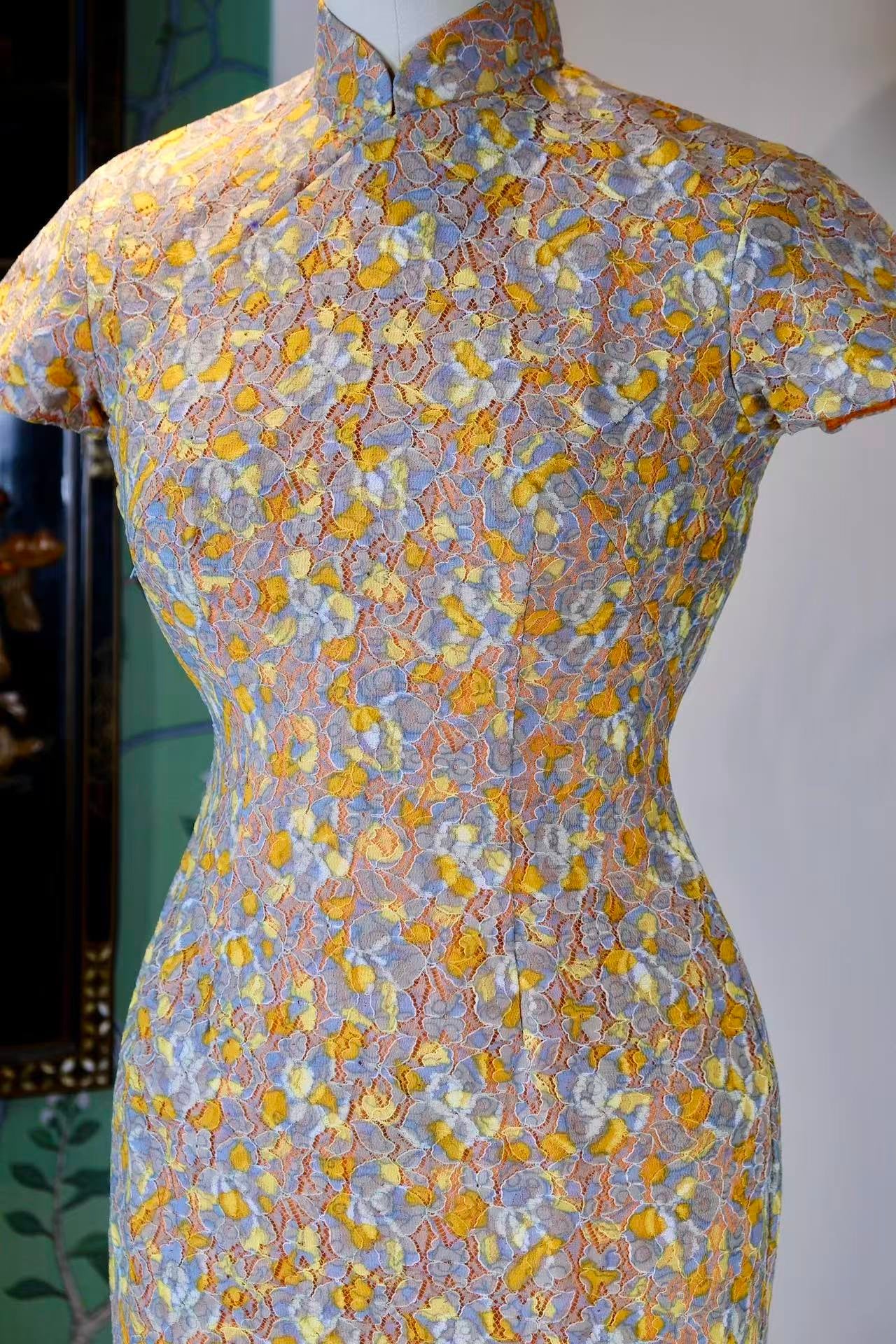
旗袍的蕾丝面料以晕染技法绘制,如印象派打翻的调色盘——鹅黄、
其工艺之罕,首在面料——上世纪五十年代法国纯棉手工蕾丝,
《礼记》云“衣服在躬,而不知其名为奥”,这件旗袍的奥义,
“罗衣何幸,金针谁度?”这件旗袍的每一针每一线,
"A meeting of the Golden Wind and Jade Dew surpasses all the countless joys on earth." When French hand-woven cotton lace meets the tailoring of Hong Kong’s golden era, a poem in fabric is born.
The lace fabric of this Qipao uses an ombré technique, resembling an overturned palette of an Impressionist painter—a seamless fusion of primrose yellow, lotus purple, and apricot pink. Upon closer inspection, within the openwork of the warp and weft, hand-painted yellow tints the delicate petals, lotus purple outlines the curling stems, and apricot pink washes the background floral shadows. This creates a modern variation of the traditional "Intertwining Lotus and Scrolling Grass" (Chanzhi Lian) motif. As described in Yuanye: "The wind ripples the mirror-like water into shallow blues; the rain washes the thousand peaks into deep indigos." The three-color gradient feels like wisteria in Jiangnan’s misty rain—the yellow fresh as a new lemon, the purple like a blooming magnolia, and the pink like a begonia at dawn. Within the interplay of light and shadow, the apertures of the lace seem filled with champagne bubbles, light and airy as the Goddess of the Luo River described in Luo Shen Fu: "Treading upon the fragrant path of pepper, walking through the lush meadows of sweet herbs."
The rarity of this piece lies first in its material—1950s French pure cotton handmade lace. At that time, only three workshops in France mastered the "Ombré Weaving Method": embedding gradient cotton threads during the weaving process to allow colors to transition naturally, a feat far superior to mere printing. This "Western material, Eastern making" craftsmanship is a testament to Hong Kong’s role as a cultural hub. As Eileen Chang once said, "Everyone lives in their own clothes," and this Qipao lives within the romance of France and the inclusivity of old Hong Kong.
The Book of Rites states: "One wears the clothing, yet knows not its profound mystery." The mystery of this Qipao is hidden in every inch of the lace’s light and shadow. Under sunlight, the cotton lace emits a pearlescent glow, casting intricate shadows upon the skin like Li Qingzhao’s poem: "Dark fragrance fills the sleeves." When in motion, the fabric sways gently, and the intertwining lotus patterns come alive like vibrant vines, echoing the philosophy of Kao Gong Ji: "The season of Heaven, the breath of Earth, the beauty of Material, and the skill of Craft." In 1950s Hong Kong, the Qipao was a socialite’s "walking calling card," and French lace was a supreme mark of status. While most ateliers used local silk, only top-tier bespoke houses selected French cotton lace for the elite Chinese diaspora from Southeast Asia. With production extremely limited, fewer than a hundred such pieces survive today—each a piece of "wearable amber."
"How fortunate the silken robe; who guided the golden needle?" Every stitch of this Qipao condenses the breath of French artisans and the warmth of Hong Kong tailors. It is not merely a garment, but a specimen of time: the gradient colors are the sunset glow of 1950s Hong Kong; the lotus vines are the intimate whispers between Oriental aesthetics and Western craft. Having traversed seventy years, it arrives with the breathtaking beauty of "Clouds remind me of her clothes, and flowers of her face." If the Qipao is the poetry of the East, then this lace masterpiece is the "Golden Threaded Robe" within that poetry—worthy of being measured by the gentlest gaze and preserved by the most solemn hands.