深圳溯源
Couldn't load pickup availability
衣服尺寸:
胸围/腰围/臀围:92/76/98 厘米
衣长:98 厘米
细节描述:
一、 纹样考据:繁花似锦中的东方隐喻
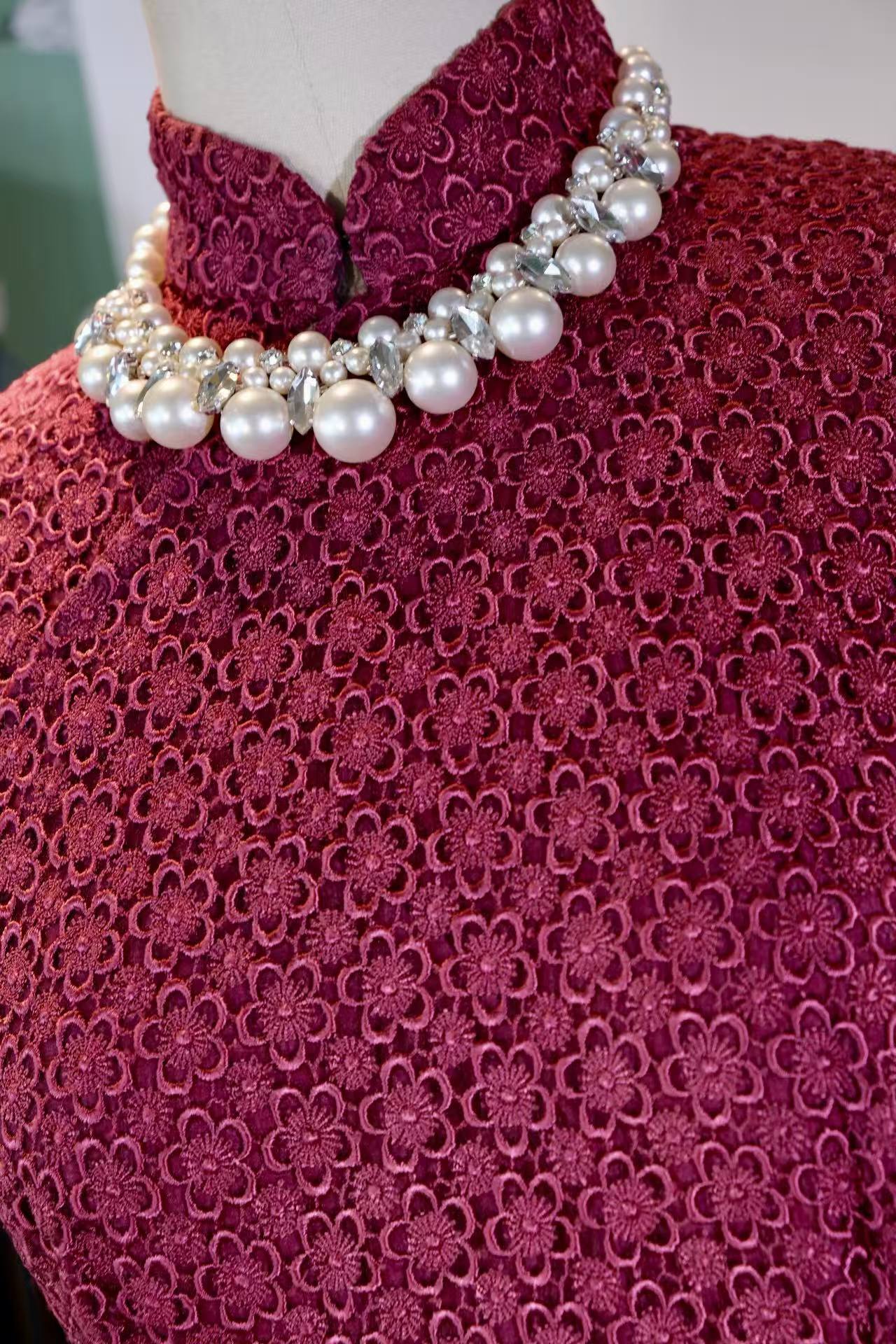
细观此衣,最令人惊叹的是其面料工艺。这是一件典型的上世纪六十年代产物,采用了当时极为先进的日本进口机绣蕾丝(Machine-embroidered Lace)技术。
不同于传统手工刺绣的随性与写意,这种源自日本的工业化蕾丝呈现出一种极具秩序感的几何美学。
- 图案解构: 满身的纹样并非随意的花卉,而是高度程式化的五瓣梅花(或樱花)纹。每一朵花都由精密的针法勾勒出轮廓,花蕊处通过镂空技法(Cutwork)营造出通透感。
- 视觉韵律: 花朵呈矩阵式排列,疏密有致,如同宋代瓷器上的印花纹理般规整。这种设计在视觉上产生了一种微妙的“视错觉”,远看如织锦般华丽,近看则能感受到蕾丝特有的轻盈与呼吸感。
- 色彩美学: 选用的是极具时代特征的洋红(Magenta)偏紫调。在六十年代的色彩心理学中,这种颜色既保留了传统的喜庆,又融入了西方波普艺术兴起前的现代感,象征着成熟女性的妩媚与端庄。
二、 剪裁与形制:海派余韵与台式改良
从服装史的角度来看,这件旗袍处于“经典海派”向“现代成衣”过渡的关键时期。
- 立领与无袖: 经典的元宝领依然挺括,但袖口已完全去除,演变为利落的无袖剪裁(Sleeveless)。这是为了适应六十年代日益活跃的社交生活和亚热带气候所做的功能性改良,同时也更大胆地展示了女性手臂的线条美。
- 省道(Darts)的运用: 请注意胸部与腰部的收省处理。相比四十年代的平直剪裁,这件衣服明显运用了西式立体剪裁手法,极力勾勒女性的S型曲线(Hourglass Silhouette),这是受好莱坞电影明星(如格蕾丝·凯利)着装风格影响的直接体现。
三、 历史叙事:海峡对岸的纺织黄金期
这件旗袍的身世,折射出一段特殊的经济史。
上世纪五六十年代,台湾正处于出口导向型经济的起飞阶段,纺织业是当时的支柱产业。而日本,作为亚洲纺织技术的领跑者,其生产的化纤与蕾丝面料大量出口至台湾。
这件旗袍便是这一贸易往来的实物见证——“东洋的面料,宝岛的裁缝”。它极有可能是当年台北某家高档洋服店(Tailor Shop)的定制作品。那时的名媛闺秀,不再满足于传统的绸缎,转而追求这种带有“洋气”且易于打理的蕾丝面料。它不仅仅是一件衣服,更是那个年代女性追求独立、时尚与现代身份认同的战袍。
四、 艺术风格与稀缺性:引经据典
古人云:“锦衣雪华玉颜色,回眸一笑百媚生。” 但这件旗袍的美,不在于“雪华”,而在于那份经过岁月沉淀后的“浓丽”。
- 材质的稀缺性: 随着时间推移,六十年代的尼龙与人造丝混纺蕾丝极易脆化断裂。能像这件一样,历经六十载寒暑,依然保持色泽鲜亮、网眼完整、没有大面积破损的,实属凤毛麟角。这得益于当年日本纺织业极高的品控标准。
- 风格的独特性: 张爱玲曾在《更衣记》中写道:“对于不会说话的人,衣服是一种语言,随身带着的袖珍戏剧。”这件旗袍就是那出戏剧的高潮部分。它既有《花样年华》中苏丽珍的含蓄,又有六十年代西方“New Look”风格的张扬。
结语
这不仅仅是一件蕾丝旗袍,它是六十年代东亚时尚版图上的一块拼图。那一朵朵精密的机绣梅花,锁住了一个时代的风华绝代。对于收藏家而言,拥有的不仅是一件孤品,更是一段关于美、关于技艺、关于那个流金岁月的鲜活记忆。
Measurements / Size Guide:
Bust / Waist / Hips: 92/76/98 cm
Total Length: 98 cm
Detailed Description:
A meticulous examination of this garment reveals that its definitive triumph lies in its textile engineering. A textbook manifestation of 1960s sartorial material culture, the piece utilizes what was then highly advanced, premium imported Japanese machine-embroidered lace (kikai-shishū lace).
Departing from the fluid, spontaneous brushstroke style of traditional hand embroidery, this mid-century industrialized lace delivers a geometric aesthetic defined by absolute order and structural rhythm:
Pattern Deconstruction: The all-over motif avoids haphazard floral placement, opting instead for highly stylized, pristine five-petal plum (or cherry) blossoms. Every individual corolla is crisply defined by precision tension stitching, while the center of each bloom features an intricate cutwork technique (openwork), establishing negative space that invites a sense of structural transparency.
Visual Rhythm: The blossoms are mapped in a rigorous matrix layout, balanced meticulously between dense clustering and open space—reminiscent of the pressed or stamped diaper patterns seen on classic Song Dynasty ceramics. This strategic arrangement triggers a subtle optical illusion: from afar, the textile projects the dense luxury of a heavy brocade; upon closer inspection, it reveals the characteristic weightlessness and breathability of true lace.
Chromatics: The garment is saturated in a rich magenta with deep violet undertones, a quintessential mid-century colorway. In the context of 1960s color psychology, this hue elegantly bridges the gap between traditional Chinese celebratory red and the bold, graphic sensibilities of the emerging pre-Pop Art era, projecting a mature blend of Eastern poise and cosmopolitan allure.
From the perspective of costume history, this qipao sits precisely at the critical evolutionary junction where classic Haipai (Shanghai-style) tailoring transitioned into modern, high-grade ready-to-wear construction:
The Mandarin Collar and Sleeveless Armscye: While the classic high Yuanbao collar (yuanbao ling) remains rigidly interlined and erect to frame the jawline, the sleeves have been entirely eliminated in favor of a clean, sharp sleeveless cut. This functional adaptation accommodated the increasingly active social lifestyles of 1960s women and the subtropical climates of East Asia, while boldly celebrating the clean, natural lines of the shoulder and arm.
The Architecture of Darting: The engineering of the bust and waist contours demonstrates an advanced grasp of Western three-dimensional pattern drafting. Unlike the flatter, more rectilinear cuts of the 1940s, this piece relies on precise hourglass silhouette shaping via deeply taken bust and waist darts (se省). This structural emphasis directly mirrors the global influence of mid-century Hollywood icons like Grace Kelly, adapted seamlessly to the Eastern form.
The provenance of this qipao serves as an archival mirror to a distinctive chapter of mid-century geopolitical economic history.
During the 1950s and 1960s, Taiwan was entering its export-oriented economic takeoff, with textiles serving as the primary foundational industry. Simultaneously, Japan led post-war Asian textile innovation, exporting massive volumes of sophisticated synthetic fibers and mechanical laces to Taiwanese ports.
This garment stands as a physical monument to that specific commercial symbiosis: "Textiles of the Orient, Tailoring of the Treasury Island." It is highly probable that this piece was commissioned from a prestigious premier tailor shop (Tailor Shop) in Taipei. The high-society matrons and debutantes of that era, seeking a departure from traditional silks and satins, turned to these imported laces for their cosmopolitan flair and resilient, easy-to-maintain structure. It was not merely a dress; it was armor for the modern woman establishing her independence, taste, and contemporary identity.
The ancient poets wrote: "In a splendid embroidered gown under the crisp snow, with skin like flawless jade; she turns with a single smile, birthing a hundred charms." Yet the beauty of this particular qipao does not reside in cold, snowy understatement, but rather in a concentrated, saturated magnificence that has only sweetened with age.
Material Conservation Rarity: Due to the chemical composition of early 1960s nylon and rayon-blend laces, these textiles are notoriously prone to embrittlement, oxidation, and structural tearing over time. For a piece to survive over six decades with its dye transfer integrity intact, its mesh grid unbroken, and its structural seams completely free of major deterioration is an extraordinary rarity. This serves as a testament to the rigorous quality control standards of mid-century Japanese textile mills.
Sartorial Drama: As Eileen Chang famously observed in A Chronicle of Changing Clothes, "To those who cannot speak, clothing is a form of speech; it carries with it a pocket-sized drama." This qipao represents the cinematic climax of that text. It captures both the quiet, smoldering restraint of Su Li-zhen in In the Mood for Love and the structural assertiveness of Western mid-century haute couture.
This is far more than a lace qipao; it is a vital, material puzzle piece from the 1960s East Asian fashion landscape. Each precision machine-embroidered plum blossom locks away the collective memories of a magnificent, golden generation. For the serious collector, to hold this piece is to preserve an unblemished monument to mid-century artistry, cross-cultural trade, and historical elegance.