深圳溯源
Couldn't load pickup availability
衣服尺寸:
胸围/腰围/臀围/衣长:88/76/96/109 厘米
细节描述:
一、 纹样与肌理:理性的秩序与感性的流动
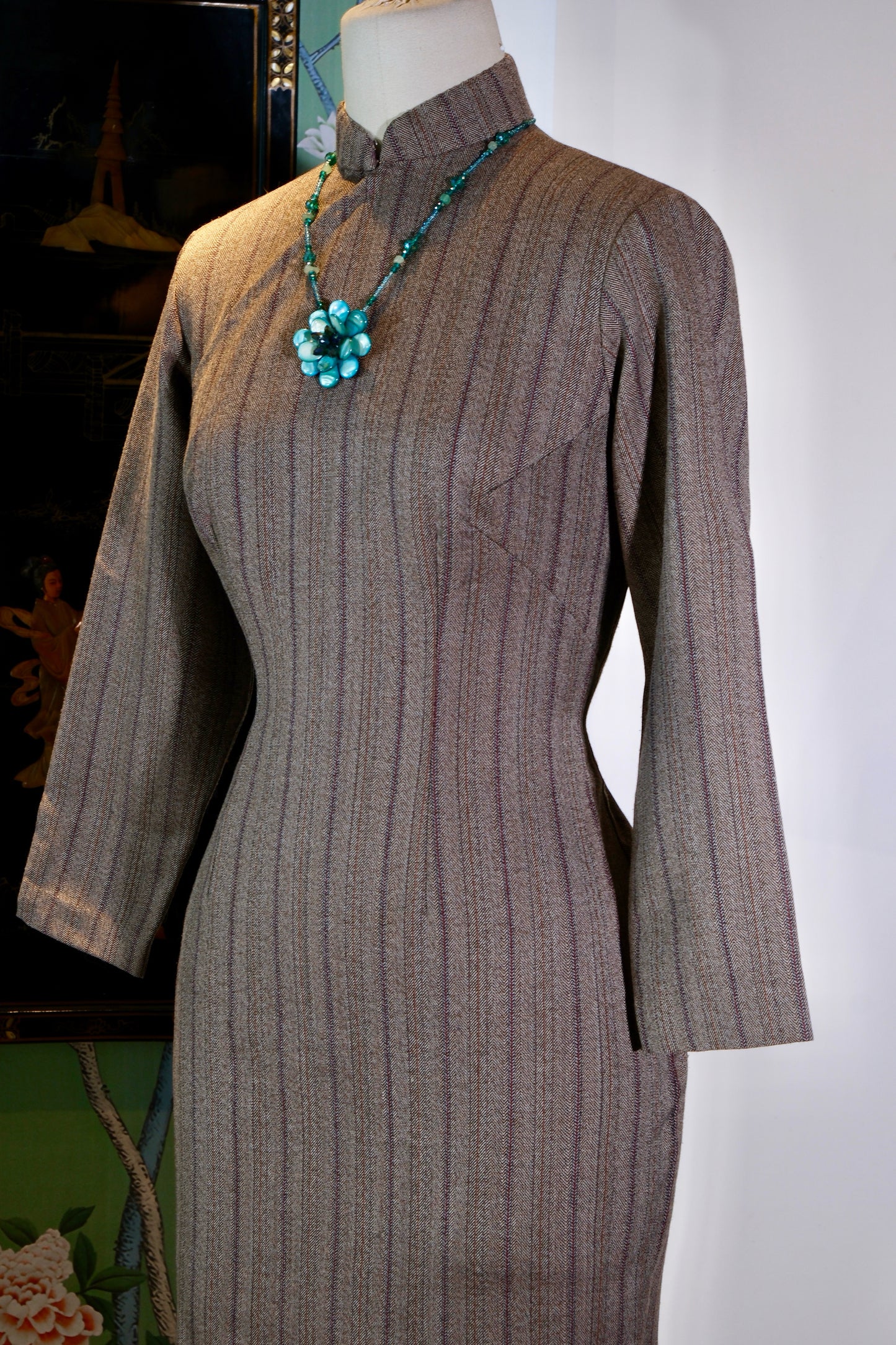
这件旗袍的面料,绝非寻常市井之物。它选用的是上世纪六十年代意大利进口的精纺羊毛面料。请细看其表面的纹理——这是一种极为经典的“细密竖条纹”设计。
在服装符号学中,竖条纹往往代表着一种“理性的秩序”与“视觉的延伸”。这种条纹并非简单的印染,而是通过高支数的羊毛纱线交织而成的提花或色织效果。深褐色的底色中,隐约透着紫灰色的细线,如同老照片中的颗粒感,沉稳而内敛。
这种面料的肌理感(Texture)极佳,羊毛特有的糯性与垂坠感,使得条纹在随着人体曲线起伏时,产生了一种微妙的光影流动。它不似丝绸般张扬耀眼,却有着如旧时光般温润的哑光质感。这种图案在当时被称为“洋气”的代表,它摒弃了传统旗袍繁复的龙凤刺绣,转而用几何线条构建出现代女性的干练与知性。
二、 剪裁与形制:海派遗风与港式改良的巅峰
此衣产自香港,正值香港旗袍制作的“黄金时代”尾声与成衣化早期的过渡阶段。
观察其剪裁,我们可以清晰地看到西式立体剪裁对传统平面剪裁的彻底改造。
1. 省道(Darts)的运用: 请注意胸部与腰部的收省,这是典型的西式女装技法。它精准地勾勒出女性的S型曲线,使得原本宽袍大袖的东方服饰,变成了贴合身体的“第二层皮肤”。
2. 归拔工艺: 六十年代的香港裁缝师傅,擅长通过高温熨烫的“归拔”工艺,让羊毛这种厚重的面料也能呈现出如水般的服帖。
3. 领型与袖长: 低而贴合的元宝领,既保留了东方的含蓄,又露出了修长的颈部线条;七分袖的设计,刚好露出手腕最纤细处,这是张爱玲笔下“细节处的讲究”。
三、 历史叙事:张爱玲时代的余韵与《花样年华》的前奏
这件旗袍,是连接两个时代的桥梁。
如果说三十年代上海的旗袍是“乱世中的奢华”,那么六十年代香港的旗袍则是“奋斗中的优雅”。彼时,大量上海裁缝南下香港,将海派旗袍的精髓与西方的时尚资讯在香港碰撞。
这件衣服让我想起王安忆在《长恨歌》中所写的那种对质地的执着:“那是些有年头的面料,摸上去有一种凉凉的滑滑的感觉,像是摸着了一段历史。”
穿着这件旗袍的女性,或许是在中环写字楼里雷厉风行的职业女性,或许是在出席晚宴时举止优雅的名媛。她们不再仅仅是家庭的附属品,而是开始走向社会,因此她们的着装需要更具功能性、更利落,同时不失女性的柔美。这件意毛旗袍,正是那个时代女性独立意识觉醒的物证。它比丝绸更耐磨,比棉布更挺括,它是为行动中的女性设计的战袍。
四、 稀缺性与艺术价值:不可复制的绝唱
在古董衣收藏界,面料的保存难度决定了其价值。丝绸易脆化,棉麻易褪色,唯有高品质的羊毛,若保存得当,能历经六十载而风采依旧。
材质的绝版: 六十年代的意大利羊毛纺织业处于世界巅峰,那种高支数、高密度的混纺工艺,在现代快时尚工业中已难觅踪迹。现在的羊毛往往过于轻薄或过于粗糙,很难复刻这种厚重的“骨感”。
结语
这不仅是一件衣服,这是一首穿在身上的散文诗。它见证了东西方文化的剧烈碰撞与温柔和解。拥有它,便是拥有了一段关于美、关于时间、关于女性自我发现的珍贵记忆。正如古人云:“衣以载道”,这件旗袍所载之道,便是那个风华绝代年代的永恒回响。
Measurements / Size Guide:
Bust / Waist / Hips / Total Length: 88/76/96/109 cm
Detailed Description:
The textile of this garment represents a remarkable specimen of mid-century material culture. Crafted from fine worsted wool imported from Italy during the 1960s, the fabric features an exceptionally precise, narrow vertical stripe design.
In sartorial semiotics, vertical stripes project both visual elongation and a disciplined, rational order. Rather than relying on superficial printing or topical dyeing, these pinstripes are integral to the weave—formed through high-count yarn-dyed jacquard techniques. Across a deep charcoal-brown ground, subtle purplish-grey threads emerge, providing a tactile depth akin to the fine grain of a vintage photograph.
The material exhibits remarkable drape and structural "bone" (gugan). Wool’s inherent resilience allows the vertical lines to shift subtly over the body’s contours, generating a quiet interplay of light and shadow. Departing from the overt shine of silk, it presents a muted, matte patina. Free of redundant traditional dragon or phoenix embroidery, the clean geometric directionality speaks directly to the crisp, intellectual demeanor of the modern 1960s professional woman.
Produced in Hong Kong during the transitional golden age between traditional bespoke dressmaking and early ready-to-wear manufacturing, this qipao documents the full integration of Western three-dimensional pattern-making into Eastern tailoring traditions.
Darts & Contour Shaping: The careful positioning of chest and waist darts exemplifies Western tailoring techniques, translating what was historically a flat, two-dimensional garment into a sculptural second skin.
Heat-Shaping (Guiba): Master Shanghainese and Hong Kong tailors utilized precise iron heat and moisture (guiba) to manipulate the heavy worsted wool, curving flat fabric panels to fit human anatomy smoothly without buckling.
Proportions & Collar Construction: The modest, low mandarin collar preserves traditional Eastern composure while accentuating the neck. Paired with three-quarter sleeves that end just above the wrist, the proportions mirror the meticulous attention to detail celebrated in mid-century literature.
This qipao acts as a physical bridge between two historical epicenters: pre-war Shanghai and mid-century Hong Kong.
Following the migration of Shanghainese master tailors to Hong Kong in the late 1940s and 1950s, classic Haipai tailoring fused with Western textile imports and the bustling energy of Victoria Harbour. If 1930s Shanghai qipaos represented wartime luxury, 1960s Hong Kong qipaos embodied the tailored elegance of an expanding female workforce.
The wearer of such a garment was likely a modern professional navigating Central's commercial district or attending evening social gatherings. These women required attire that offered mobility, durability, and structure without sacrificing grace. Fine Italian wool provided precisely this balance—more resilient than silk, crisper than cotton, and built as a sartorial armor for the active modern woman.
In vintage garment archiving, the structural integrity of the textile determines its long-term research and preservation value.
Textile Integrity: While vintage silk embrittles and cotton degrades under UV exposure, high-grade worsted wool—when stored in stable environmental conditions—retains its structural elasticity and color density across decades.
Historical Textile Formulations: Mid-century Italian woolen mills operated at the height of global textile innovation, producing high-twist, high-density worsted yarns with a distinct weight and hand-feel that modern mass-market manufacturing rarely reproduces.
This 1960s Italian wool qipao transcends simple garment function. Written in fine worsted pinstripes and structured wool, it remains a tangible document of cultural migration, industrial crossover, and the enduring poise of mid-century East Asian fashion.