深圳溯源
Couldn't load pickup availability
衣服尺寸:
胸围/腰围/臀围:108/100/112 厘米
衣长:118 厘米
细节描述:
一、图案解码:黑红交织的东方美学符号
这件旗袍以墨黑丝绒为底,红色机绣玫瑰如暗夜星火般绽放,构成极具张力的视觉叙事。丝绒材质本身自带“暗夜流光”的质感——光线流转间,黑色绒面泛着幽微光泽,恰如《长物志》所言“丝绒之贵,在其含而不露”,为整体奠定了低调奢华的基调。
红色玫瑰图案采用机绣工艺,却呈现出媲美手工的细腻层次:花瓣以渐变红丝线绣制,从花心的深绛红向外晕染至边缘的亮朱红,每片花瓣边缘皆以极细的金线勾勒轮廓,仿若晨露未晞时花瓣上的微光。花朵并非孤立存在,而是以“缠枝纹”的古典构图串联——枝蔓如游龙般蜿蜒,叶片以深浅不一的绿色丝线绣出脉络,其间点缀着细小的红色花苞,形成“花开满枝,生生不息”的吉祥意象。这种“西花东韵”的设计,既吸收了西方玫瑰的浪漫象征,又融入了中国传统纹样的韵律感,是六十年代台湾“中西合璧”审美思潮的典型体现。
二、古董衣的故事:花旗旗袍专家与一个时代的衣香鬓影
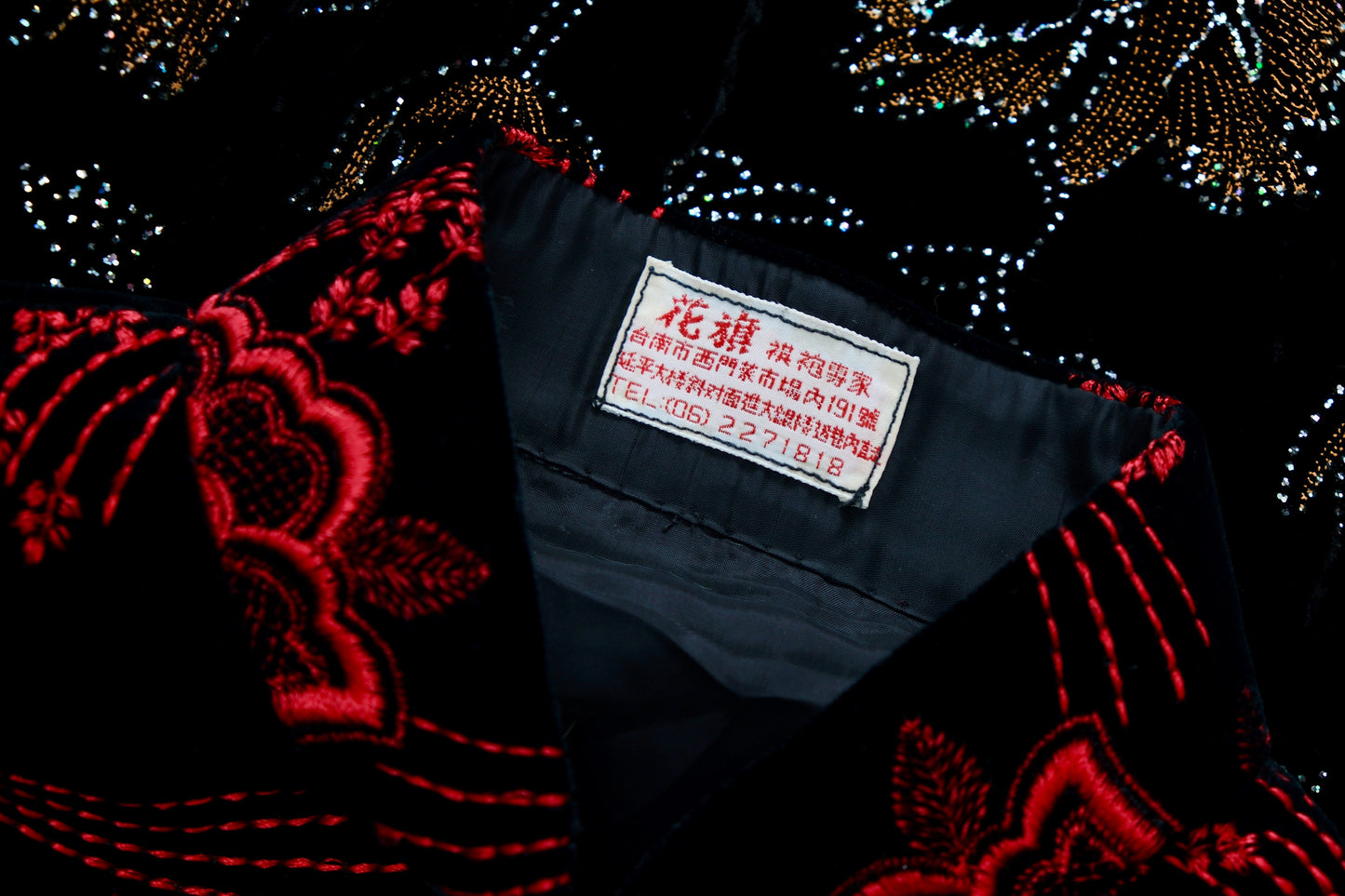
旗袍领口的“花旗旗袍专家”标签,是打开这件衣物历史之门的钥匙。六十年代的台湾,正处于传统与现代的激烈碰撞中:一方面,旗袍作为“国服”的余韵未散,是女性出席正式场合的必备礼服;另一方面,西方成衣文化开始渗透,机绣等新技术逐渐取代部分手工工序,成为平衡成本与美感的折中选择。
“花旗旗袍专家”正是这一时代的产物——它并非传统家庭作坊,而是具备规模化生产能力的成衣品牌,却仍坚守着旗袍的形制精髓:立领高度精准贴合颈部曲线,既保留了“含胸拔背”的东方仪态要求,又通过略微收窄的领口设计,暗合六十年代女性追求独立的精神气质;腰身剪裁采用“省道”工艺,精准收束腰线,下摆自然垂坠至小腿中部,行走时裙摆微开,露出纤细脚踝,既符合传统“行不露足”的含蓄,又暗藏现代女性对身体的自信展露。
这件旗袍的主人,或许是一位穿梭于台北圆山大饭店的社交名媛,或是在西门町咖啡馆里与友人谈天的大学生。它见证过六十年代台湾的“经济起飞”前夕,女性在社会角色转变中的优雅与坚韧——正如张爱玲在《更衣记》中所写:“旗袍是女人们的第二层皮肤,藏着她们的心事与野心。”
三、艺术风格与稀缺性:不可复制的时代标本
从艺术风格而言,这件旗袍是“装饰艺术运动”与“中国传统工艺”的奇妙融合。黑色丝绒的厚重质感与红色玫瑰的热烈形成强烈对比,暗合装饰艺术运动“几何化、色彩对比”的核心特征;而机绣玫瑰的细腻针法,又延续了中国苏绣“平、齐、细、密”的工艺传统。这种“新旧交织”的风格,使其既不同于三十年代海派旗袍的繁复珠绣,也区别于七十年代后逐渐式微的简约旗袍,成为六十年代独有的“过渡美学”标本。
其稀缺性更体现在三个层面:一是材质的不可复制——六十年代台湾产的优质丝绒,因原料与工艺限制,如今已难觅踪迹;二是工艺的断层——当时的机绣设备需工匠手工调试针距与张力,方能达到如此细腻效果,现代工业化机绣难以复刻这种“机器中的手工温度”;三是历史的唯一性——“花旗旗袍专家”作为特定时代的品牌,其标签本身即是台湾成衣史的重要物证,而保存如此完好的六十年代丝绒旗袍,在古董衣市场中已属凤毛麟角。
这件旗袍,早已超越了衣物本身的实用功能,它是六十年代台湾社会风貌的缩影,是传统工艺与现代技术碰撞的火花,更是一位无名女性曾经鲜活生命的见证。当指尖抚过丝绒上的玫瑰,仿佛能触摸到那个时代的温度——那是旧时光里的优雅,亦是历史长河中的绝唱。
Measurements / Size Guide:
Bust / Waist / Hips: 108/100/112 cm
Total Length: 118 cm
Detailed Description:
[I. Iconographic Decoding: The Sino-Western Aesthetics of Black and Crimson] The textile architecture of this Qipao deploys a deep midnight-black silk velvet as its proscenium arch, across which crimson embroidered roses bloom like volatile starfire inside a dark abyss, engineering a powerful visual narrative. The luxury velvet medium inherently possesses an introverted, dynamic luster; under shifting light, the black pile projects a subtle, multi-dimensional radiance. This material safely materializes the Ming Dynasty aesthetic dictum from Treatise on Superfluous Things (Chang Wu Zhi): "The supreme virtue of velvet resides in its absolute containment, projecting opulence without overt exposure," establishing a deeply disciplined foundation of under-stated luxury.
Although executed via early industrial machinery, the crimson rose iconography delivers a structural delicacy that fiercely rivals hand-embroidery. The petals are spun with gradient crimson silk threads that diffuse outward from a deep, bruised burgundy core to a brilliant, saturated vermilion edge. Crucially, the margins of every single petal are contoured by microscopically thin metallic gold threads, resembling the kinetic shimmer of morning dew catching early light. The blossoms reject flat, isolated placement; instead, they are interlocked via a classical Chanzhi (interlocking scrolling helix) composition—the vines wind across the torso like calligraphic dragons, while the foliage utilizes varying tones of forest and jade green silk to trace organic veins, punctuated by micro-buds. This synthesis of "Western Form, Eastern Soul" borrows the romanticism of the Western rose while anchoring it within the rhythmic cadence of ancestral Chinese iconography, operating as a pristine material specimen of the eclectic cultural syncretism dominating 1960s Taiwan.
[II. Sartorial Archeology: The "Huaqi Specialist" and Mid-Century Urban Poise] The woven label stitched into the mandarin collar—reading "Huaqi Cheongsam Specialist"—serves as the definitive archival key to unlocking the geopolitical provenance of this asset. During the 1960s, Taiwan was traversing a fierce crucible where heritage collided violently with industrial modernity. On one hand, the Qipao, operating as the de facto "National Dress" (Guofu), remained the mandatory uniform for elite formal decorum; on the other hand, Western ready-to-wear production chains were infiltrating the island, rendering precision machine embroidery a highly strategic ideological compromise to balance commercial scaling with strict haute couture aesthetics.
The "Huaqi Cheongsam Specialist" brand was a pure crystallization of this mid-century zeitgeist. It bypassed the limitations of traditional, decentralized family workshops to operate as a pioneering luxury ready-to-wear label, yet it uncompromisingly guarded the structural marrow of classical tailoring. The high mandarin collar is engineered to hug the cervical curve with razor-sharp precision, satisfying the traditional Eastern posture mandate of "containing the chest and elevating the spine" (Hanxiong Babei), while its slightly tapered silhouette subtly references the independent, self-governing identity of mid-century women. The torso employs highly disciplined structural darts to cinch the waist aggressively, while the hem cascades naturally to the mid-calf. This layout allows the side vents to split open rhythmically with the wearer’s stride to reveal a slender ankle—honoring the ancestral modesty of concealing the feet while modernly broadcasting a quiet confidence in the female form.
The original custodian of this piece was likely a high-society matriarch traversing the grand salons of Taipei’s Grand Hotel, or an avant-garde university academic debating in a Ximen Ding café. It bore direct material witness to the twilight eve of Taiwan's post-war economic miracle, archiving the resilience and grace of women navigating shifting macro-sociological roles. As Eileen Chang masterfully historicized in Chronicle of Changing Clothes: "The Qipao operates as a woman's second skin, housing both her private secrets and her grandest ambitions."
[III. Aesthetic Philosophy and Rarity: The Non-Reproducible Historical Specimen] Sartorially, this garment represents a virtuoso intersection between the international Art Deco movement and ancestral Chinese craftsmanship. The substantial, structural gravity of the black silk velvet creates a violent, poetic contrast against the passionate heat of the crimson roses—aligning seamlessly with Art Deco’s core fixation on geometric planar compression and aggressive color juxtapositions. Simultaneously, the microscopic precision of the embroidery paths preserves the foundational tenets of traditional Suzhou embroidery (Su Xiu), characterized by flatness, alignment, thinness, and absolute density. This rare synthesis isolates the Qipao as a definitive specimen of "transitional aesthetics," radically distinct both from the hyper-ornamental beadwork of 1930s Shanghai and the highly simplified, commercialized Qipaos that marked the decline of the industry post-1970s.
The archival asset value of this piece is reinforced across three absolute layers of rarity:
Material Extinction: High-tier silk velvet manufactured in 1960s Taiwan has completely vanished from modern global supply chains due to the extinction of specific mid-century silk mills and processing techniques.
Mechanical Hand-Temperature: The machine embroidery equipment of this specific epoch demanded that a master mechanic manually adjust the stitch-distance and tension gauge in real-time to achieve this fluid, painterly graduation. Modern digital embroidery algorithms completely lack this organic irregularity, making it impossible to replicate this "human warmth trapped inside the machine."
Archival Provenance: As a targeted historical brand, the "Huaqi" label functions as a vital physical monument to Taiwan's early industrial garment history. An original 1960s velvet specimen preserving this degree of material preservation is a near-extinct anomaly in contemporary antiquarian circles.
Ultimately, this Qipao has long since transcended the baseline utility of apparel. It stands proud as a miniature capsule of 1960s Taiwanese sociological reality, a brilliant spark ignited by the collision of heritage craft and industrial evolution, and a magnificent physical monument to a life once vividly lived. When your fingertips brush past the raised velvet roses, they are capturing the exact thermal signature of a vanished golden age—it is an elegance frozen in time, a supreme material swan song echoing across history.