深圳溯源
Couldn't load pickup availability
衣服尺寸:
胸围/腰围/臀围:92/76/96 厘米
衣长: 100 厘米
细节描述:
【衣上繁花:抽象印花里的时代情绪】
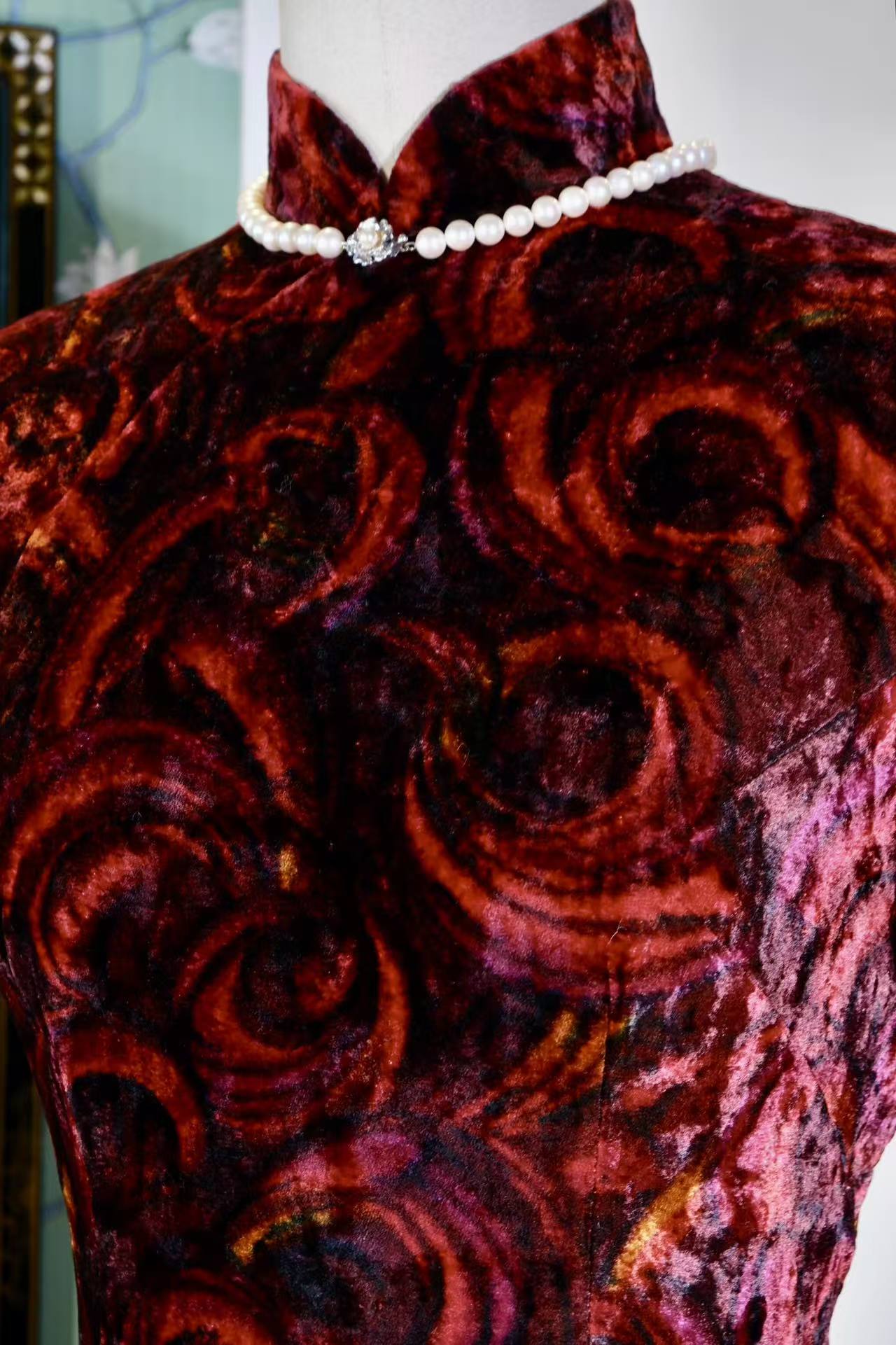
这件上世纪六十年代的香港产古董旗袍,面料选用重磅金丝绒——丝绒特有的垂坠感与光泽度,让酒红底色如陈年佳酿般醇厚,其上晕染的抽象玫瑰纹样,是整件衣裳的灵魂所在。
不同于传统工笔花卉的具象写实,这些玫瑰以印象派式的朦胧笔触呈现:花瓣轮廓在深红、暗紫与鎏金间流转,似暗夜中摇曳的烛火,又像老电影里柔焦的镜头。它们并非静止的装饰,而是随着光线与穿着者的身姿“流动”起来——静立时是沉静的复古油画,行走时便化作流动的波光,将六十年代香港中西文化碰撞下的摩登浪漫,织进了每一寸丝绒肌理。
【衣载春秋:从裁缝铺到时光胶囊的故事】
六十年代的香港,是旗袍发展的“黄金余晖”。彼时,上海裁缝南迁带来精湛技艺,西方时尚思潮涌入催生审美革新,这件旗袍正是时代的缩影:它保留了传统旗袍的立领、收腰、开衩形制,却用抽象印花打破古典桎梏;丝绒材质本是西方晚礼服的宠儿,却被东方匠人驯化为贴合曲线的温柔铠甲。
想象半个世纪前,它或许诞生于中环某间隐秘裁缝铺——老师傅戴着老花镜,用粉片在丝绒上勾勒版型,针脚里藏着对“美”的执念;或许曾陪伴一位名伶出席晚宴,在舞池灯光下流转风华;又或许被珍藏于樟木箱底,在岁月里沉淀出独一无二的包浆。如今它穿越时光而来,不仅是一件衣裳,更是可触摸的历史切片——每一道褶皱里,都藏着香江旧梦的温度。
【引经据典:稀缺性里的艺术孤品】
张爱玲在《更衣记》中写:“各人住在各人的衣服里。”这件旗袍,便是六十年代香港女性“住”在其中的精神居所。
从工艺看,金丝绒+抽象印花的组合在当时已属奢侈:丝绒易损难存,能完好保留至今的古董凤毛麟角;抽象印花需多次套色印染,稍有不慎便会糊版,成品率极低。从审美看,它是“新中式”的先声——比当代改良旗袍早半个世纪,就完成了“传统形制+现代艺术”的融合实验。
正如沈从文研究服饰史所言:“衣裳是穿在身上的历史。”这件旗袍的稀缺,不止于材质的珍贵、工艺的失传,更在于它承载了一个时代的文化野心:在传统与现代、东方与西方的夹缝中,长出了独属于香港的、鲜活的美学之花。
【结语:把时光穿在身上】
若你懂它的故事,便知它不止是一件古董衣——它是六十年代香港的呼吸,是丝绒与印花的诗歌,是能被拥抱的时光。当指尖抚过那些抽象玫瑰,仿佛能听见老唱片机里的爵士乐,看见霓虹灯下的香江夜色……这样的衣裳,值得被懂得的人珍藏,让它在新的岁月里,继续讲述关于美、关于时代、关于“人如何住在衣服里”的永恒命题。
Measurements / Size Guide:
Bust / Waist / Hips: 92/76/96 cm
Total Length: 100 cm
Detailed Description:
This antique qipao produced in Hong Kong during the 1960s of the last century selects heavy-gauge silk velvet as its fabric chassis—the characteristic drape and deep luster unique to velvet grant the burgundy background matrix a concentration as rich as aged vintage wine, while the abstract rose motifs blended across its surface operate as the absolute soul of the entire garment.
Completely departing from the literal representation and concrete realism of traditional fine-brush botanical paintings, these roses are expressed through the hazy, fluid brushwork characteristic of Impressionism: the boundaries of the petals shift across shades of deep red, dark purple, and liquid gold, resembling flickering candle flames in the dark night, or a soft-focus lens sequence from an archival film. They reject functioning as static decoration, choosing instead to "flow" alongside the shifting ambient light and the physical posture of the wearer—remaining a serene, vintage oil painting when standing perfectly still, yet transforming into fluid, shifting ripples during movement, weaving the modern romance of 1960s Hong Kong born from the collision of Eastern and Western cultures directly into every inch of the velvet texture.
The 1960s decade in Hong Kong occupied the "golden twilight" of the qipao’s historical evolution. During this timeline, custom tailors from old Shanghai migrated south bringing their exquisite, peak handcraft, while Western fashion philosophies poured in to catalyze aesthetic updates. This qipao stands as a precise miniature portrait of that generation: it faithfully preserves the traditional standing collar, waist reduction, and side-slit architecture of the classic qipao, yet utilizes abstract prints to break away from classical constraints; velvet, traditionally the absolute darling of Western evening couture, was tamed by Eastern artisans to become a gentle piece of armor conforming seamlessly to human curves.
Imagining half a century ago, it was perhaps born within a secluded custom tailoring workshop nestled in the Central district—where an old master tailor, wearing reading spectacles, used tailor's chalk to trace out the pattern draft over the velvet chassis, concealing a fierce obsession with "beauty" within every needle stroke; perhaps it accompanied a celebrated actress attending a gala dinner, shifting its visual brilliance under the ballroom lights; or perhaps it was carefully archived at the bottom of a camphor trunk, building a unique vintage patina over decades of quiet deposition. Today, it crosses through time to arrive here, serving not merely as a functional garment, but as a tangible historical slice—where every single fold and wrinkle conceals the physical warmth of mid-century Hong Kong dreams.
Eileen Chang recorded in her essay A Record of Changing Clothes: "Each individual lives within their own apparel." This specific qipao operated precisely as the spiritual residence within which 1960s Hong Kong women chose to "live."
Appraised under technical metrics, the structural pairing of heavy silk velvet and abstract printing stood already as an absolute luxury during its era: velvet textiles are highly delicate to maintain and easily damaged by moisture or friction, rendering surviving antique specimens in flawless condition exceptionally scarce; furthermore, abstract printing required highly complex multi-color registration and overlay dyeing, where the slightest structural error would ruin the entire textile plate, yielding an extremely low percentage of successful manufacturing output. From an aesthetic perspective, it operates as the true avant-garde pioneer of "New Chinese Style"—completing the structural fusion experiment of "traditional architecture + modern art" a full half-century before contemporary modified qipaos emerged in the commercial market.
Just as scholar Shen Congwen emphasized in his research on costume history: "Apparel is history worn upon the body." The absolute scarcity of this qipao resides far beyond the preciousness of its base materials or the permanent loss of its manufacturing handcraft; it rests squarely upon the immense cultural ambition it archives: blooming a vivid, singular aesthetic flower unique to Hong Kong right out of the narrow crossroads between tradition and modernism, East and West.
If you comprehend its internal narrative, you recognize that it transcends its primary classification as an antique garment—it is the living respiration of 1960s Hong Kong, a visual poem composed of velvet and print, a segment of time that can be physically embraced. When your fingertips pass over those abstract roses, it is almost as if you can hear jazz melodies radiating from an old gramophone, and perceive the Hong Kong nightscape glowing beneath vintage neon signs... A garment of this caliber deserves to be permanently preserved by a custodian who truly understands its language, allowing it to continue archiving the eternal proposition of beauty, lineage, and "how human beings live within their clothes" across a new generation of time.