深圳溯源
Couldn't load pickup availability
衣服尺寸:
胸围/腰围/臀围:92/76/98 厘米
衣长:115 厘米
细节描述:
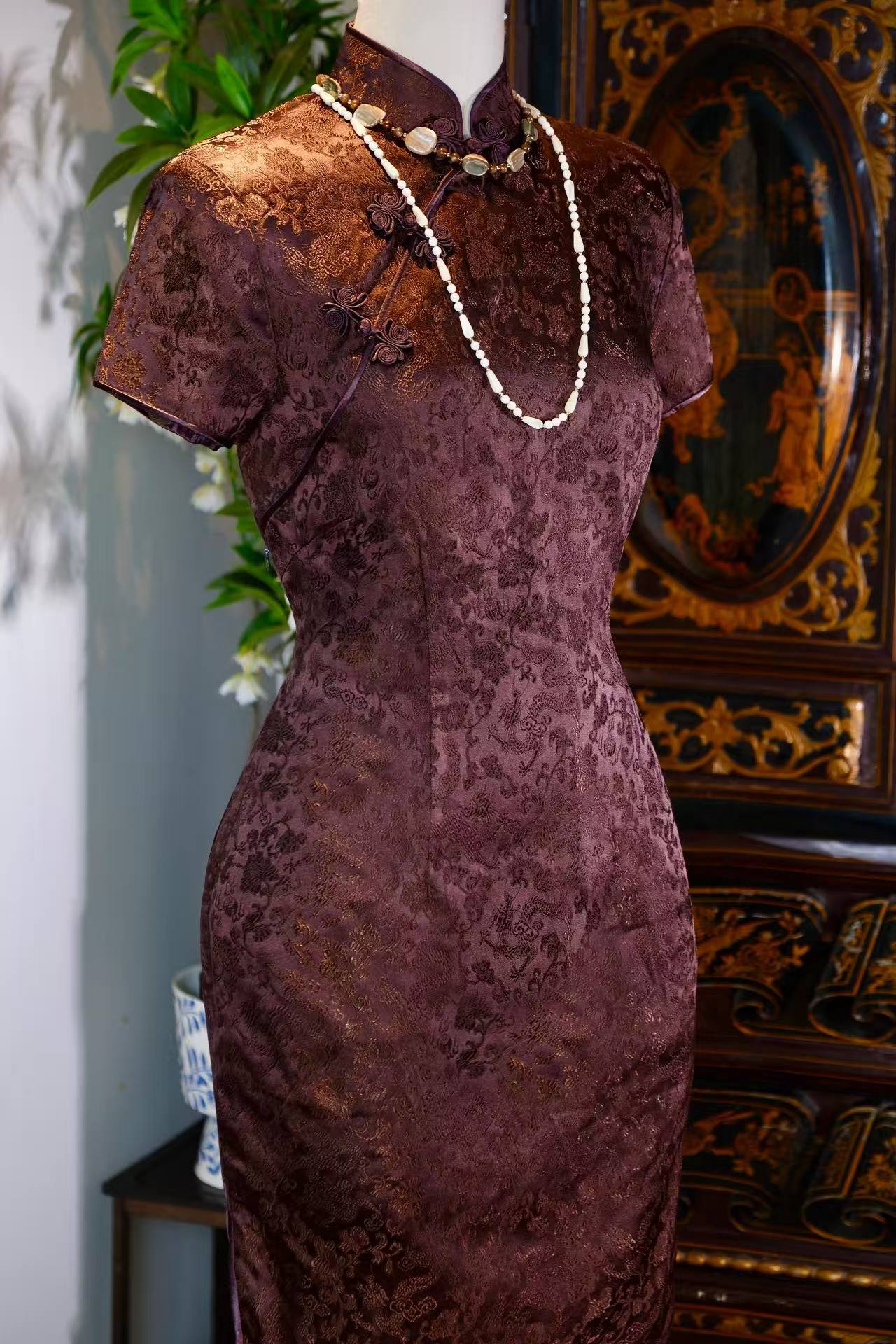
1960年代的香港,东西方文化在维多利亚港的潮声中交织。这件古董旗袍以深紫褐色为底,提花织就的祥云龙纹在光影间若隐若现,既延续着宫廷织锦的庄重,又融入了民国以来海派旗袍的修身剪裁。彼时香港纺织业正值黄金期,工匠们将传统纹样与现代审美熔于一炉,让每一寸面料都成为流动的史诗。如今它静立展柜,盘扣间的岁月包浆、裙摆处的自然褶皱,都在诉说着半个世纪前东方女性的优雅与坚韧。
- 祥云龙纹:采用传统“云地蟒纹”构图,龙身蜿蜒于卷云之间,龙首昂扬,龙爪遒劲,云纹以“如意头”造型为主,线条流畅如行云流水。
- 提花工艺:运用“重经提花”技法,以深紫褐色丝线为地,金棕色丝线显花,形成深浅交错的浮雕效果,光线照射下可见龙鳞与云纹的立体肌理。
- 细节处理:领口、袖口及襟边以同色系暗纹滚边,盘扣为“蝴蝶扣”造型,与面料提花形成虚实呼应。
这件旗袍诞生于1962年的香港中环裁缝铺,当时的香港作为远东纺织中心,汇聚了苏杭的丝绸、上海的剪裁技艺与西方的立体剪裁理念。面料上的祥云龙纹源自《营造法式》中的“云纹”与《周礼》记载的“五爪为龙”规制,却摒弃了清代龙纹的威严感,转而以“游龙戏珠”的灵动姿态,暗合六十年代香港社会对自由与繁荣的向往。其艺术风格可追溯至明代“妆花缎”工艺,又融入了民国“月份牌”广告中女性的柔美曲线,是传统纹样在现代语境下的创造性转化。
六十年代香港产旗袍存世量不足万件,且多为普通素色面料,如此完整的提花织锦款式极为罕见。
“重经提花”工艺在七十年代后因成本高昂逐渐式微,现存能完整呈现龙纹立体效果的旗袍不足百件。
作为东西方文化碰撞的产物,它见证了香港从转口港向国际都市转型的历史,其纹样与剪裁的融合,是研究二十世纪东亚服饰史的重要实物标本。
这件旗袍不仅是一件衣物,更是一段被织入丝线的时光,它让1960年代的香港风韵,在今日依然熠熠生辉。
Measurements / Size Guide:
Bust / Waist / Hips: 92/76/98 cm
Total Length: 115 cm
Detailed Description:
In 1960s Hong Kong, Eastern and Western cultures intertwined amidst the rhythmic tides of Victoria Harbour. This antique cheongsam (qipao), with its deep purplish-brown base and jacquard-woven auspicious clouds and dragon motifs, flickers between light and shadow. It preserves the solemnity of palace brocade while embracing the slim-fit silhouette that has defined the Shanghainese style since the Republican era. During this golden age of the Hong Kong textile industry, artisans fused traditional motifs with modern aesthetics, turning every inch of fabric into a flowing epic. Today, as it stands silently in the gallery, the patina on its buttons and the natural folds at its hem speak of the grace and resilience of Oriental women from half a century ago.
Auspicious Cloud and Dragon: Utilizing a traditional "Cloud Ground and Python Pattern" composition, the dragon meanders through rolling clouds with its head held high and claws powerful. The cloud motifs are primarily shaped like "Ruyi heads," with lines as fluid as drifting clouds and flowing water.
Jacquard Craftsmanship: The piece employs the "Multi-warp Jacquard" (重经提花) technique. With deep purplish-brown silk as the ground and golden-brown silk for the pattern, it creates a staggered, bas-relief effect. Under light, the three-dimensional texture of the dragon scales and clouds becomes strikingly visible.
Detailing: The collar, cuffs, and lapel edges feature tonal dark-patterned piping. The fasteners are shaped as "Butterfly Buttons," creating a poetic echo between the physical closures and the woven patterns.
This cheongsam was born in 1962 in a tailor shop in Hong Kong’s Central district. At that time, Hong Kong served as the textile hub of the Far East, gathering Suzhou and Hangzhou silk, Shanghai tailoring skills, and Western three-dimensional cutting concepts. The cloud and dragon motifs trace back to the "Cloud Patterns" in Yingzao Fashi and the "Five Claws for a Dragon" regulation recorded in the Rites of Zhou. However, it discards the sternness of Qing Dynasty imperial dragons in favor of a "Dragon Playing with a Pearl" vitality, subtly mirroring the 1960s Hong Kong aspiration for freedom and prosperity. Artistically, it traces its roots to the Ming Dynasty’s "Zhuanghua" (cloud brocade) craft while absorbing the soft feminine curves seen in Republican-era "Calendar Girl" posters—a creative transformation of traditional motifs within a modern context.
Extant Quantity: Fewer than 10,000 Hong Kong-made cheongsams from the 1960s survive today, and most are plain, solid-colored garments. A complete jacquard brocade style like this is exceptionally rare.
Vanishing Technique: The "Multi-warp Jacquard" process gradually declined after the 1970s due to prohibitive costs. There are fewer than a hundred surviving qipaos that perfectly present the three-dimensional effect of such dragon motifs.
Cultural Value: As a product of the collision between East and West, it witnessed Hong Kong's transformation from an entrepôt to an international metropolis. The fusion of its patterns and tailoring makes it a crucial physical specimen for the study of 20th-century East Asian costume history.
This cheongsam is more than a garment; it is a segment of time woven into silk threads, allowing the charm of 1960s Hong Kong to shine brilliantly even today.