溯源
Couldn't load pickup availability
年代:约1960年代初期(Early 1960s)
风格定位:新古典主义(Neoclassicism)与杰奎琳式优雅(Jackie Kennedy Style)的完美融合。
一、 形制与版型:承袭经典的“沙漏”余韵
这套连衣裙的版型设计,精准捕捉了60年代初“摇摆年代”黎明时的时尚脉搏。它既未走向中后期“摩登风(Mod Style)”的极度叛逆与迷你化,又摆脱了50年代迪奥(Dior)式“New Look”的繁复与沉重,转而追求一种“克制的高级感”。
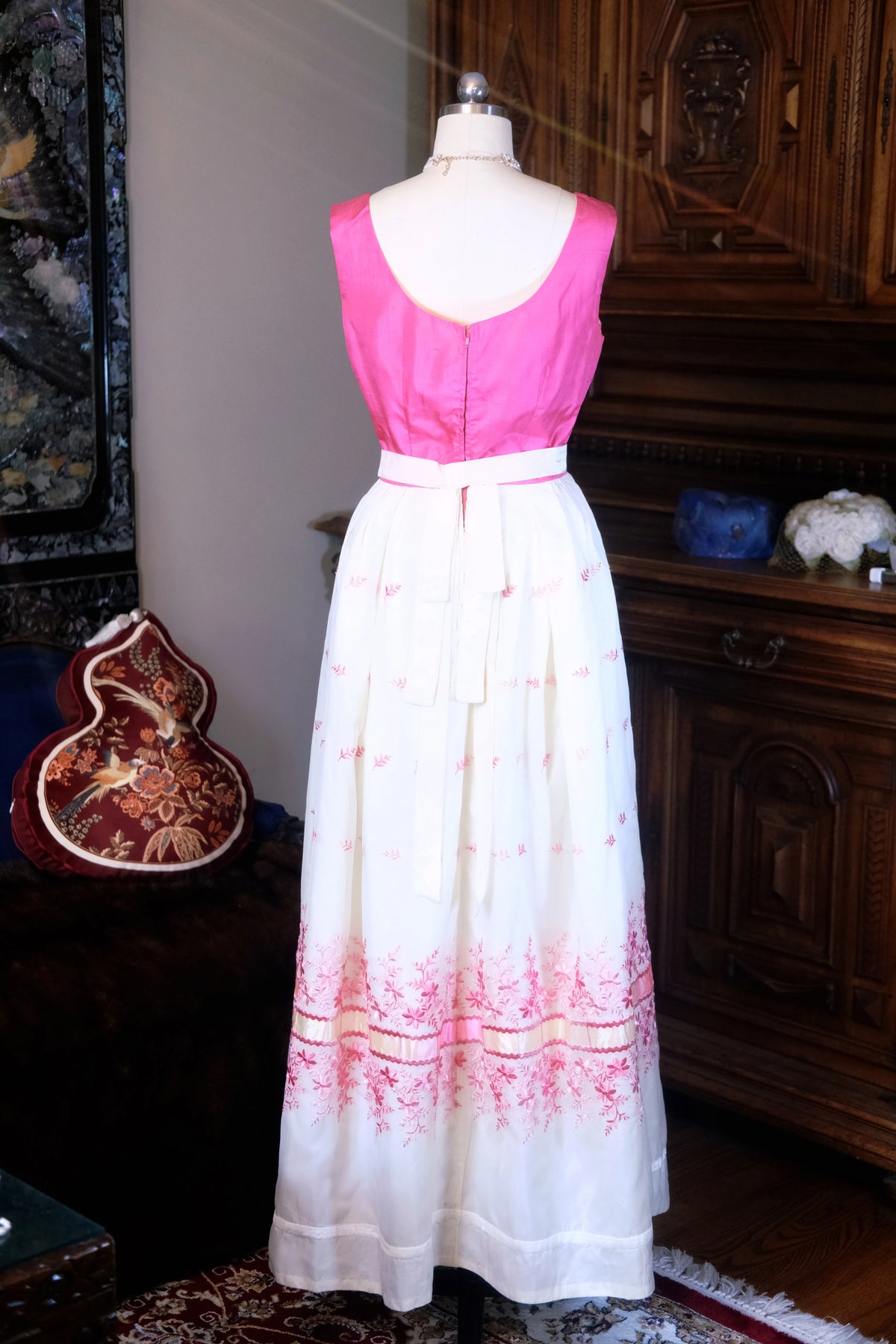
* 上装:采用了无袖大圆领(Scooped Neckline)设计,贴合人体工学的收腰剪裁,如同古希腊雕塑般勾勒出女性的肩颈线条与胸腰比。其简洁、流畅的结构感,让人联想到杰奎琳·肯尼迪(Jackie Kennedy)那标志性的端庄风范。
* 下裙:高腰线设计配合经典的A字摆(A-line Silhouette),裙长过膝,不仅极具时代特征,更赋予穿着者一种优雅、从容的社交气场。
二、 面料与工艺:顶级奢材的双重奏
这件藏品在面料的运用上,堪称“刚柔并济”的纺织艺术典范,展现了那个年代高级定制(Haute Couture)对材质肌理的极致追求。
* 上装——双宫真丝(Double Pongee Silk):
上衣选用了极为珍贵的双宫真丝。双宫茧由两只蚕共结一茧,其缫出的丝线天然带有不规则的结节与颗粒感(Slubs)。这种独特的肌理不仅赋予了面料极佳的骨感与挺括度,使其能完美撑起上装的廓形,更在光线下折射出温润、内敛的天然光泽,透气且不易皱。在古代,这是专供皇室与顶级奢侈品牌的贡品级面料。
* 下裙——真丝欧根纱(Silk Organza):
裙摆采用了轻盈透视的真丝欧根纱。欧根纱起源于东方,经由丝绸之路传入欧洲宫廷,因其轻薄如雾却又自带微挺的“建筑感”而备受青睐。在这里,设计师巧妙利用欧根纱的半透明特性,营造出一种“雾里看花”的空灵美感。
三、 刺绣艺术:惊艳时光的“渐变晕染”
整套服装的视觉焦点与灵魂所在,无疑是裙摆处那片繁复而精美的刺绣。
* 工艺溯源:刺绣师采用了类似中国传统苏绣中“散套针”与西方机器刺绣结合的技法,针脚细密、排列紧密。
* 渐变之美:最令人叹为观止的是其渐变晕染(Ombre Gradient)的色彩处理。从腰部散落的零星花叶,到裙摆下方逐渐密集的繁花,丝线的色彩由浅至深,从淡粉色、桃粉色自然过渡到浓郁的玫瑰红与胭脂色。
这种色彩渐变如同水墨在宣纸上晕染开来,不仅打破了单色面料的单调,更赋予了静态的裙摆以流动的生命力。裙摆中段点缀的波浪边(Scallop)粉色缎带,则如同一条玉带束腰,进一步丰富了视觉层次。
四、 文学意象与馆藏价值
《诗经·周南·桃夭》有云:“桃之夭夭,灼灼其华。之子于归,宜其室家。”
这件连衣裙宛如一首穿在身上的赞美诗。那裙摆上层层叠叠、由浅入深、热烈绽放的粉色花卉,正是“灼灼其华”最生动的写照。60年代的粉彩(Pastel Pink)本身就代表着希望、青春与甜蜜,而这件裙子将其演绎到了极致。
它不仅是一件复古服饰,更是一件“可穿的艺术品”。它见证了60年代初女性从繁复的束身衣中彻底解放,走向自信、优雅与独立的历史时刻。其保存之完好、面料之珍贵、刺绣之精绝,使其具备了极高的博物馆级馆藏价值。
Circa early 1960s (Early 1960s). Stylistic positioning: A seamless fusion of Neoclassicism and Jackie Kennedy-esque elegance (Jackie Kennedy Style).
The pattern-making of this dress precisely captures the fashion pulse at the dawn of the "Swinging Sixties." Eschewing both the extreme rebellion and miniature proportions of the mid-to-late Mod style and the heavy intricacy of 1950s Dior-esque "New Look" architecture, it pursues a distilled, restrained sense of elevated sophistication.
Bodice: Features a sleeveless scooped neckline (Scooped Neckline) paired with ergonomic waist-cinching tailoring, sculpting the wearer's shoulder-to-neckline ratio and bust-to-waist contour with the poise of an ancient Greek sculpture. Its clean, flowing structural line evokes the iconic, poised demeanor of Jacqueline Kennedy.
Skirt: An elevated waistline paired with a classic A-line silhouette (A-line Silhouette), cut to a sophisticated midi length that hits below the knee. This proportion not only epitomizes period characteristics but endows the wearer with an elegant, composed social presence.
The fabric selection of this collector's piece stands as a textile masterpiece of "strength interwoven with gentleness," demonstrating the era's haute couture devotion to material tactility.
Bodice — Dupioni Silk (Double Pongee Silk): The bodice is crafted from exceptionally rare dupioni silk. Woven from double cocoons spun by twin silkworms, the resulting yarn naturally exhibits irregular slubs and textural nodes (Slubs). This distinctive texture not only endows the fabric with superb body and crispness—allowing it to flawlessly uphold the bodice's structural contour—but also refracts a warm, restrained natural luster under light while remaining breathable and crease-resistant. Historically, this grade of textile was reserved as tribute silk for royalty and premier luxury houses.
Skirt — Silk Organza (Silk Organza): The skirt utilizes lightweight, translucent silk organza. Originating in the East and travelling along the Silk Road into European royal courts, organza has long been favored for possessing a misty, weightless lightness balanced by an inherent, crisp "architectural" body. Here, the designer masterfully leverages the semi-transparent properties of organza to generate an ethereal, "flowers viewed through a fog" aesthetic.
The visual focal point and absolute soul of the entire garment reside in the lush, exquisite embroidery fringing the skirt.
Craftsmanship Lineage: The embroiderers deployed a technique combining elements of traditional Chinese Suzhou embroidery's scattered needlework (scattered-stitch shading) with precision mechanical embroidery, yielding ultra-dense, impeccably uniform stitches.
The Beauty of the Ombre Gradient: Most staggering of all is its chromatic treatment via an ombre gradient (Ombre Gradient). Cascading from sparse flower buds scattered near the waist down to densely blooming floral clusters along the lower hem, the silk thread colors transition fluidly from pale pink and peach pink to rich, saturated rose red and carmine. This chromatic gradation unfolds like ink bleeding across rice paper, shattering the monotony of solid fabrics while infusing static drapery with kinetic, breathing vitality. Scalloped pink satin ribbon edging (Scallop) interwoven through the middle of the skirt serves like a jade belt, further enriching the optical depth.
The Classic of Poetry (The Book of Songs: Zhou Nan: Peach Blossoms) records: "The peach tree is young and tender; brilliant are its flowers. This girl is getting married; she will make a good home."
This dress reads like a hymn composed to be worn upon the body. The cascading layers of pink flora unfurling in deepening shades upon the skirt serve as the most vivid embodiment of being "brilliant in their blooms." 1950s and 60s pastel pink (Pastel Pink) inherently signifies hope, youth, and sweetness, yet this garment elevates that vocabulary to its absolute zenith.
It transcends ordinary vintage apparel to become a piece of "wearable art." It bears witness to the historical epoch of the early 1960s when women emancipated themselves from cumbersome corsetry to step toward confidence, elegance, and independence. Its pristine state of preservation, precious material composition, and breathtaking embroidery invest it with supreme, museum-grade collecting value.