溯源
Couldn't load pickup availability
【史学与形制】
这是一件典型的六十年代香港产旗袍。那个时期的香港旗袍,正处于海派与广式工艺交融的鼎盛期,逐渐褪去了三十年代的大袖飘逸,转向了更强调实用性与人体曲线的立体剪裁。
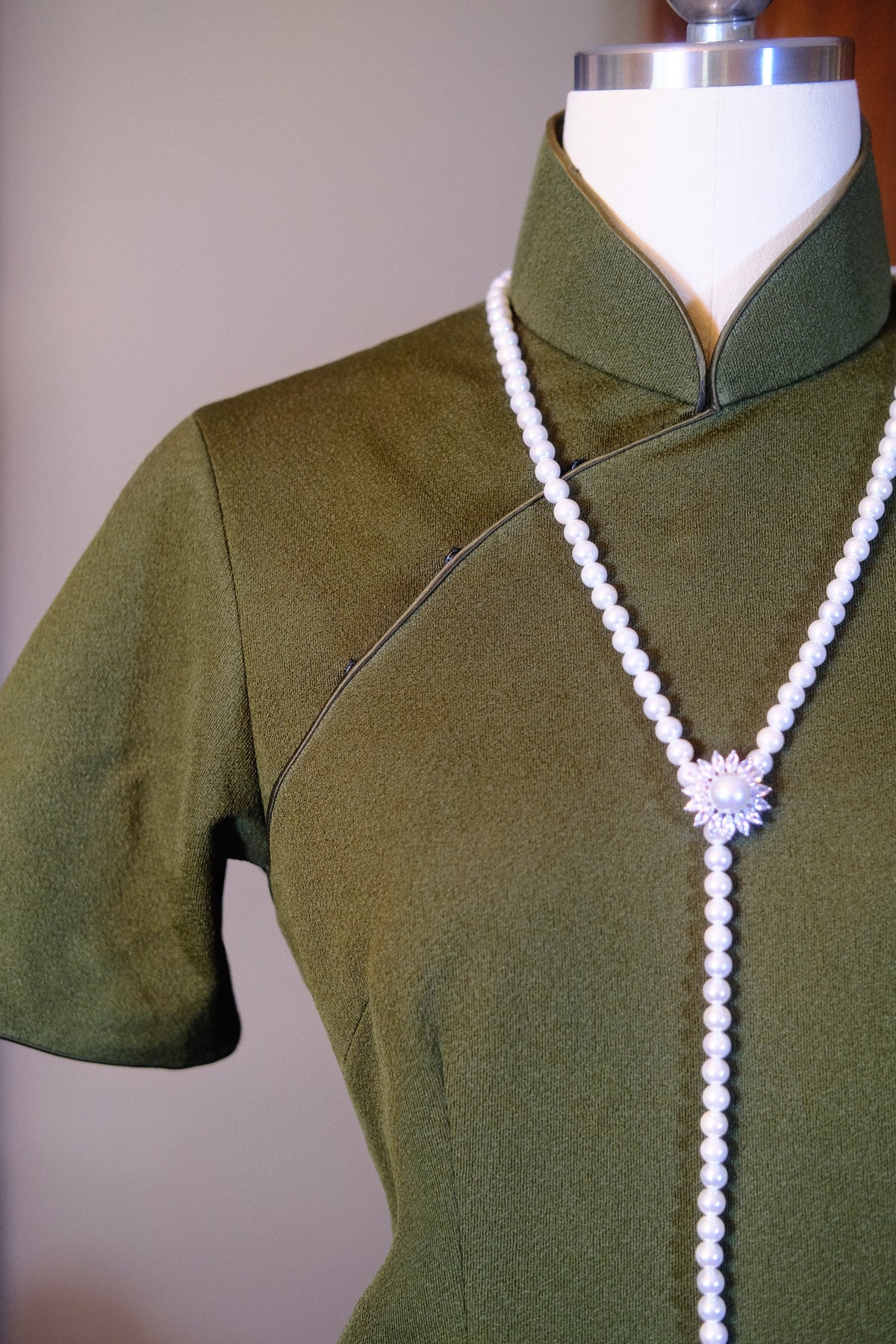
这件旗袍最为人称道的工艺,在于其领口与襟边采用的“线香绲”。在六十年代的《旗袍工艺图解》中,“线香绲”是一种对裁缝技艺要求极高的装饰工艺——将面料与嵌条一同折边,绲出的线条仅如一缕线香般粗细。它摒弃了繁琐的宽边,以极简的线条勾勒出门襟的走向,不仅让视觉更加清爽利落,更在端庄中透出一丝严谨,是当时知识女性最为推崇的“高定”细节。
【文学与意境】
张爱玲曾言:“在旧中国,女人是男人的衣服,而在新中国,女人是时代的衣服。”六十年代的香港,中西文化在维多利亚港畔激荡,这件橄榄绿的旗袍,便是那个时代最温柔的注脚。
橄榄绿,是一种沉稳而富有生命力的颜色,正如钱钟书先生笔下的苏文纨,虽不似红玫瑰般炽烈张扬,却有着“清水出芙蓉,天然去雕花”的素雅。这件旗袍,便是属于“白玫瑰”的战袍。
穿上它的女子,或许正如旧时光里那所名校的女教师。她不需要浓妆艳抹,只需在领口系上一串珍珠,手持几本线装书,便能在喧嚣的尘世中,守得一方宁静。那是一种“腹有诗书气自华”的从容,是“最是那一低头的温柔,像一朵水莲花不胜凉风的娇羞”。
【穿搭美学】
在这件素色旗袍上,搭配的Y字长款珍珠项链是点睛之笔。这种搭配在六十年代的上海与香港名媛中极为流行。珍珠的圆润温润中和了橄榄绿的硬朗,Y字形的延伸在视觉上拉长了颈部线条,使整个人显得更加挺拔、高贵。
这不仅仅是一件衣服,它是一种生活态度的传承。在快节奏的今天,它提醒我们,有一种美,叫做“慢”;有一种优雅,源自内心的丰盈与宁静。
结语:
衣香鬓影,终成过往;唯有风骨,历久弥新。这件六十年代橄榄绿旗袍,是岁月的馈赠,是留给有书卷气女子的最美情书。
This is a quintessential 1960s Hong Kong-tailored Qipao. Hong Kong Qipaos of that era stood at the peak of the convergence between Shanghai-style and Cantonese craftsmanship, gradually shedding the flowing wide sleeves of the 1930s in favor of three-dimensional tailoring that placed greater emphasis on utility and human bodily curves.
The most celebrated craftwork on this Qipao lies in the "incense-stick trim" (Incense-Stick Trim) applied along the collar and lapel edges. In 1960s tailoring manuals, the incense-stick trim denoted a decorative technique demanding exceptionally rigorous needlework—folding the fabric and piping together so that the resulting finished line is rendered as slender as a wisp of burning incense. Abandoning cumbersome wide bindings, it outlines the trajectory of the lapel using ultra-minimalist lines, rendering the visual presentation remarkably crisp and clean while infusing decorum with a sense of disciplined precision. It represented the "haute couture" detail most revered by intellectual women of the period.
Eileen Chang once wrote: "In old China, women were men's garments; whereas in the new era, women are the garments of the times." In 1960s Hong Kong, where Eastern and Western cultures surged along Victoria Harbour, this olive-green Qipao serves as the most tender footnote to that era.
Olive green is a composed yet deeply vital hue. Much like Su Wenwan from Qian Zhongshu’s novels, though it lacks the blazing ostentatiousness of a red rose, it possesses the natural purity of "a lotus rising out of clear water, naturally crafted without carved ornamentation." This Qipao is the battle-dress belonging to the "white rose."
The woman wearing it might well evoke the image of a distinguished female educator from bygone days. Requiring no heavy makeup, she need only fasten a string of pearls at her collar and carry a few thread-bound books to preserve an island of tranquility amidst a bustling world. It is the poised self-assurance born of the proverb "poetry in the belly makes one naturally graceful," mirroring the lyric line: "Most tender is that lowering of the head, like a water lily bashfully withstanding the cool wind."
The Y-shaped long pearl necklace styled with this solid-color Qipao serves as the definitive finishing touch. This pairing was immensely popular among elite socialites in 1960s Shanghai and Hong Kong. The lustrous, round warmth of the pearls softens the understated composure of the olive green, while the Y-line elongation visually lengthens the neck, lending the wearer an even more upright and noble bearing.
This is far more than a garment; it is the transmission of a philosophy of living. In today's fast-paced world, it reminds us that a certain kind of beauty exists, known as "slowness"—an elegance originating from internal richness and peace.
Epilogue: Shimmering glamour ultimately fades into the past; only backbone and character endure through the ages. This 1960s olive-green Qipao is a gift of time, a most magnificent love letter reserved for a woman of scholarly grace.