深圳溯源
Couldn't load pickup availability
衣服尺寸:
胸围/腰围/臀围/衣长:94/78/106/103 厘米
细节描述:
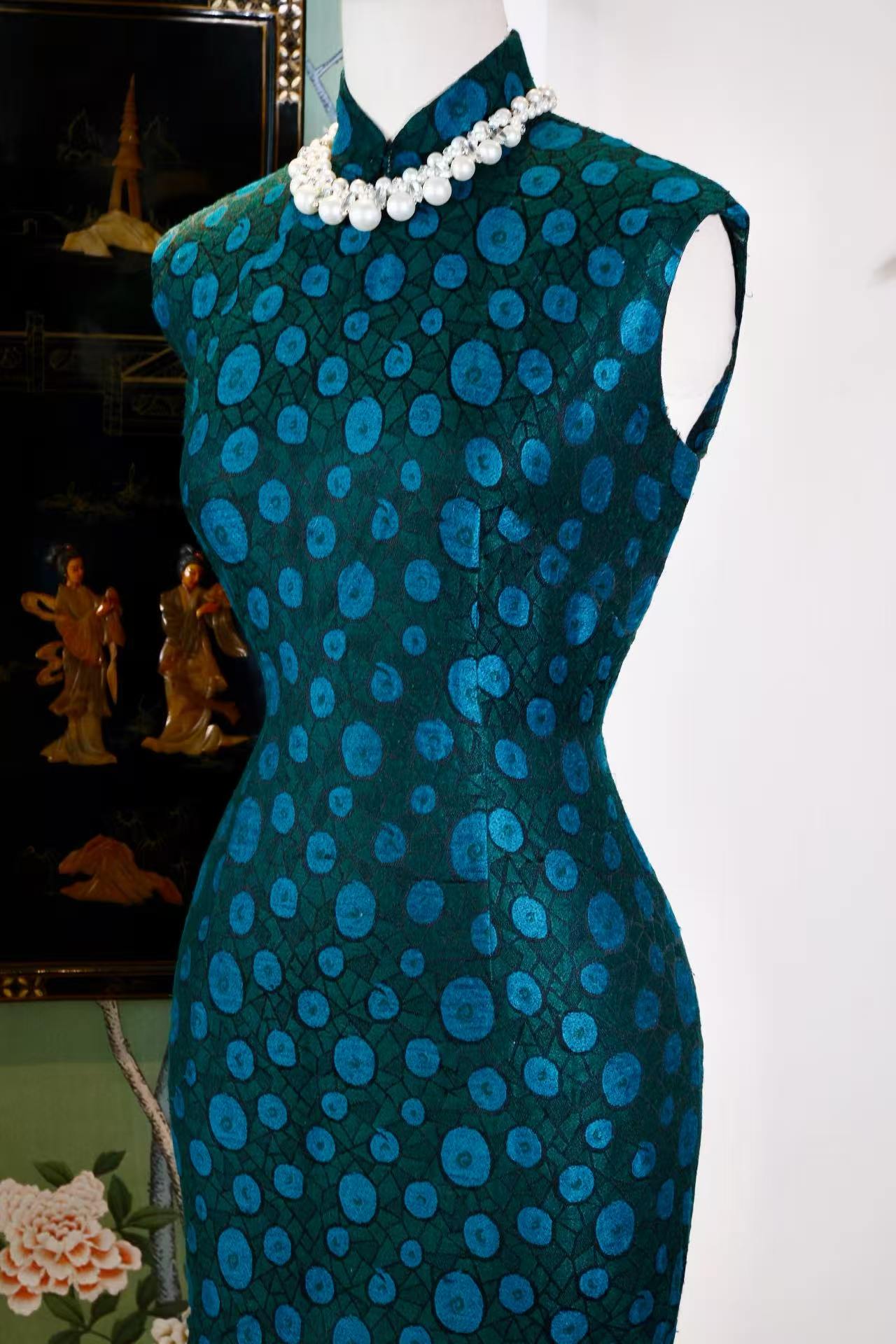
这件旗袍最引人注目的特质,在于其面料所呈现出的强烈现代主义特征与传统工艺的奇妙融合。
- 冰裂纹提花肌理:
仔细观察面料表面,并非平滑的丝绸,而是布满了细密、不规则的网状纹理。这种工艺在纺织学中被称为“冰裂纹”或“龟裂纹”提花。它模仿了宋代哥窑瓷器中“金丝铁线”的开片美感,赋予了织物一种古朴而坚硬的视觉张力。这种肌理不仅增加了面料的挺括度,使旗袍的轮廓更加利落,更在光影下产生了一种类似浮雕的立体感。
- 波普艺术风格的圆点阵列:
在深沉的墨绿色底色之上,分布着大小不一、错落有致的孔雀蓝圆点。这并非传统的吉祥纹样,而是典型的波普艺术风格。20世纪60年代正是波普艺术席卷全球的时期,这种高饱和度、重复几何图形的运用,打破了传统旗袍含蓄内敛的审美范式。圆点的排列看似随机,实则经过精心设计,利用视错觉在视觉上修饰了穿着者的身形曲线,既复古又极具前卫感。
六十年代的台北风华:剪裁与时代的缩影
这件旗袍诞生于20世纪60年代的台湾,那是一个东西方文化剧烈碰撞与融合的“黄金时代”。
- 海派剪裁的延续与改良:
从形制上看,它继承了海派旗袍注重人体工程学的立体剪裁传统。无袖设计(或是极短的盖肩袖)是60年代为了适应亚热带气候及受西方晚礼服影响而产生的流行款式。这种设计大胆地露出了女性优美的肩部线条和手臂,展现了当时女性追求解放、自信独立的时代精神。
- 意大利进口面料的稀缺性:
在60年代的台湾,能够使用进口的高级合成纤维或混纺面料制作旗袍,是身份与品味的象征。当时的台湾纺织业正处于腾飞前夜,这种来自欧洲的面料往往通过特殊的贸易渠道进入,因其色牢度高、抗皱性好且光泽感独特,成为了当时名媛淑女的追捧对象。这也解释了为何历经半个多世纪,其色泽依然如新,毫无褪色之态。
引经据典:物哀与摩登的共生
张爱玲在《更衣记》中曾写道:“对于不会说话的人,衣服是一种语言,随身带着的是袖珍戏剧。”这件旗袍,便是一出关于“跨越”的戏剧。
- “青出于蓝”的色彩哲学:
《荀子·劝学》云:“青,取之于蓝,而青于蓝。”这件旗袍的主色调——深邃的墨绿与明亮的孔雀蓝,正是对这一古老东方色彩哲学的现代演绎。它既有中国传统绘画中“石青”、“石绿”的厚重底蕴,又融入了西方现代设计的构成主义理念。
- 稀缺性的学术注脚:
在目前的古董衣收藏市场中,50-70年代的旗袍虽有不少存世,但像这样结合了“欧式冰裂肌理”与“美式波普图腾”,且保存如此完好的作品,实属凤毛麟角。它不仅是一件衣物,更是一个微缩的历史切片,记录了那个年代台湾社会在全球化浪潮中,如何以一种优雅的姿态,将西方潮流内化为东方的时尚表达。
总结
这件旗袍不仅是身体的装饰,更是时间的艺术。它以冰裂纹为骨,撑起岁月的风骨;以波普圆点为魂,跳动时代的脉搏。对于收藏家而言,拥有一件这样的旗袍,便是拥有了一段凝固的、流光溢彩的六十年代风华。
Measurements / Size Guide:
Bust / Waist / Hips / Total Length: 94/78/106/103 cm
Detailed Description:
The defining curatorial signature of this specimen resides in its intense modernist aesthetic fused seamlessly with historical artisan production techniques.
Ice-Crackle Jacquard Topography: Structural analysis of the textile surface reveals a dense, non-linear network of irregular, intersecting fissures rather than a flat silk plane. Documented in textile engineering as an "ice-crackle" (bingliewen) or "crackle-glaze" jacquard, this technique masterfully references the historical Jinqiang Tiexian (gold filaments and iron threads) opening patterns characteristic of Song Dynasty Ge Ware ceramics. This gives the substrate a primitive, calcified visual tension. This highly specialized micro-topography increases the structural stiffness (tingkuo) of the yardage, ensuring crisp, geometric silhouettes while generating a sculptural relief under directed gallery lighting.
The Pop Art Dot Array: Superimposed onto a deep, ink-like forest green field is an asymmetrical array of multi-scale peacock blue circular points. This arrangement aggressively rejects conventional Chinese auspicious motifs, leaning instead into the graphic vocabulary of mid-century Western Pop Art. The use of high-chroma, repeating geometric matrices reflects the global explosion of Pop sensibilities during the 1960s, completely disrupting the reserved, monochromatic behavioral expectations of traditional Chinese vestments. The positioning of the dots relies on deliberate optical engineering, leveraging visual illusion to structurally contour and slim the biological form—yielding an effect that is simultaneously historicist and deeply avant-garde.
This artifact stands as a primary material witness to 1960s Taiwan—a pivotal geopolitical window characterized by intense socio-cultural friction and cosmopolitan hybridization.
The Continuous Evolution of the Shanghai Lineage: Morphologically, the garment maintains the strict three-dimensional, anatomical pattern drafting inherited from the Haipai (Shanghai) tailoring lineage. The sleeveless configuration (incorporating a minimal cap-sleeve extension) historicizes a distinct 1960s stylistic turn. This adaptation met the practical demands of a sub-tropical climate while absorbing the styling cues of Western evening haute couture, boldly baring the shoulder slopes and arms to index the social liberation and rising civic confidence of the era's professionalizing female population.
The Premium of Imported Italian Textiles: Within the mid-century Taiwanese socioeconomic landscape, constructing a qipao from premium imported European synthetic polymers or specialty blends operated as an absolute marker of socio-economic status. Arriving through specialized trade routes prior to the full industrialization of the local textile sector, these Italian yardages were highly prized by the civic elite for their superior colorfastness, rigorous crease-resistance, and unique structural luster. This specific material science explains why, across a sixty-year archival timeline, the textile maintains its original high-chroma vibrancy without displaying localized atmospheric fading or UV degradation.
As Eileen Chang famously noted in Reflections on Clothing (Geng Yi Ji): "For those who cannot speak, clothes are a language, a pocket theater carried upon the body." This specimen operates as an intricate cross-cultural drama.
The Chromatic Philosophy of Inversion: The classical text Xunzi: Encouraging Learning (Quan Xue) posits: "Blue pigment is extracted from the indigo plant, yet it grows more brilliant than the indigo itself" (Qing, qu zhi yu lan, er qing yu lan). The color story of this qipao—pairing profound ink-green with brilliant peacock blue—serves as a highly modernized material translation of this ancient Eastern color theory. It preserves the heavy mineral weight of shiqing (azurite) and shilü (malachite) found in classical Chinese painting while integrating the structural, geometric composition principles of Western Constructivism.
Archival and Curatorial Premium: Within the contemporary vintage marketplace, while mid-century qipaos remain accessible, a specimen that unifies an Euro-centric ice-crackle structural ground with an American Pop Art graphic motif—preserved in an uncompromised state—is an absolute anomaly. It transcends the utilitarian function of dress to operate as a micro-fossil of global design history, documenting the precise methodology by which post-war Taiwan internalized Western mass-culture movements and translated them into an elite expression of Eastern modernism.
This qipao functions simultaneously as a physical adornment and a temporal archive. It leverages the ice-crackle jacquard as its skeletal armature, supporting the structural dignity of a bygone century, while utilizing the Pop Art dot array as its vital pulse, capturing the rapid velocity of its era. For the institutional collector, the preservation of this artifact represents the permanent acquisition of an immutable, brilliant fragment of 1960s transnational design history.