溯源
Couldn't load pickup availability
一、 版型考据:风骨在骨,风韵在肉
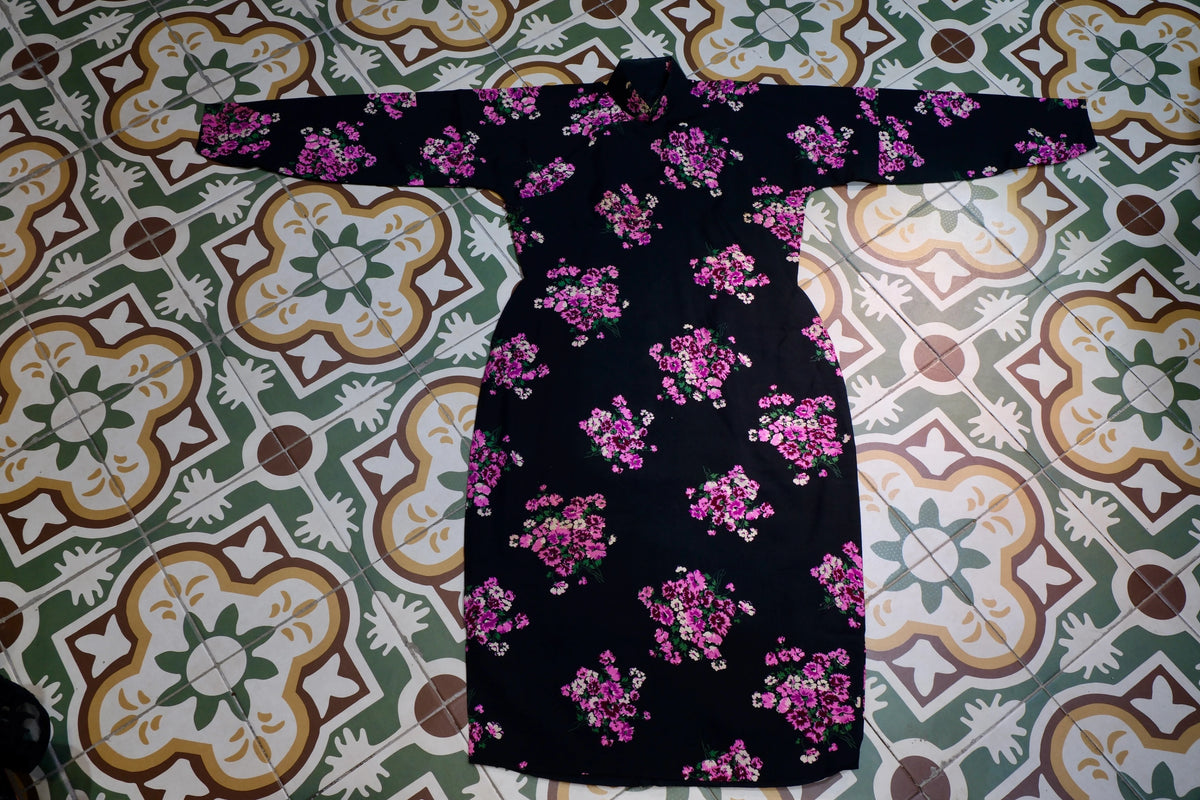
这件旗袍,是典型的民国晚期(1940s)大陆地区“海派”与“本土改良”结合的经典之作。领口采用了极具年代感的“低元宝领”,高度适中,既修饰了东方女性修长的颈项,又保留了端庄的克制。
二、 面料与纹样:暗夜繁花,绝代风华
面料质感:细看其肌理,应为民国时期大陆(如苏州、杭州一带)特制的优质棉绸或人造丝(Rayon)混纺面料。这类面料在当时极其流行,因其悬垂感极佳,光泽内敛,能极好地贴合女性身形。
印花工艺:衣身以深邃的墨黑色为底,寓意沉稳与深邃。其上满布着大朵大朵的紫红与粉色碎花。这种“大印花”风格在四十年代的上海及江南地区风靡一时,它既不像传统苏绣那般清冷,也不似西洋面料那般张扬,而是一种充满了烟火气的、浓烈的浪漫。
色彩美学:黑色压住了阵脚,而粉紫色的花朵如同在暗夜中燃烧的火焰。这暗合了那个时代的审美——“于无声处听惊雷,于黑白间见霓虹”。这是一种颓废美学与顽强生命力的完美结合。
三、 文学意象:张爱玲笔下的“传奇”
看着这件旗袍,脑海中总会浮现出张爱玲在《更衣记》里的描写:“……那是一种参差的对照,一种苍凉的美学。”
它像极了《倾城之恋》里的白流苏,穿着这件墨地碎花旗袍,站在阳台上,风吹起她宽大的袖口,她是那个乱世里唯一清醒的舞者。
也像极了《金锁记》里的七巧,在无数个寂寞的午后,指尖抚过旗袍上繁复的花朵,那些花朵是她被压抑的、无法言说的青春。
四、 收藏价值:一件可触摸的民国史
这件旗袍,历经八十余载风雨,不仅是一件衣物,更是一份珍贵的文物档案。
历史切片:它记录了抗战胜利后,民国社会从动荡走向短暂繁华、人们渴望回归生活本真的那段特殊时期。
工艺绝响:那个年代的“大陆产”意味着纯正的江南裁缝手艺。没有机器的冰冷,每一寸剪裁、每一道缝合,都带着手工时代的温度。
如果你拥有一件这样的旗袍,你拥有的不仅仅是一件衣服,而是那个时代的风月,是“旧上海”的最后一声叹息。
穿上它,哪怕只是静静地站在镜前,你也能与八十年前的那些优雅女性,进行一场跨越时空的灵魂对话。
墨底生花,衣香鬓影。
这不是一件旧衣,这是被封存的、永恒的东方韵味。
This Qipao represents a classic synthesis of late-Republican-era (1940s) mainland "Shanghainese style" (Haipai) and indigenous modern reform. The neckline adopts an unmistakably period-specific low "ingot collar" (Yuanbao Collar) of moderate height, simultaneously flattering the slender neck of an Eastern woman while preserving a poised, dignified restraint.
Fabric Texture: A close examination of its grain indicates a premier cotton-silk or rayon (Rayon) blend specially woven on the mainland (such as in the Suzhou and Hangzhou regions) during the Republican era. Such textiles enjoyed immense popularity at the time; prized for their fluid drape and understated sheen, they contour gracefully to the female form.
Printing Craft: Set against a profound, ink-black ground symbolizing composure and depth, the body is blanketed with generous clusters of purplish-red and pink floral prints. This bold floral style swept through 1940s Shanghai and the Jiangnan region—possessing neither the cool detachment of traditional Suzhou embroidery nor the overt flamboyance of Western fabrics, offering instead an earthy, deeply passionate romance.
Chromatic Aesthetics: The black ground anchors the visual composition, while the purplish-pink blossoms flicker like flames burning in the dark night. This echoes the era's signature sensibility: "hearing thunder in places of silence; glimpsing neon amidst black and white"—a seamless union of decadent aesthetics and tenacious vitality.
Gazing upon this Qipao inevitably calls to mind Eileen Chang’s reflections in A Chronicle of Changing Clothes (Gengyi Ji): "...It is an uneven contrast, an aesthetic of desolation."
It closely mirrors Bai Liusu from Love in a Fallen City (Qingcheng Zhi Lian)—standing upon a balcony clad in this ink-black floral Qipao as the breeze catches her wide cuffs, the sole lucid dancer amidst a turbulent world. Equally, it evokes Cao Qiqiao from The Golden Cangue (Jinsuo Ji)—tracing her fingertips across the intricate blossoms over countless solitary afternoons, those flowers embodying her suppressed, unspoken youth.
Having weathered over eighty years of wind and rain, this Qipao transcends mere apparel to stand as a precious cultural archive.
A Slice of History: It chronicles that singular post-war moment following victory in the War of Resistance, as Republican society transitioned from turmoil into a fleeting prosperity and people yearned to return to the authentic essence of daily life.
An Echo of Master Craft: "Mainland-made" from that decade signifies unadulterated Jiangnan tailoring mastery. Free from the coldness of industrial machinery, every inch of cut and every seam carries the living warmth of a handmade era.
To possess such a Qipao is to hold far more than a garment—it is to hold the romance of an epoch, the final sigh of "Old Shanghai." Slipping into it, even while standing silently before a mirror, invites a soulful dialogue across time and space with the graceful women of eighty years ago.
Blossoms rising from an ink-black ground; fragrant robes and shadowed tresses. This is no mere vintage garment—it is sealed, eternal Eastern charm.