深圳溯源
Couldn't load pickup availability
衣服尺寸:
胸围/腰围/臀围:88/72/92 厘米
衣长:93 厘米
细节描述:
一、 此时无声胜有声——关于“无”的艺术哲学
这袭旗袍,第一眼给人的震撼,在于它的“决绝”。
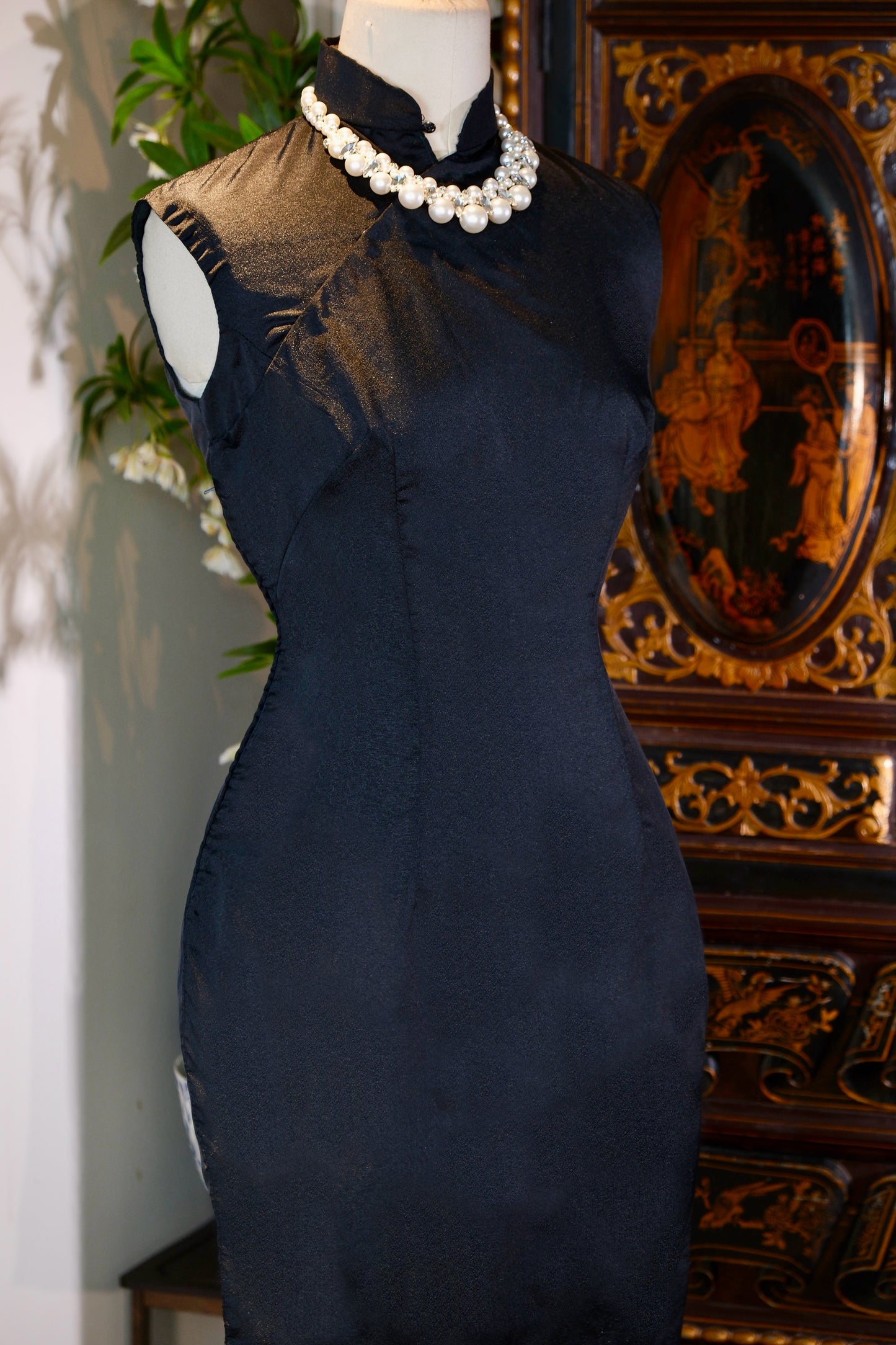
它摒弃了传统旗袍标志性的滚边,摒弃了象征中式结扣的盘扣,面料上也并无繁复的提花。这种“三无”设计,在讲究“衣必锦绣”的旧时代是难以想象的,但在上世纪六十年代的台湾,这恰恰是最高级的时尚宣言。
- 无滚边:传统的滚边是为了掩盖拼接的瑕疵或增加挺括感,而这件旗袍的领口与袖口采用的是“净边”或“暗做”工艺。这是一种极度考究的剪裁手法,要求面料不能有一丝脱线,边缘处理如刀裁般利落。这种“裸边”的视觉效果,让黑色的轮廓更加锋利,如同一道划破夜色的闪电。
- 无盘扣:仔细看领口右侧,它采用了隐形的拉链或暗钩设计。这是六十年代西风东渐的产物,当时的台湾上流社会女性,开始追求更便捷的穿着方式和更流畅的身体线条。去掉了盘扣的凸起,胸前的线条一气呵成,如同宋瓷中的“汝窑”,以釉色取胜,而不以纹饰争艳。
- 无提花:面料呈现的是一种纯色的哑光质感,极有可能是当时台湾纺织业引以为傲的高支数棉混纺或人造丝(Rayon)。这种面料垂坠感极佳,吸光而不反光,这种“黑”,是深邃的、纯粹的,正如《道德经》所言:“知其白,守其黑,为天下式。”
二、 剪影的雕塑感——六十年代台湾的摩登觉醒
这件旗袍的版型,是它真正的灵魂所在。
它不再强调民国早期那种“倒大袖”的圆润,也不追求清末的宽大,而是完全拥抱了立体剪裁。
- 工字褶与无袖设计:肩部的无袖剪裁(削肩)极其大胆,完美展露了女性的肩颈线条。这种设计在六十年代的台北,是名媛们在鸡尾酒会上的战袍。
- 腰线的建筑感:请注意照片中腰部的接缝,它运用了西式的“公主线”剪裁逻辑,将多片布料拼接,强行“塑造”出腰身的曲线。这不再是裹在身上的布,而是穿在身上的雕塑。
三、 稀缺性:那个“过渡时代”的孤本
为什么这件看似简单的旗袍极具收藏价值?
因为它处于一个不可复制的历史夹缝中。
- 历史的孤证:六十年代的台湾,正处于从传统农业社会向出口导向型工业社会转型的阵痛与辉煌期。这件旗袍,既保留了中国服装的“立领”和“旗袍”形制,又彻底西化了结构与闭合方式。它是那个时代台湾女性渴望现代化、国际化的心理投射。
- 工艺的绝响:这种极简风格,对裁缝的要求其实比做花哨的旗袍更高。因为没有花纹和滚边来转移视线,任何一道车线的歪斜、任何一处弧度的生硬,都会在纯黑色的映衬下无所遁形。这是一件容错率为零的衣服,代表了当时台湾裁缝业“海派精工”的最高水准。
结语:
这不仅仅是一件衣服,这是一段被折叠的时光。
它属于那个奥黛丽·赫本穿着小黑裙风靡全球的时代,也属于那个台北街头开始响起爵士乐的年代。它沉默、冷峻、优雅,像一位看透世事的民国才女,在六十年的光阴流转后,依然保持着那份“不争而善胜”的傲骨。
Measurements / Size Guide:
Bust / Waist / Hips: 88/72/92 cm
Total Length: 93 cm
Detailed Description:
[I. Art Within the Absence of Motif: The Philosophy of Void] The structural shock of encountering this Qipao for the first time resides in its absolute, uncompromising "finality."
It courageously discards the iconic piping (Gunbian) ubiquitous to traditional robes, systematically eliminates the ancestral knotted frogs (Pankou), and features a textile completely free of superficial jacquard or print. This "Tri-Absence" matrix, entirely unthinkable during previous dynasties that heavily demanded "apparel must be heavily brocaded," stood during 1960s Taiwan as the supreme vanguard fashion manifesto.
The Absence of Piping: Historical piping functioned to conceal structural seaming imperfections or reinforce crispness; conversely, the collar and armholes of this masterpiece implement an elite Jingbian (clean-edge) or Anzuo (concealed interior stitching) methodology. This technique demands absolute structural perfection, as the fabric must be engineered against even a microscopic millimeter of fraying, yielding margins as razor-sharp as a blade's shearing. This "naked boundary" effect sharpens the black silhouette into a severe line—resembling a crack of lightning splitting a quiet midnight sky.
The Absence of Knotted Frogs: An interrogation of the right asymmetrical closure reveals a brilliant shift to completely hidden hooks or an invisible micro-zipper. This engineering stands as a pure material witness to the mid-century westernization of Taiwan’s elite social echelons, where matriarchs demanded accelerated utility married to fluid, continuous bodily lines. By eradicating the physical protrusion of traditional frogs, the architecture across the chest executes an unbroken, singular movement—mimicking the pristine, minimalist monochrome glaze of Song Dynasty Ru Ware (Ru Yao), which triumphed entirely through raw substance rather than loud surface ornamentation.
The Absence of Jacquard: The textile acts as a pure, light-absorbing matte medium, utilizing an exceptional high-count cotton blend or industrial rayon engineered during the post-war apex of Taiwan’s textile expansion. This medium possesses an unparalleled structural drop and weight, stubbornly capturing light rather than reflecting it. This tier of "absolute black" operates as a profound philosophical text, embodying the Taoist dictum from Tao Te Ching: "Knowing the pristine white, yet fiercely guarding the deep black, one transforms into the supreme mold for the entire world."
[II. The Architecture of a Silhouette: The Modernist Awakening of 1960s Taiwan] The definitive soul of this antique monument resides fundamentally within its pattern-making.
It completely abandons the loose, circular drapes of early Republican styles or the concealing volumes of late Qing dress, fully weaponizing Western three-dimensional, body-conscious tailoring.
The Slashed-Shoulder Cut: The aggressive, sleeveless armhole configuration (slashed-shoulder) is exceptionally daring, completely liberating the cervical and shoulder architecture of the female form. In 1960s Taipei, this precise layout operated as the definitive haute couture uniform for international diplomatic cocktail galas.
The Architectural Waistline: Note the precise placement of the torso seaming; it integrates the western "Princess Line" cutting logic, interlocking multiple contoured panels to forcefully sculpt a hyper-articulated waist curve. This is no longer cloth merely draped across a living body; it is a magnificent modernist sculpture made wearable.
[III. Archival Asset Value: The Non-Reproducible Specimen of a Transitional Epoch] Why does an antique Qipao possessing such stark simplicity command supreme curatorial and collector value?
Because it was birthed within an unrepeatable, high-stakes historical fissure.
Material Fossil of Transformation: 1960s Taiwan was traversing the intense, brilliant matrix of converting from a traditional agrarian economy into an export-oriented industrial powerhouse. This garment rigorously preserves the core Eastern markers—the mandarin collar and the baseline Qipao blueprint—while completely westernizing its interior closure and fastening mechanics. It stands as a flawless psychological projection of mid-century women yearning for international modernization.
The Swan Song of Craft: A minimalist linguistic of this tier places far higher demands upon a master couturier than any heavily embellished robe. Because the gaze is completely stripped of decorative diversions like floral patterns or heavy border ribbons, any microscopic deviation of a needle-path or any rigid tension in a seam becomes instantly exposed against the deep matte black canvas. This is a garment with an absolute zero margin for error, representing the absolute apex of the "Shanghainese Precision Mastery" (Haipai Jinggong) preserved by migrated tailors in post-war Taiwan.
Epilogue: A Locked Micro-History of Grace Ultimately, this transcends the baseline classification of clothing; it represents a folded capsule of time itself.
It belongs fiercely to that international epoch where Audrey Hepburn’s Little Black Dress shook the foundations of global style, while concurrently mirroring a Taipei streetscape newly vibrant with the syncopated rhythm of jazz salons. It remains silent, cold, sharp, and intensely elegant—resembling a legendary twentieth-century literary matriarch who, after sixty years of shifting tides, stubbornly guards her unyielding pride: "triumphing precisely through non-contention."