深圳溯源
Couldn't load pickup availability
衣服尺寸:
胸围/腰围/臀围/衣长:104/100/116/115 厘米
细节描述:
【形制与断代:西风东渐下的东方风骨】
此件旗袍断代为二十世纪六十年代的台湾制品。彼时,随着历史变迁,大量江浙沪裁缝名匠迁台,将海派旗袍的精髓与台湾本土的审美及南洋风情相融合,造就了这一时期旗袍独特的“立体剪裁”风格。
观察其形制,不同于早期平裁的宽松,这件旗袍采用了极为考究的西式省道(Darts)工艺,胸腰差处理得淋漓尽致,完美贴合女性S型曲线,展现了六十年代追求现代、干练的女性形象。其袖型为经典的“倒大袖”改良版,既保留了传统连肩袖的圆润,又通过收口设计显得利落大方,是那个时代“中西合璧”美学的最佳注脚。
【纹样与面料:低调奢华的暗语】
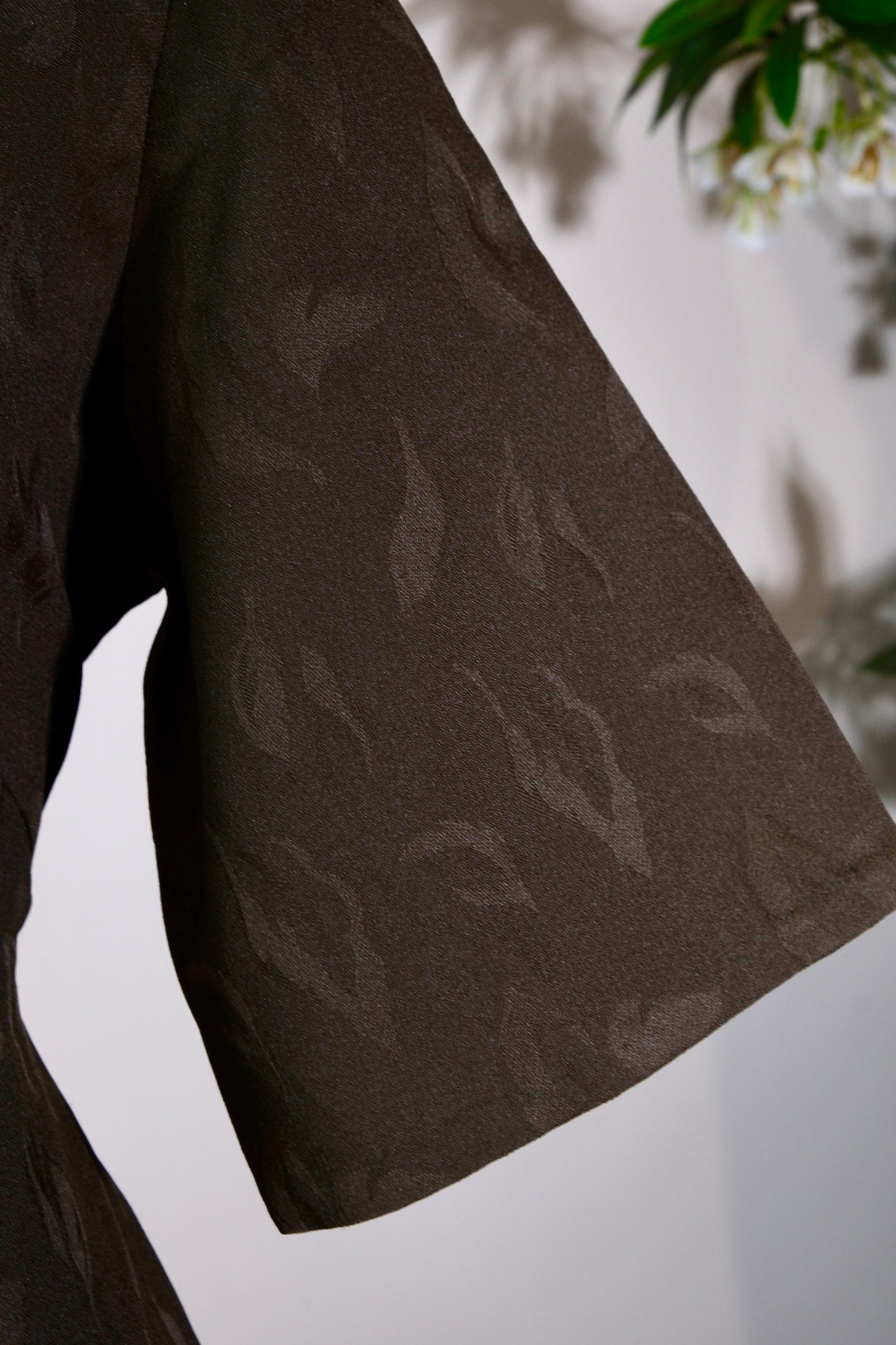
面料是这件古董衣的灵魂所在。它选用了一种极具质感的深橄榄绿(或称苔藓绿)提花织锦缎。这种颜色在色谱中属于“间色”,古雅沉稳,极具文人气质。
细观其暗纹图案,并非具象的花鸟,而是抽象化的“兰叶描”与“竹叶”变体。
- 图案描述: 纹样以同色系但光泽度不同的丝线织就,呈现出若隐若现的视觉效果。叶片修长舒展,笔触如同中国水墨画中的“撇捺”,疏密有致地散落在衣身。这种纹样设计深受宋代瓷器影青刻花的影响,讲究“由于无画处皆成妙境”。
- 文化寓意: 在中国传统文化语境中,“兰”象征幽独君子,“竹”象征虚心劲节。苏东坡曾云:“宁可食无肉,不可居无竹。”这种纹样不仅是为了装饰,更是穿着者内心高洁志趣的外化。在光线的流转下,这些暗纹如同风吹过的竹林,波光粼粼,动静之间尽显高级感。
【工艺与稀缺:不可复制的时光孤品】
从服装史的宏观角度来看,六十年代的台湾旗袍处于一个特殊的“黄金过渡期”。
1. 手工的温度: 注意看领口的立领高度与扞边工艺,那是老式缝纫机与手工熨烫配合的产物。现在的工业化流水线无法复刻那种挺括而温润的领型。
2. 存世量的稀缺: 那个年代的织物多为天然真丝或人造丝混纺,极难保存。历经六十载岁月,能保持色泽如新、无明显脆化断裂的实物已是凤毛麟角。这件衣服的品相完好,暗纹依然清晰立体,实属博物馆级的收藏佳品。
【结语:穿在身上的文学】
张爱玲曾说:“衣服是一种言语,随身带着一种袖珍戏剧。”这件旗袍,就是一出关于优雅与坚守的默剧。它不似大红大紫般喧哗,却以一种“润物细无声”的姿态,诉说着那个年代名媛闺秀的从容与雅致。
拥有一件这样的古董衣,不仅是拥有了一件服饰,更是收藏了一段凝固的历史,一份对东方美学极致追求的见证。
Measurements / Size Guide:
Bust / Waist / Hips / Total Length: 104/100/116/115 cm
Detailed Description:
This specific piece is dated to Taiwan during the 1960s. At that time, following historical shifts, a large number of master tailors from the Jiangsu, Zhejiang, and Shanghai regions migrated to Taiwan. They fused the core essence of the Shanghai style (Haipai) qipao with local Taiwanese aesthetics and South Seas flavors, giving birth to the unique "three-dimensional tailoring" style characteristic of this period.
Observing its construction, it completely diverges from the looseness of early flat pattern cutting. This qipao adopts highly meticulous Western darting (darts) technology, which executes the differential between the bust and waist to its absolute limit. It perfectly contours the S-shaped curve of the female form, reflecting the modern, efficient image of women pursued during the 1960s. Its sleeve profile is a modified version of the classic inverted wide sleeve (daodaxiu); it firmly retains the rounded grace of traditional extended cap sleeves while appearing clean and elegant through a tapered cuff design, serving as the ultimate annotation to the "East meets West" aesthetic of that era.
The fabric is the absolute soul of this antique garment. It utilizes a highly textured, deep olive green (or moss green) jacquard brocade. Within the color spectrum, this hue belongs to the "intermediate colors" (jianse), which is ancient, elegant, composed, and heavily imbued with a literati temperament.
Examining its structural details closely, the damask patterns are by no means representational flora or fauna, but rather abstract variations of "orchid leaf brushstrokes" (lanyemiao) and "bamboo leaves."
Pattern Description: The motifs are woven using silk threads of the same color family but varying degrees of luster, presenting a faint, shimmering, now-you-see-it-now-you-don't visual effect. The slender leaves stretch out smoothly, with line movements resembling the diagonal sweeping brushstrokes (pie and na) of Chinese ink painting, scattered across the body of the garment with rhythmic density. This motif design is deeply influenced by the incised decorations of Song Dynasty Yingqing celadon porcelain, emphasizing the philosophy that "even the unpainted spaces form a wondrous realm."
Cultural Metaphors: Within the context of traditional Chinese culture, the "orchid" symbolizes a solitary, noble person of virtue (junzi), while the "bamboo" symbolizes open-mindedness and unyielding integrity. As Su Dongpo once noted: "Better to eat a meal without meat than to live in a place without bamboo." This layout is not deployed for mere decoration, but acts as the externalization of the wearer’s inner noble character and aspirations. Under the shifting play of light, these damask motifs move like a bamboo forest rustling in the wind, shimmering with ripples, fully manifesting a premium quality between motion and stillness.
Looked at from the macro-perspective of dress history, 1960s Taiwanese qipaos sat within a highly specific "golden transitional phase."
The Warmth of Manual Execution: Observe the standing height of the Mandarin collar and the hand-rolled hemming craft along the edges; these are the precise products of old-fashioned sewing machines operating in tandem with manual iron-pressing. Modern, industrialized production lines cannot replicate that crisp yet gentle collar shape.
Scarcity of Absolute Numbers: The textiles of that era were predominantly composed of natural real silk or rayon blends, which are exceptionally difficult to preserve. Having journeyed across sixty years of time, actual physical specimens that maintain original saturated coloration and remain completely free from obvious brittleness or fiber breakage are truly one in a million. The preservation quality of this garment is pristine, with the damask patterns remaining perfectly clear and three-dimensional, making it a stellar collector's item of museum grade.
Eileen Chang once observed: "Clothes are a language, a pocket theater carried upon the body." This qipao is precisely a silent drama concerning elegance and perseverance. It does not clamor for attention like loud reds or vibrant purples; instead, it adopts a posture of "moistening things silently," chronicling the composure and refinement of high-society ladies and gentlewomen from that bygone era.
Owning such an antique garment is not merely possessing a piece of apparel; it is collecting a frozen segment of history, standing as a physical witness to the ultimate pursuit of Eastern aesthetics.