深圳溯源
Couldn't load pickup availability
衣服尺寸:
胸围/腰围/臀围/衣长:94/80/100/104 厘米
细节描述:
“锦衣旗袍诗,曼玉花样时。”
在时尚的轮回中,唯有经典能穿越半个世纪的风霜,依旧熠熠生辉。这件诞生于上世纪六十年代的香港制古董旗袍,以其独特的剪裁与雅致的纹样,无声地诉说着那个黄金时代的摩登与风雅。
🍃 图案解析:飞花碎玉,写意东方
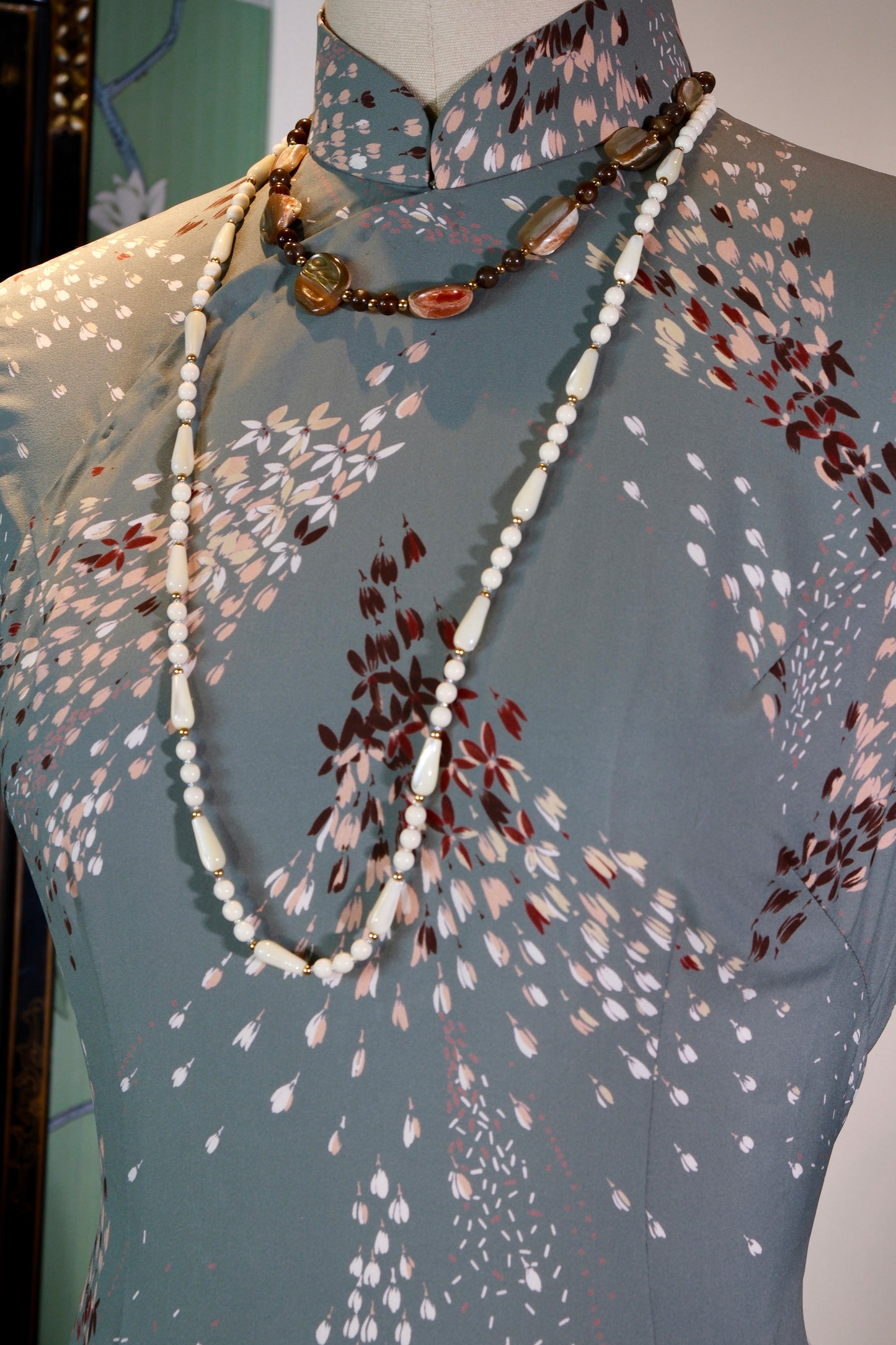
这件旗袍最引人入胜之处,在于其面料上那如梦似幻的印花图案。
不同于传统旗袍常见的大朵牡丹或具象龙凤,这件衣裳采用的是极具现代感的抽象植物纹样。底色选用了极为高级的灰蓝色(Dusty Blue),这种低饱和度的色调自带一种清冷而温婉的书卷气,宛如雨后初霁的天空,又似淡雅的青瓷。
其上的纹饰,似是被风吹散的柳絮,又像是初冬飘落的梅花瓣,采用白色与赭石色(红褐色)的点染技法,呈现出一种“疏影横斜水清浅”的意境。白色的点状笔触轻盈灵动,如同飞舞的精灵;而深褐色的枝叶则苍劲有力,起到了视觉平衡的作用。这种图案设计深受当时西方抽象表现主义艺术的影响,同时又保留了中国水墨画的留白神韵,是中西文化在六十年代香港完美交融的见证。
🧵 工艺与形制:海派余韵,港式改良
从形制上看,这件旗袍体现了六十年代香港旗袍的典型特征——极致的修身与实用主义的结合。
- 立领: 依然保留了传统的元宝领或高立领设计,紧扣颈部线条,彰显东方女性的含蓄与端庄。
- 无袖剪裁: 这是一个大胆而摩登的设计。相比四十年代的宽袖或五十年代的短袖,无袖设计更加突显肩部线条的优美,适应了香港亚热带的气候,也迎合了当时女性追求解放、展现身体曲线的审美潮流。
📜 历史回响:张爱玲笔下的“各各不同”
张爱玲曾在《更衣记》中写道:“回忆这东西若是有气味的话,那就是樟脑的香,甜而稳妥,像记得分明的快乐,甜而怅惘,像忘却了的忧愁。”
这件古董衣,便带着这样一种樟脑箱底开启时的迷人香气。它曾属于哪位名媛?或许她曾穿着它漫步在中环的石板路上,听着电车叮当的声响;或许她曾穿着它出席一场盛大的晚宴,在光影交错间留下一抹惊鸿。
六十年代的香港,正处于经济腾飞与文化爆发的前夜。那时的旗袍,不再仅仅是满清遗老的服饰,而是成为了职业女性、电影明星乃至普通主妇的日常着装。它是那个时代女性独立意识觉醒的符号——既有传统的骨架,又有现代的灵魂。
💎 稀缺性与收藏价值
历经六十载光阴,丝绸或棉麻质地极易脆化褪色,但这件旗袍保存状况极佳,色泽依然温润,版型挺括,实属罕见。
它不仅仅是一件衣服,更是一件可穿戴的艺术品。在当今的高级定制领域,这种老式印花布料早已绝版,那种经过时间沉淀下来的哑光质感,是现代化学纤维无法复制的。
“衣裳是文化的表征,衣裳是思想的形象。” 拥有这件六十年代的香港古董旗袍,便是拥有了一段关于美、关于时光、关于东方韵味永不褪色的记忆。
Measurements / Size Guide:
Bust / Waist / Hips / Total Length: 94/80/100/104 cm
Detailed Description:
"A poem rendered in the silk of a qipao; Maggie Cheung navigating the moods of a changing era." Within the cyclical velocity of global fashion, only true classics cross the threshold of half a century's weathering while retaining their pristine visual resonance. This custom antique qipao, manufactured in Hong Kong during the 1960s, deploys a highly individual structural silhouette and an elegant iconographic scheme to silently articulate the modernism and cosmopolitan refinement of a golden age.
The most compelling dimension of this curatorial specimen resides in the dreamlike, impressionistic printed layout of its textile epidermis. Distancing itself entirely from the literal, representational auspicious motifs—such as sprawling peonies or imperial dragons and phoenixes—ubiquitous in traditional Chinese dress, this garment champions an abstract botanical taxonomy heavily charged with modernist sensibilities.
The Ground Chromatic Value: The baseline matrix utilizes a sophisticated dusty blue. This low-saturation, low-chroma value projects a cool, intellectual composure reminiscent of skies cleared after monsoon rains or the muted, unctuous glazes of fine underglaze-blue celadon wares.
The Kinetics of Ornamentation: The surface motifs evoke images of willow catkins scattered by crosswinds or plum blossom petals descending in early winter. Executed through localized stippling and painterly gestural brushwork in pure white and deep iron-oxide ochre (reddish-brown), the composition manifests the classic Chinese spatial layout rule of "sparse shadows slanting across shallow water." The white stippled accents float weightlessly across the plane like kinetic points of light, while the deep ochre structural stems provide a robust, stabilizing graphic anchor. This compositional methodology interfaces directly with mid-century Western Abstract Expressionism while safeguarding the profound calligraphic principles of negative space (Liubai) native to traditional Chinese ink painting—a pristine material witness to the cross-cultural synthesis defining 1960s Hong Kong.
From a morphological perspective, this specimen exhibits the definitive diagnostic hallmarks of the 1960s Hong Kong qipao—an absolute synthesis of radical body-contouring and urban pragmatism, marking the structural zenith of the craft.
The Mandarin Collar Architecture: The neckline strictly maintains the traditional high standing Mandarin collar layout, closing flush against the throat to structuralize a disciplined, cloistered modesty that anchors the anatomical verticality of the upper body.
The Sleeveless Silhouette: This drafting modification represents a radical, highly modern departure from prior eras. Compared to the wide, flat-plane sleeve systems of the 1940s or the truncated cap sleeves of the 1950s, this sleeveless cut completely unburdens the scapular and deltoid regions, emphasizing the natural curve of the shoulder line. This structural adjustment directly accommodated the sub-tropical maritime climate of Hong Kong while satisfying the decade's evolving aesthetic mandate for female physical emancipation and the confident articulation of the biological silhouette.
In her seminal 1943 sartorial treatise Chronicle of Changing Clothes, Eileen Chang mused: "If memory possessed an olfactory signature, it would be the fragrance of camphorwood chests—sweet and reassuring like a cleanly remembered joy; sweet and melancholic like a forgotten sorrow."
This antique specimen carries precisely that evocative aura of a newly opened camphor chest. To which historic individual did this garment originally belong? Perhaps she wore this textile while navigating the granite pavings of Central, accompanied by the rhythmic, percussive chimes of the double-decker trams; perhaps she donned it for a formal salon gathering, leaving an indelible kinetic trace amidst the shifting light and shadow of mid-century high society. During the 1960s, Hong Kong stood at the absolute threshold of socioeconomic industrialization and cultural explosion. The qipao ceased to function as a conservative vestige of dynastic history; instead, it became the ubiquitous daily uniform of corporate professionals, cinematic icons, and modern matriarchs alike. It operated as the definitive material repository of emerging female autonomy—preserving a traditional structural framework while housing a thoroughly modern soul.
Having completed a sixty-year historical trajectory, natural protein fibers (such as mulberry silk) or cellulosic matrices (such as premium cotton and linen) are acutely susceptible to localized embrittlement, structural fatigue, and photochemical fading. That this specimen has retained its pristine structural integrity, showing zero relaxation of the seams and preserving its original rich chromatic saturation, is extraordinary.
It stands not merely as an article of dress, but as an irreplaceable piece of wearable art. Within contemporary haute couture, these mid-century small-batch textile prints have entered total obsolescence; the specific sub-lustrous, unctuous matte patination acquired through decades of natural aging represents a material state that contemporary synthetic polymers are chemically incapable of duplicating. As the historical maxim dictates: "Garments serve as the ultimate material index of culture; dress is the physical image of human thought." To command this 1960s Hong Kong antique qipao is to possess a pristine, non-renewable fragment of Eastern aesthetic history caught in the permanent embrace of time.