溯源
Couldn't load pickup availability
当目光触及这件华服,便仿佛一脚踏入了上世纪三十年代那繁华而内敛的时光深处。彼时的香港,正处于中西文化交汇的鼎盛期,其旗袍的制式,既承袭了上海的摩登,又独有一份岭南的婉约与务实。
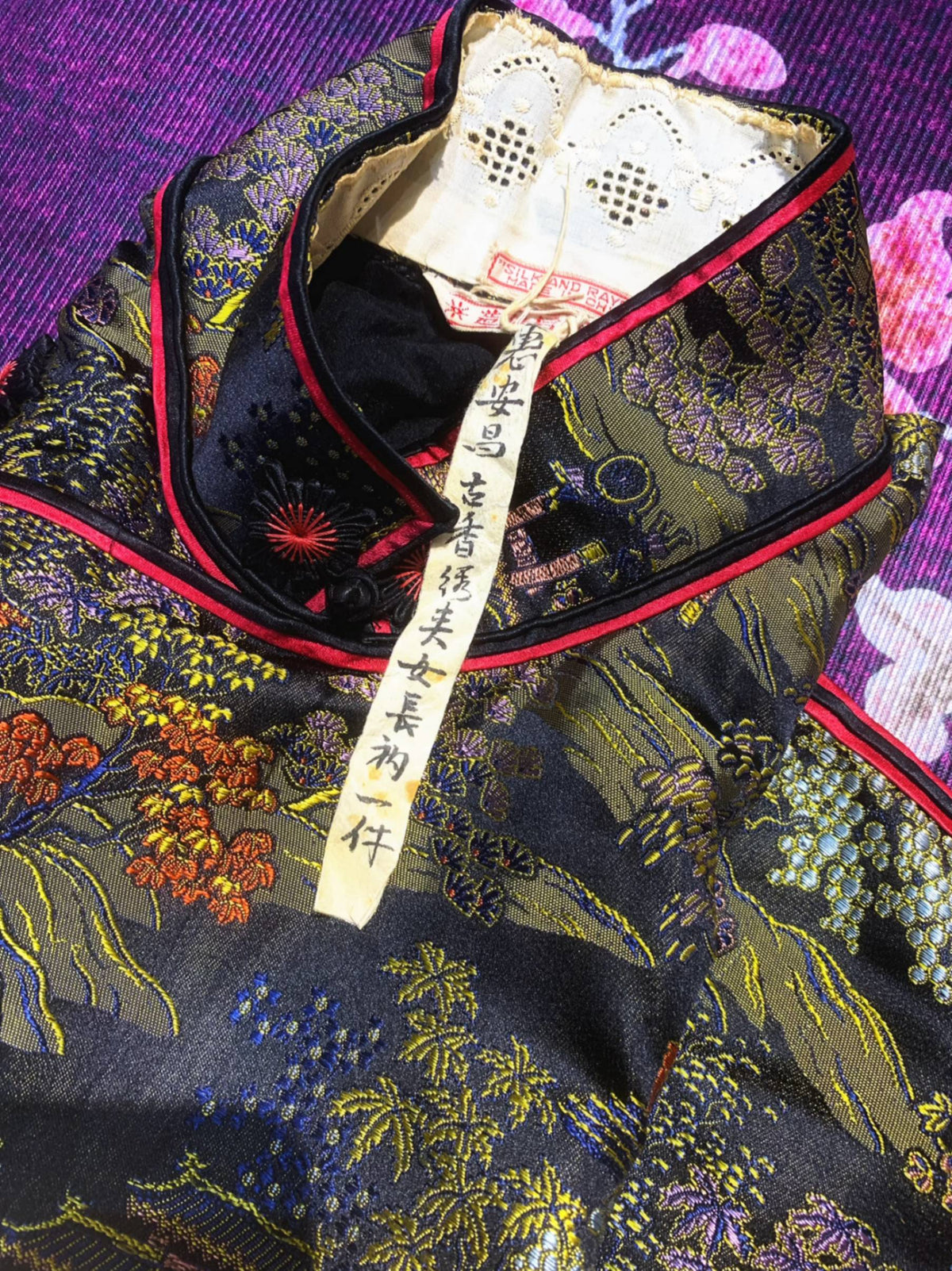
此件旗袍,乃出自当时香港著名的绸缎庄——卢信隆。翻开衣领,那张略显斑驳却依然字迹可辨的旧时标签,与那张手书的竖条纸签,便是它最真实、最动人的身份凭证。纸签上书“惠安昌古香绣夹女长衫一件”,寥寥数字,将其出身、面料、形制交代得一清二楚。这不仅是一件衣裳,更是一件承载着“惠安昌”商号信誉与裁缝铺温度的历史文物。
面料之韵:古香缎上的亭台楼阁
此衫之华,首在面料。选用的是极为珍贵的“古香缎”。古香缎,由织锦缎派生,其纹样多以亭台楼阁、山水花鸟为主,色彩淳朴古雅,故得“古香”之名。细观这件旗袍,深蓝近墨的缎地之上,金线勾勒的层峦叠嶂间,散落着粉墙黛瓦的亭台楼阁,间杂以五色花草,宛如一幅展开的立体山水画卷。其采用“熟织”工艺,将染好色的经纬线交织成花纹,因此图案具有独特的浮雕质感与内敛光泽。不同于织锦缎的浓艳夺目,古香缎的色调更为含蓄,正契合了传统文人审美的雅致趣味。行走之间,衣袂轻摇,缎面光影流动,那些亭台楼阁仿佛也随之活了过来,充满了东方园林的诗意与画境。
形制之美:黄金年代的优雅廓形
从形制上看,这件旗袍堪称民国三十年代“旗袍黄金年代”的典范。
1. 版型与剪裁:它采用了当时的流行廓形,衣身修长,线条流畅。虽未像四十年代后那样极度强调胸腰曲线的西式立体剪裁,但已脱离了早期宽袍大袖的平直,通过巧妙的“归拔”工艺,使衣料自然地贴合身体,勾勒出端庄而优雅的轮廓。长及脚踝的衣摆,被称为“曳地旗袍”,尽显女性的修长与高贵。
2. 绲边与花扣:细节之处,最见匠心。衣襟、领口及袖口,皆以黑、红两色布条进行绲边。外黑内红的撞色搭配,既压住了古香缎的华美,又于沉稳中透出一抹鲜亮,是当时粤港地区颇受欢迎的精致点缀。而衣襟之上的盘扣,更是点睛之笔。细看之下,这些花扣形制精巧,呈菊花绽放之态,线条细腻,结扣坚实。菊花,素有“花中君子”之称,象征高洁与隐逸,以此作为盘扣,无疑赋予了这件华服更深一层的精神内涵。
岁月留痕:针线间的情感寄托
翻开衣领,内里那层素白的棉蕾丝衬里上,精致的镂空花边依然依稀可见。在民国时期,旗袍的内衬亦是品质的象征。这种花边衬里,不仅是为了增加舒适度,更体现了穿着者对细节的讲究与对生活品质的追求。这张略显陈旧的标签,连同那层温柔的内里,共同诉说着一个旧日名媛的私密故事,它曾贴肤而穿,陪伴主人度过无数个重要的场合与寻常的日子。
结语
总而言之,这件民国三十年代的香港卢信隆古香缎长衫,集顶级的丝绸面料、经典的黄金时代廓形与精湛的传统工艺于一身。它不仅是一件衣裳,更是一段凝固的香江旧梦,是一首用丝线与金线写就的东方美学诗篇。它将亭台楼阁织入衣间,将君子品格缝进扣中,历经近百年风雨,依然散发着令人心折的沉静之美。它值得我们以最审慎的态度去珍藏,以最深厚的感情去品读。
The moment one’s gaze meets this sumptuous garment, it feels as though one has stepped directly into the depths of a prosperous yet understated bygone era—the 1930s. At that time, Hong Kong stood at the zenith of East-West cultural convergence; its Qipao tailoring inherited the sleek modernity of Shanghai while retaining a distinctly Lingnan gentleness and pragmatism.
This Qipao originated from Lo Shun Lung (Lo Shun Lung), a renowned silk and satin emporium in period Hong Kong. Turning back the collar reveals its most authentic and moving proof of provenance: a slightly mottled yet clearly legible vintage woven label alongside a vertical handwritten paper tag. Inscribed with the characters "One lined women’s long gown in Hui'anchang Guxiang brocade satin" (Hui'anchang Guxiang Xiu Jia Nü Changshan Yi Jian), these few crisp words chronicle its origin, textile, and construction with crystalline clarity. Far more than mere apparel, it is a historical artifact carrying the commercial reputation of the Hui'anchang house and the living warmth of a master tailor's workshop.
The splendor of this robe begins with its fabric—the exceedingly precious Guxiang Satin (Guxiang Duan, literally "Ancient-Fragrance Satin"). Derived from traditional brocade (Zhijin Duan), Guxiang satin features motifs predominantly depicting pavilions, terraces, landscapes, flowers, and birds rendered in pure, antique-toned hues—hence its evocative name.
Examine the textile closely: against a deep ink-blue satin ground, layered mountain ridges outlined in gold thread frame scattered white-walled, dark-tiled pavilions and terraces, interspersed with polychrome flora—unfolding like a three-dimensional landscape scroll. Woven using the "cooked-silk" (Shuzhi) technique, where pre-dyed warp and weft threads are interlaced directly into complex patterns, the design possesses a distinct bas-relief texture and an introverted luster. Unlike the bold, dazzling brilliance of conventional brocade, the palette of Guxiang satin remains restrained, harmonizing seamlessly with the refined sensibilities of traditional literati aesthetics. In motion, as the hem sways gently and light ripples across the satin, those architectural pavilions seem to come alive, brimming with the poetic imagery of a classical Eastern garden.
Structurally, this Qipao stands as an exemplary archetype of the 1930s "Golden Age of the Qipao":
Pattern & Tailoring: Adopting the favored silhouette of the decade, the robe features an elongated, fluid line. While stopping short of the hyper-sculpted, Westernized bust-and-waist tailoring that emerged after the 1940s, it had already cast off the flat, boxy cut of earlier wide-sleeved robes. Through skillful iron-shaping (Guiba), the fabric drapes naturally against the body, tracing a dignified and graceful contour. Reaching down to the ankles, this floor-grazing cut—known as the "sweeping-hem Qipao" (Yedi Qipao)—accentuates feminine stature and aristocratic poise.
Piping & Floral Frog Buttons (Pankou): True artisanal mastery reveals itself in the fine details. Along the overlapping placket, collar, and cuffs runs dual-tone piping in black and red cloth. This contrasting pairing—black on the exterior, red on the interior—simultaneously tempers the opulence of the Guxiang satin and introduces a vibrant spark within its composed palette, a refined embellishment particularly favored across the Guangdong-Hong Kong region. Serving as the crowning focal point along the placket are the frog buttons: sculpted with exquisite delicacy into blooming chrysanthemums with crisp contours and firm knotting. Long revered as the "gentleman among flowers" symbolizing nobility and secluded integrity, the chrysanthemum motif imbues this magnificent garment with profound spiritual resonance.
Turning back the collar exposes an interior lined in plain white cotton lace, where delicate openwork trim remains faintly visible. During the Republican era, the lining of a Qipao served as a quiet barometer of quality; such lace-trimmed linings not only enhanced wearing comfort, but reflected the wearer’s fastidious attention to detail and pursuit of refined living. Together, the aged woven label and this gentle interior lining whisper the intimate story of a bygone society lady—worn close to the skin, accompanying its owner through countless milestone occasions and quiet, everyday hours.
In sum, this 1930s Hong Kong Lo Shun Lung Guxiang satin Qipao unites premier silk weaving, a classic Golden Age silhouette, and consummate traditional craftsmanship. It transcends mere clothing to become a solidified dream of old Hong Kong—a poem of Eastern aesthetics composed in silk and gold thread. Weaving pavilions and gardens into cloth and stitching noble character into every knot, it has weathered nearly a century of wind and rain while continuing to radiate a captivating, serene beauty—worthy of our most careful preservation and deepest appreciation.