深圳溯源
Couldn't load pickup availability
衣服尺寸:
胸围/腰围/臀围/衣长:90/84/98/105 厘米
细节描述:
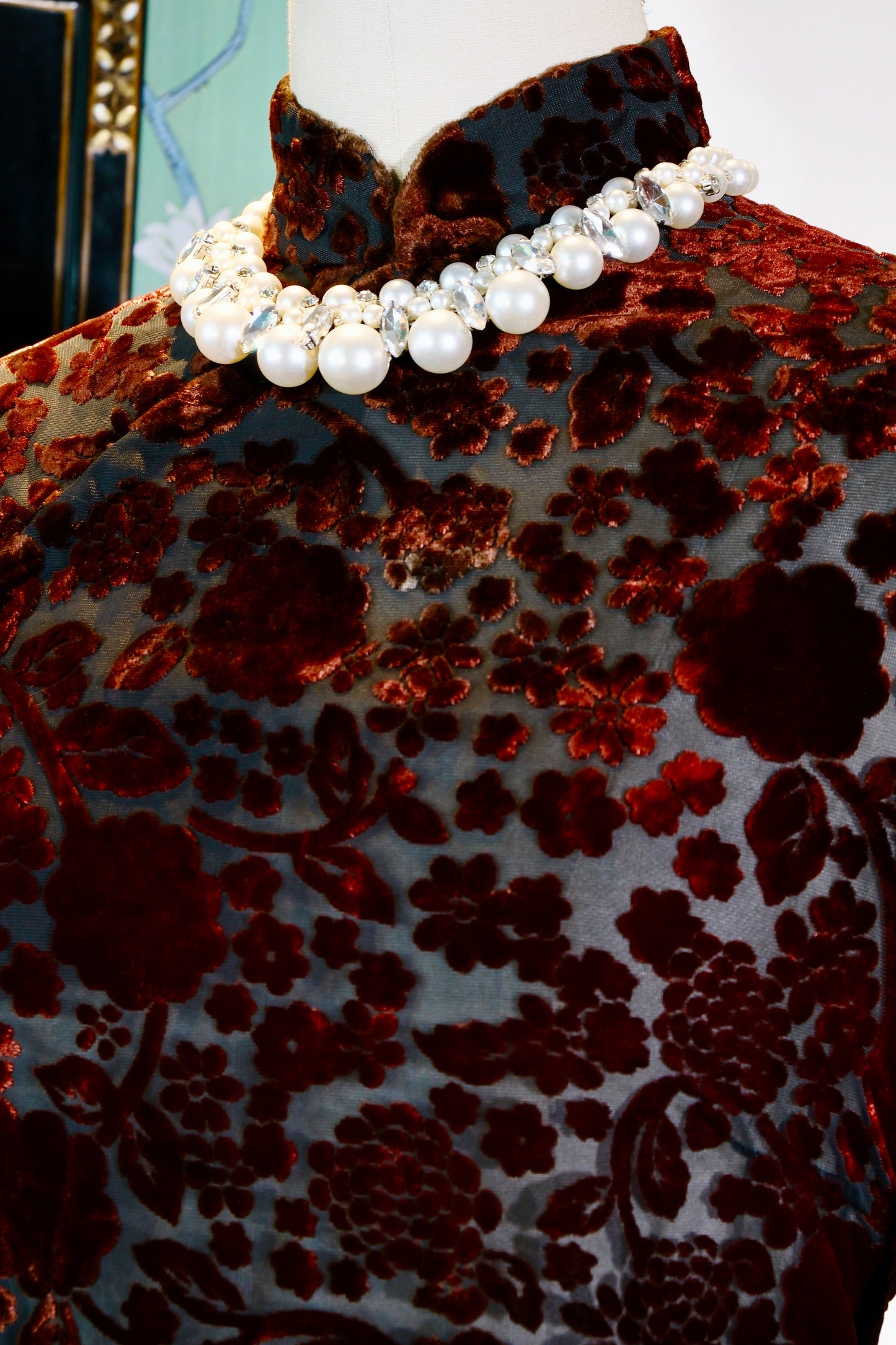
这件上世纪六十年代香港产的古董旗袍,以意大利进口烧花丝绒为面料,其图案与工艺堪称中西合璧的典范,不仅承载着特定时代的审美记忆,更是一件可触可感的纺织艺术珍品。
旗袍上的图案并非简单的印花或刺绣,而是通过“烧花”(Devoré)工艺在丝绒底布上蚀刻出的立体花卉纹样。深酒红色的绒花如浮雕般凸起,与灰蓝色的底布形成强烈对比,视觉上既有丝绒的温润光泽,又透出底布的轻盈通透。花卉形态繁复而不杂乱,大朵牡丹与细碎菊瓣、藤蔓交织缠绕,呈现出一种“满园春色关不住”的盛放姿态。这种图案布局深受中国传统“缠枝莲”“百花图”纹样的影响,但在构图上又融入了六十年代西方流行的“波普艺术”式密集排布,形成一种既古典又现代的视觉张力。
从服装史角度看,这件旗袍是“香港制造”黄金时代的缩影。六十年代的香港,作为东西方贸易与文化交汇的枢纽,汇聚了来自欧洲的顶级面料与本地精湛的裁缝技艺。意大利进口的烧花丝绒在当时属奢侈品,多用于高级定制或出口精品。而“烧花”工艺本身,是通过化学药剂腐蚀掉部分纤维,使图案呈现凹凸质感,技术难度高、成品率低,故存世量极少。此件旗袍能完整保存至今,且无明显破损或褪色,实属罕见。
从文化语境看,这件旗袍亦呼应了张爱玲笔下“衣服是一种言语”的美学观。她曾写道:“对于不会说话的人,衣服是一种语言,随身带着的是袖珍戏剧。”这件旗袍正是这样一出“袖珍戏剧”——它不言不语,却以面料的肌理、图案的密度、剪裁的曲线,诉说着一个时代女性对美、对身份、对自由的追求。它既非完全西化,亦非固守传统,而是在碰撞中孕育出独特的“海派”或“港派”风格,是全球化早期时尚本土化的绝佳案例。
若引经据典,可追溯至《诗经·豳风·七月》中“为公子裳”的织造传统,亦可联系明代《天工开物》对“绒”类织物的记载:“凡绒,用丝织成,有平绒、立绒、烧花绒之别。”而“烧花”工艺虽非中国原生,却在六十年代被香港匠人巧妙吸纳,赋予其东方神韵,正如钱钟书所言:“东海西海,心理攸同;南学北学,道术未裂。”这件旗袍,正是“道术未裂”的物证。
Measurements / Size Guide:
Bust / Waist / Hips / Total Length: 90/84/98/105 cm
Detailed Description:
This 1960s Hong Kong-made antique qipao—crafted from imported Italian devoré (shaohua) velvet—stands as a textbook model of Eastern and Western aesthetic integration. Far beyond a mere historical garment, it serves as a tactile, preserved work of textile art and a physical record of mid-century cosmopolitan identity.
The surface ornamentation of this qipao avoids flat printing or standard embroidery, relying instead on the specialized devoré (burn-out) technique to etch a multi-dimensional floral pattern directly into the velvet substrate.
Tactile & Visual Contrast: Raised burgundy velvet petals rise like sculpted relief work against a soft, atmospheric grey-blue base mesh. This structural dual-layering balances the warm, light-absorbing luster of dense velvet pile with the sheer, breathable transparency of the backing weave.
Motif Layout & Synthesis: Large peony blossoms interweave with micro-chrysanthemum petals and sprawling vines, projecting an aura of boundless spring vitality (manyuan chunse). While the underlying arrangement draws from classical Chinese interlocking lotus (chanzhilian) and "hundred flowers" (baihuatu) traditions, the dense, rhythmic repeat carries clear visual notes of 1960s Western Pop Art—generating a dynamic tension between classical restraint and modern visual density.
Contextualized within apparel history, this garment represents a physical microcosm of Hong Kong’s manufacturing zenith during the 1960s. As a premier Far East trade and tailoring hub, mid-century Hong Kong united European luxury textiles with master-level Cantonese and Shanghainese dressmaking techniques.
Textile Procurement: Italian imported devoré velvet represented a luxury material during this era, reserved almost exclusively for bespoke commissions or high-end export wear.
Chemical Etching Complexity: The devoré process requires precise application of chemical paste to selectively dissolve cellulose backing fibers while leaving silk or synthetic pile intact. Given the narrow margins for error and low yield rates of mid-century production, surviving pieces are exceptionally scarce.
Archival Preservation: Devoré velvet is notoriously susceptible to pile crushing, fiber degradation, and color bleeding over extended decades. That this piece survives with intact pile contrast and vibrant coloration makes it an exceptional museum-grade specimen.
The garment echoes Eileen Chang's foundational sartorial thesis: "For those who cannot speak, clothes are a language, a pocket theater carried upon the body."
This qipao acts as precisely such a "pocket theater." Without uttering a word, it communicates through the nap of its velvet, the density of its layout, and the architecture of its seams. It articulates a generation of East Asian women navigating self-expression, modern autonomy, and cultural heritage. Rather than adopting uncritical Westernization or adhering to rigid traditionalism, it demonstrates early globalized fashion localized through an Eastern lens.
Textile traditions in Chinese literature trace back to the Classic of Poetry (Shijing): "weaving robes for the noble son" (wei gongzi shang). Later, the Ming Dynasty technical treatise Tiangong Kaiwu (The Exploitation of the Works of Nature) explicitly documented velvet classification: "All velvet is woven from silk, divided into flat velvet, raised velvet, and devoré velvet."
Though devoré technology originated outside East Asia, 1960s Hong Kong ateliers adapted the European technique to express authentic Eastern motifs—a physical realization of scholar Qian Zhongshu’s famous adage: "Eastern and Western seas share the same human mind; southern and northern learning share the same fundamental truth."
This 1960s Italian devoré velvet qipao transcends its function as apparel. Written in deep burgundy pile and structured grey-blue mesh, it remains a standing monologue from a golden age of craftsmanship—a tangible, wearable piece of mid-century history.