深圳溯源
Couldn't load pickup availability
衣服尺寸:
胸围/腰围/臀围:100/94/104 厘米
衣长:117 厘米
细节描述:
【衣上风华:纹样里的东方密码】
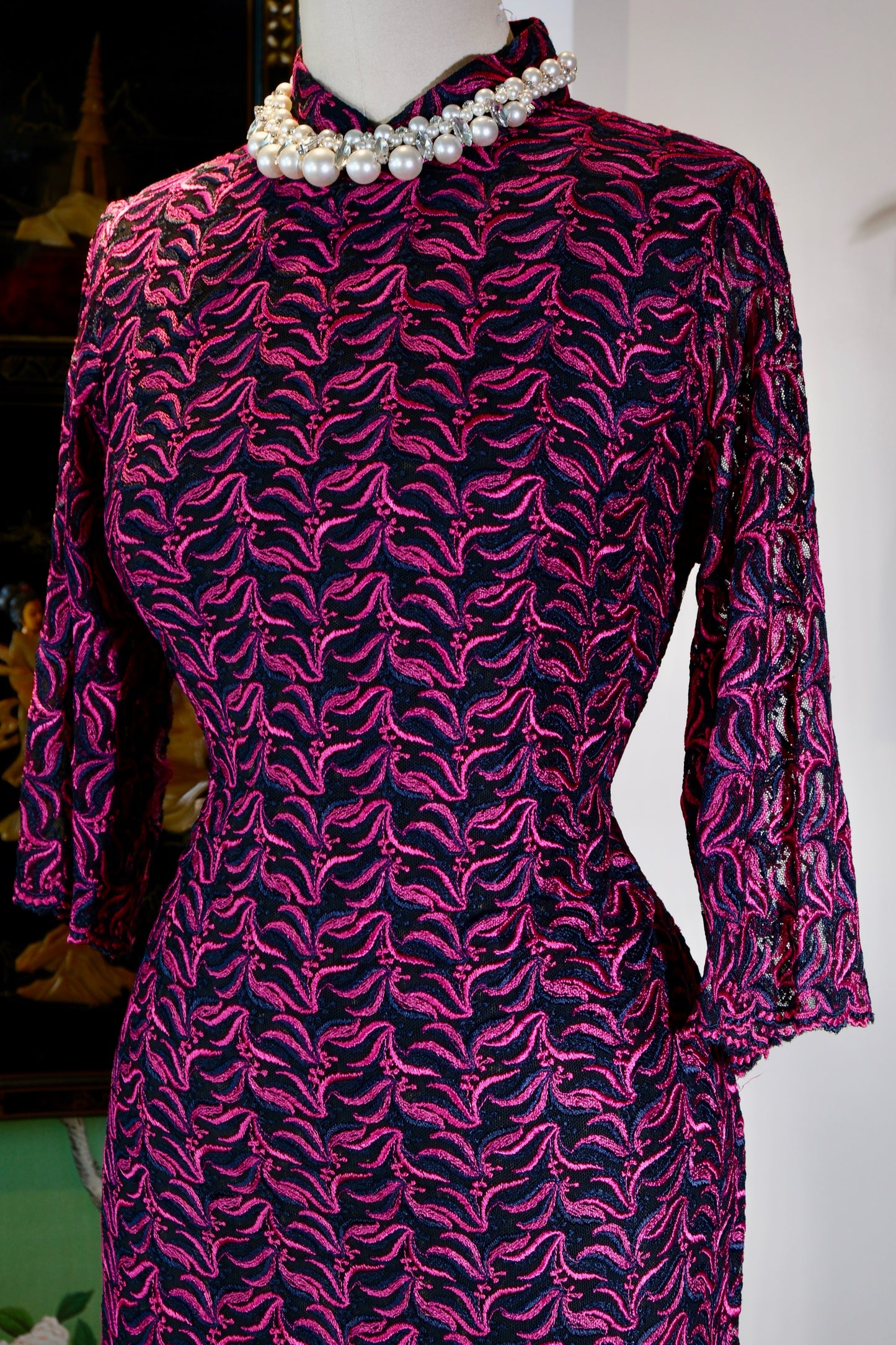
这件旗袍的肌理,是一首用丝线写就的视觉诗。通体以机绣蕾丝为骨,深绀底色如夜幕垂落,其上密布的洋红色卷草纹似藤蔓缠绕、又若云气流转,每一片叶脉都藏着匠人的呼吸——那是上世纪六十年代日本刺绣工坊里,缝纫机针脚与手工熨烫交织出的精密韵律。纹样既承袭了中国传统“缠枝莲”的绵延生机,又融入了日式“唐草纹”的纤细雅致,更因台湾裁缝对旗袍廓形的本土化改良,让曲线在收腰处凝练成一道属于那个时代的性感符号。袖口的蕾丝透肤感,恰是六十年代女性解放思潮下,对“含蓄中见张扬”的大胆诠释。
【岁月留痕:一件衣裳的跨海身世】
1960年代的东亚,正经历着战后经济腾飞的阵痛与新生。彼时日本纺织业以“技术输出”为名,将精密机绣工艺辐射至亚洲各地;而台湾作为当时华人世界的时尚前沿,无数裁缝铺里,老师傅们用从日本进口的蕾丝面料,为港台的名伶、政商名流的眷属,量身定制着一件件“穿在身上的身份”。这件旗袍或许曾陪某位女士出席过台北圆山大饭店的晚宴,裙摆拂过雕花楼梯时,珍珠项链与蕾丝光影相映,成为旧照片里一抹惊艳的紫红;也或许它被压在樟木箱底数十年,直到某天被后人翻出,才发现那些细密的针脚里,藏着祖母辈未曾言说的青春。
【文心雕龙:藏在针脚里的文化对话】
《考工记》有云:“天有时,地有气,材有美,工有巧。”这件旗袍恰是四者合一的活化石:“天时”是六十年代全球化初期,东亚纺织业的技术交融;“地气”是日本工艺的精密、台湾剪裁的灵动、中华审美底蕴的三重共振;“材美”是进口蕾丝历经半世纪仍不褪色的韧性;“工巧”则是机器与手工博弈间,留下的不可复制的温度。它比博物馆里的文物更鲜活——因为每一道褶皱里,都浸着某个具体生命的体温;每一寸蕾丝的磨损处,都是时光写给当代的情书。
【稀世之珍:为何值得被珍藏?】
如今市面所见“复古旗袍”,多是新仿之作,而这件的稀缺性在于:其一,工艺断层——六十年代日本机绣蕾丝的生产线早已消失,现存同类面料不足百匹;其二,地域孤品——台湾产的“日料台工”旗袍,因当年多为私人定制,流传有序者凤毛麟角;其三,文化标本——它是冷战时期东亚时尚交流的实物证据,比任何文献都更能说明“全球化”如何在衣着上落地生根。当我们在拍卖行或古董店遇见它,遇见的不仅是一件衣服,更是一段被折叠的时光、一场跨越国界的审美对话。
Measurements / Size Guide:
Bust / Waist / Hips: 100/94/104 cm
Total Length: 117 cm
Detailed Description:
The texture of this qipao is a visual poem written with silk threads. The entire body is structured with machine-embroidered lace, set against a deep navy-blue background that resembles the falling night sky. It is densely adorned with magenta scrolling plant motifs that entwine like vines and flow like mist. Every vein of the leaves conceals the artisan's breath—a testament to the precise rhythm interwoven by sewing machine stitches and hand-ironing in a 1960s Japanese embroidery workshop.
The pattern inherits the continuous vitality of traditional Chinese "intertwined lotuses" while integrating the delicate elegance of Japanese "karakusa" scrolling patterns. Furthermore, thanks to the localized structural refinements made by Taiwanese tailors, the silhouette condenses at the cinched waist into a sensuous symbol of that era. The sheer quality of the lace at the cuffs is a bold interpretation of "expressiveness within subtlety," reflecting the tides of women's liberation in the 1960s.
In the 1960s, East Asia was experiencing the labor pains and rebirth of postwar economic takeoff. At that time, the Japanese textile industry was radiating its precise machine-embroidery craftsmanship across Asia under the banner of "technology export." Meanwhile, Taiwan stood as a fashion frontier of the Chinese-speaking world. In countless tailor shops, master craftsmen used lace fabrics imported from Japan to custom-make these "wearable identities" for celebrated actresses and the families of political and business elites in Hong Kong and Taiwan.
This qipao might have accompanied a lady to a banquet at Taipei's Grand Hotel. As the hem brushed past carved banisters, the interplay of pearl necklaces and lace shadows would become a breathtaking flash of purplish-red in an old photograph. Or perhaps it lay pressed at the bottom of a camphor trunk for decades, only to be rediscovered by later generations who found their grandmother's unspoken youth hidden within those dense, delicate stitches.
As stated in the Kao Gong Ji (The Book of Crafts): "The heavens have their seasons, the earth has its climate, materials have their beauty, and craftsmanship has its skill." This qipao is a living fossil combining all four elements:
The seasons of heaven represent the technological integration of the East Asian textile industry during the early stages of globalization in the 1960s.
The climate of earth is the triple resonance of Japanese precision craftsmanship, dynamic Taiwanese tailoring, and deep Chinese aesthetic heritage.
The beauty of materials is found in the resilience of imported lace that remains unfaded after half a century.
The skill of craftsmanship is the irreplicable warmth left behind by the interplay between machine precision and handwork.
It is more alive than any artifact in a museum—because every fold is imbued with the body heat of a specific individual, and every inch of worn lace is a love letter written by time to the contemporary world.
Most "retro qipaos" found on the market today are modern reproductions. The true rarity of this piece lies in three aspects:
The Craftsmanship Gap: The production lines for 1960s Japanese machine-embroidered lace have long since disappeared, and fewer than a hundred bolts of such surviving fabric exist today.
A Regional One-of-a-Kind: Qipaos featuring "Japanese fabric and Taiwanese tailoring" were mostly custom-made for private clients back then, making those with a traceable, orderly provenance exceptionally rare.
A Cultural Specimen: It stands as physical evidence of East Asian fashion exchange during the Cold War era, illustrating how "globalization" took root in everyday dress better than any written document.
When we encounter it in an auction house or an antique shop, what we encounter is not merely a garment, but a folded segment of time—a cross-border aesthetic dialogue.