星夜流金:民国二十年代真丝法绣古董裙的“东西合璧”
一、暗夜织锦:真丝与金线的“色与韵”
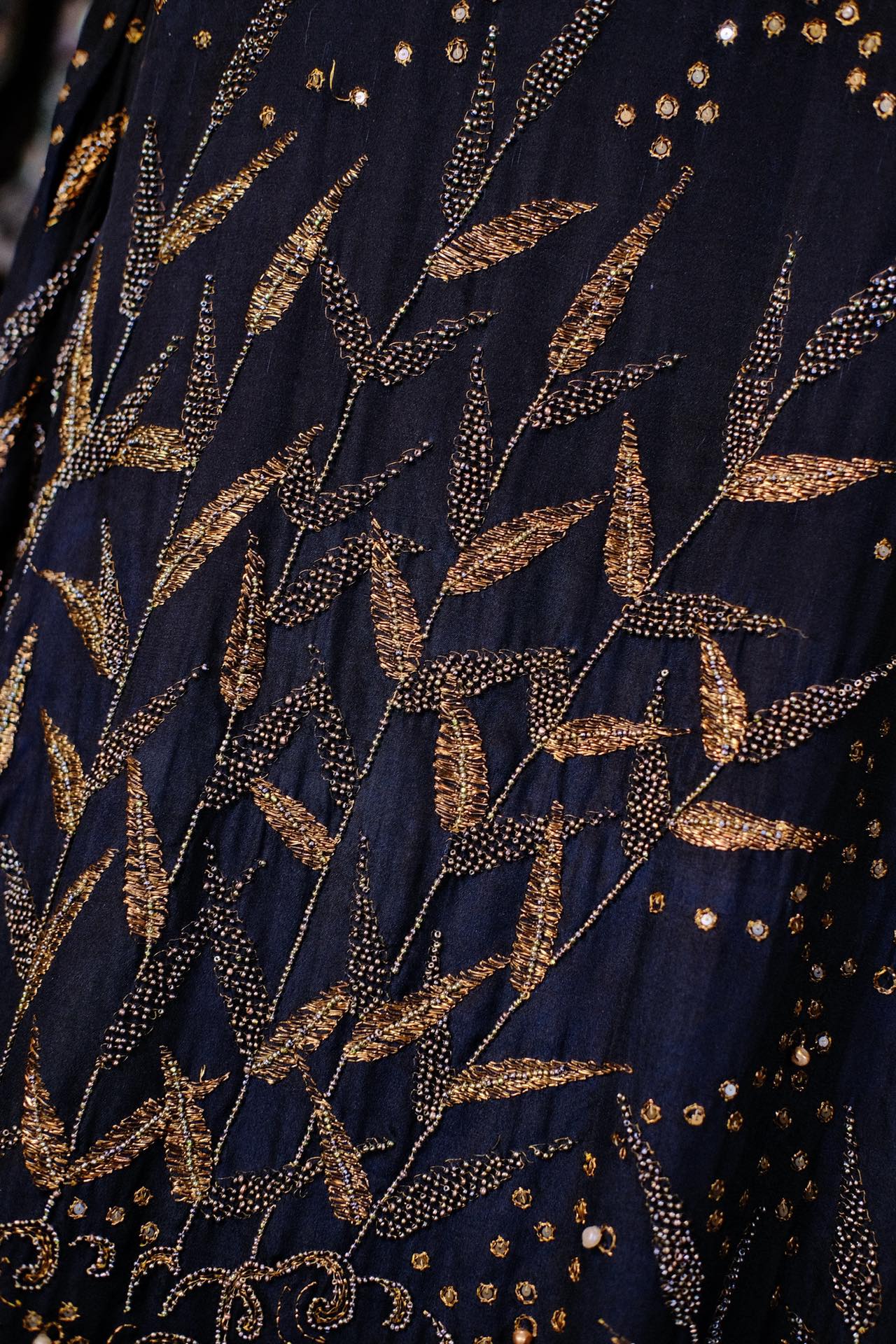
这件民国二十年代真丝纯金线绣花+米珠亮片法绣+流苏串珠的古董裙,以“星夜流金”之姿,将东方真丝的温润与西方法绣的精致凝于一身。裙身主体采用深黑色真丝,经纬间流淌着“暗夜星空”的静谧——不同于普通绸缎的单调,这种真丝需经“轻绉慢织”的特殊处理,方能织出“薄而不透,柔而不塌”的质感,恰合《长物志》“宁薄无厚,宁柔无刚”的造物哲学。
裙身的纯金线绣花,以“竹叶缠枝”为主题,金色丝线交织成“竹报平安”的图案,每一针都需匠人以“千针万线”的耐心刺绣,形成“立体如生”的形态,暗合“节节高升”的东方意境,却又以“西方式立体剪裁”重构了传统绣花的平面感,形成了“一柔一刚,一东一西”的视觉张力。
二、流苏串珠:米珠与亮片的“私密浪漫”
裙摆的流苏串珠,是这件古董裙的“点睛之笔”。流苏的顶端,以“红色米珠”收边,米珠的圆润与亮片的闪耀完美融合,形成“一硬一软,一实一虚”的视觉张力。流苏的中间,以“竹叶缠枝”为主题,红色米珠与金色亮片交织成“花开富贵”的图案,每一颗米珠都需匠人以“千针万线”的耐心串制,形成“立体如生”的形态,暗合“花开并蒂”的东方意境,却又以“西方式立体剪裁”重构了传统串珠的平面感,形成了“一柔一刚,一东一西”的视觉张力。
三、百年旧梦:从温哥华唐人街到蒙特利尔“足尖舞会”
这件古董裙的主人,正是前文所述加拿大“老钱”家族的闺秀。二十年代,她或许在蒙特利尔的“足尖舞会”上,以此古董裙搭配前文的真丝绣花高跟鞋与天鹅绒大衣惊艳四座:深蓝色真丝的温润衬得她肤色胜雪,裙身的金线绣花如“暗夜星光”,流苏串珠如“春日微风”。
四、艺术孤品:跨文化的“衣冠孤本”
此古董裙的珍稀,在于它是“跨文化时尚”的活化石。全球存世的民国二十年代真丝纯金线绣花+米珠亮片法绣+流苏串珠古董裙不足十件,而“深黑色真丝+纯金线绣花+米珠亮片法绣+流苏串珠”的组合,更是孤品中的孤品。真丝需江南织造局“以丝为骨,以墨为魂”的织造技艺,纯金线绣花则需中国工匠“以线为墨,以针为笔”的刺绣功夫,米珠亮片法绣则需法国工匠“以珠为墨,以线为笔”的刺绣功夫,流苏串珠则需“跨文化浪漫”的创意灵感,四者结合,成就了“衣以载道”的跨文化杰作。
五、结语:穿在身上的“星夜流金”
当指尖拂过裙身的真丝,仿佛能触摸到百年前蒙特利尔的“足尖舞会”——那是东方真丝的温润,是西方法绣的精致,是加拿大“老钱”家族在异域的荣光与隐忍。这件古董裙,是“离散中的坚守”,是“传统与现代的和解”,更是百年前那个风起云涌的时代,一位闺秀用衣裳写下的“星夜流金”。
Gilded Starry Night: An East-West Fusion of a 1920s Silk French-Embroidered Antique Dress
I. Brocade in the Dark Night: The "Color and Charm" of Silk and Gold Thread
This 1920s antique dress featuring pure gold thread embroidery, seed bead and sequin French embroidery, and beaded tassels takes the posture of a "gilded starry night," condensing the warm softness of Eastern silk and the refinement of Western French embroidery within a single garment. The main body of the dress utilizes a deep black silk, with a serene quietude of a "dark night starry sky" flowing through its threads. Distinct from the monotony of ordinary satin, this silk requires a specialized "light-creping and slow-weaving" technique to create a texture that is "sheer but not exposed, soft but not collapsing." This perfectly aligns with the design philosophy from The Treatise on Superfluous Things (Chang Wu Zhi): "Rather thin than thick; rather pliable than rigid."
The pure gold thread embroidery across the body of the dress centers on the theme of "intertwined bamboo branches," where gold threads interweave into a traditional "bamboo announcing peace" (zhubao ping'an) motif. Each single stitch requires the artisan's immense patience through "thousands of stitches and lines" of embroidery to shape a lifelike, three-dimensional form. This subtly channels the Eastern poetic ideal of "rising higher with every step," yet reconstructs the flat, two-dimensional nature of traditional embroidery through "Western-style three-dimensional tailoring," forming a visual tension of "one soft and one rigid, one Eastern and one Western."
II. Beaded Tassels: The "Private Romance" of Seed Beads and Sequins
The beaded tassels along the skirt hem are the crowning touch of this antique dress. The very top of the tassels is finished with "red seed beads." The round smoothness of the seed beads merges perfectly with the shimmer of the sequins, creating a visual tension of "one rigid and one soft, one abstract and one concrete." The middle of the tassels centers on the theme of "intertwined bamboo branches," where red seed beads and gold sequins interweave into patterns of "blossoms blooming with opulence." Each single seed bead requires the artisan's immense patience through "thousands of stitches and lines" of stringing to shape a lifelike, three-dimensional form, subtly channeling the Eastern poetic ideal of "twin blossoms on a single stalk," yet reconstructing the flat nature of traditional beadwork through "Western-style three-dimensional tailoring" to form a visual tension of "one soft and one rigid, one Eastern and one Western."
III. Century-Old Dreams: From Vancouver's Chinatown to Montreal's "Gala of the Toes"
The owner of this antique dress was precisely a lady from the aforementioned Canadian "old money" family. In the 1920s, she might have stunned the crowd at a "Gala of the Toes" in Montreal, pairing this antique dress with the previously mentioned silk embroidered high heels and velvet coat: the warm softness of the deep blue silk making her skin appear as fair as snow, the gold thread embroidery across the body appearing like "starlight in the dark night," and the beaded tassels swaying like a "springtime breeze."
IV. Artistic Masterpiece: A Cross-Cultural "Unique Fashion Chronicle"
The rarity of this dress lies in its status as a living fossil of "cross-cultural fashion." Fewer than ten antique dresses featuring "pure gold thread embroidery + seed bead and sequin French embroidery + beaded tassels" from the 1920s survive worldwide, and the combination of "deep black silk + pure gold thread embroidery + seed bead and sequin French embroidery + beaded tassels" makes this a unique piece among unique pieces. The silk required the craftsmanship of the Jiangnan Weaving Bureau "using silk as the bone and ink as the soul"; the pure gold thread embroidery required the embroidery skills of Chinese artisans "using thread as ink and the needle as a pen"; the seed bead and sequin French embroidery required the needlework skills of French artisans "using beads as ink and thread as a pen"; and the beaded tassels required the creative inspiration of "cross-cultural romance." The fusion of these four elements achieves a cross-cultural masterpiece where "the garment carries the culture."
V. Conclusion: "Gilded Starry Night" Worn on the Body
When fingertips brush across the silk of the dress body, it feels as though one can touch the "Gala of the Toes" of Montreal from a century ago—reflecting the warm softness of Eastern silk, the refinement of Western French embroidery, and the glory and forbearance of a Canadian "old money" family in a foreign land. This antique dress represents "perseverance amidst diaspora" and a "reconciliation between tradition and modernity"; moreover, it stands as a brilliant "gilded starry night" written with attire by a lady from that turbulent era a century ago.