溯源
Couldn't load pickup availability
衣服尺寸:
胸围/腰围/臀围/衣长:86/68/90/100 厘米
细节描述:
如果说旗袍是东方女性的第二层肌肤,那么这件诞生于1950年代香港的提花玫瑰旗袍,便是一首用丝线与经纬写就的香江挽歌。彼时,张爱玲正寓居香江,她曾言:“衣服是一种暗语,互相之间可以有一种会心的交谈。”这件孤品,正是那个风云际会、流金岁月的无声密语。
一、 织锦里的暗夜玫瑰:色彩的张力与肌理
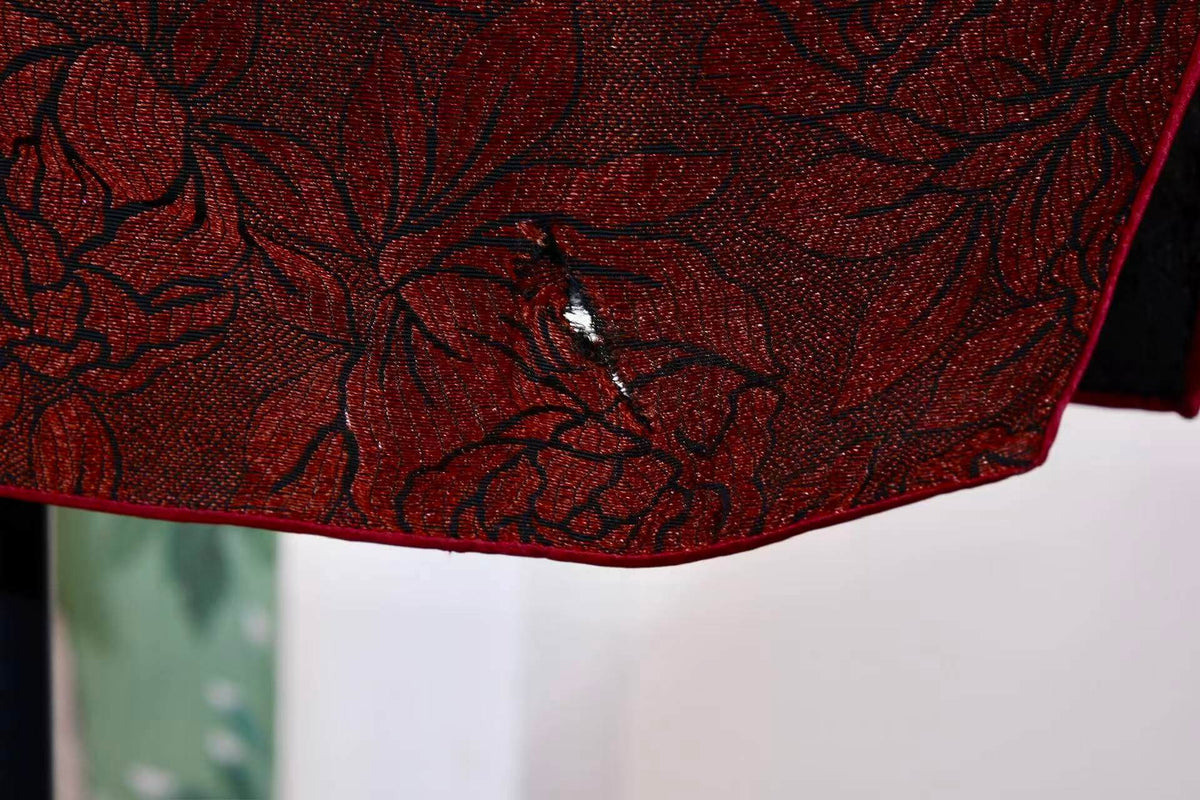
衣身选用极尽矜贵的酒红缎面,其上暗织着连绵不绝的玫瑰缠枝纹样。这并非浮光掠影的表层印花,而是经纬交错、丝线重叠堆叠出的立体肌理。在学术视阈下,这种“提花”工艺将中国传统“妆花”的繁复与西方Art Deco(装饰艺术)的几何秩序感进行了巧妙嫁接。
黑与红的撞色,在视觉上呈现出一种幽微而强烈的张力。当光线拂过衣褶,那些黑色的玫瑰便在酒红的底色中若隐若现,宛如温庭筠词中“新贴绣罗襦,双双金鹧鸪”般的隐秀。它不似明艳牡丹那般喧哗,却带着一种“冷香飞上诗句”的孤傲,完美契合了上世纪五十年代港埠女性既内敛传统、又渴望在摩登都市中确立自我主体性的微妙心理。
二、 骨法用笔:线香绲与海派立裁的世纪合流
这件旗袍的工艺核心,在于其“骨法用笔”——那几近苛刻的线香绲。
五十年代的香港,汇聚了自上海南下的“红帮裁缝”。他们将海派旗袍的西式立体剪裁(如省道的运用、胸腰臀的弧度塑造)与粤派(广帮)长衫的精微手工相结合。图中的领口与大襟,绲边宽仅半指,紧贴衣缘,行针如工笔画中的“铁线描”,一丝不苟,将衣身的挺拔线条勾勒得如雕塑般利落。
尤为精妙的是短袖袖口的绲边。微微上扬的弧度,在举手投足间露出一抹深邃的藏青里缎。这种“藏”的艺术,深得中国古典美学中“曲径通幽”与“犹抱琵琶半遮面”的意趣。
三、 稀缺性:不可复制的时代标本
从服装史的维度审视,这件旗袍具有不可再生的学术与收藏价值。
1950年代的香港手工业,处于从纯手工向半工业化过渡的临界点。彼时的长衫,讲究“量身定做,手工缝制,甚至一件衣服耗费数十工时”。随着六十年代成衣业的崛起,这种将提花面料、线香绲、立裁、手工盘扣融为一体的繁复工艺,迅速退出了历史舞台。
这件旗袍,不仅是一件蔽体的衣裳,更是那一代手艺人“一寸针线一寸心”的匠人精神标本。当它配上图中那串老珍珠项链,珍珠的温润与提花面料的幽暗光泽交相辉映,一种属于上个世纪中叶的、无可救药的古典与摩登,便在时光的褶皱里永远定格了。
Measurements / Size Guide:
Bust / Waist / Hips / Total Length: 86/68/90/100 cm
Detailed Description:
If the cheongsam is the second skin of an Eastern woman, then this jacquard rose cheongsam, born in 1950s Hong Kong, is an elegy of the Fragrant Harbour written in silk threads and warp and weft. At that time, Eileen Chang was residing in Hong Kong, and she once remarked: "Clothes are a secret code, allowing for a knowing conversation between one another." This one-of-a-kind piece is precisely a silent cipher of those golden, tumultuous years.
I. Dark Roses in Brocade: Tension of Color and Texture
The body of the garment is crafted from exceedingly precious wine-red satin, invisibly woven throughout with continuous interlocking rose motifs. This is no superficial or fleeting surface print, but rather a three-dimensional texture built layer by layer through the interlacing of warp and weft and the overlap of silk threads. From an academic perspective, this "jacquard" technique ingeniously grafts the complexity of traditional Chinese Zhuanghua brocade with the geometric sense of order found in Western Art Deco.
The contrast of black and red presents a subtle yet intense visual tension. As light brushes past the folds of the fabric, those black roses appear half-hidden against the wine-red backdrop, reminiscent of the subtle beauty described in Wen Tingyun's poem: "Newly embroidered silk bodice, a pair of golden partridges." Unlike the clamorous brightness of peonies, it carries a solitary pride akin to "cold fragrance flying onto poetic lines," perfectly fitting the delicate psychology of 1950s Hong Kong women—both reservedly traditional and longing to establish self-identity in a modern metropolis.
II. Structural Line Work: The Century Fusion of Incense-Stick Piping and Shanghainese 3D Draping
The technical core of this cheongsam lies in its "structural line work"—the nearly unforgiving incense-stick piping (Xianxiang Gun).
Hong Kong in the 1950s brought together Shanghai's Hongbang tailors who had migrated south. They combined the Western three-dimensional tailoring of Shanghainese cheongsams (such as the strategic use of darts and the sculpting of bust, waist, and hip contours) with the microscopic handcraft of Cantonese (Guangdong) long gowns. The collar and large diagonal placket shown in the image feature piping only half a finger wide, tightly hugging the edges of the garment. The needlework moves like the "iron-line drawing" in traditional fine-brush paintings, meticulous and unyielding, outlining the tall, upright lines of the body as crisply as a sculpture.
Particularly subtle is the piping on the short-sleeve cuffs. The slightly upturned curve reveals a glimpse of deep navy lining satin with every gesture. This art of "concealment" captures the essence of traditional Chinese aesthetics—"winding paths leading to quiet seclusion" and "partially hiding one's face behind a lute."
III. Rarity: An Irreplaceable Specimen of an Era
Examined through the dimension of costume history, this cheongsam holds non-renewable academic and collection value.
Hong Kong's handicraft industry in the 1950s sat at the tipping point of transitioning from pure handcraft to semi-industrialization. Long gowns of that time emphasized being "tailor-made, hand-stitched, often consuming dozens of labor hours for a single piece." With the rise of the ready-to-wear industry in the 1960s, this complex craftsmanship—integrating jacquard fabric, incense-stick piping, 3D tailoring, and hand-coiled frog buttons—rapidly exited the stage of history.
This cheongsam is not merely a garment to cover the body, but an artisan-spirit specimen of "an inch of needlework, an inch of heart" from that generation of craftsmen. When paired with the vintage pearl necklace in the image, the warm luster of the pearls and the dark shimmer of the jacquard fabric reflect off each other—an incurably classical yet modern allure belonging to the mid-20th century is forever frozen within the folds of time.