深圳溯源
Couldn't load pickup availability
一、衣上图腾:Art Deco的“暗夜鎏金”
这件民国二十年代的黑缎大衣,以“暗夜鎏金”之姿,将加拿大“
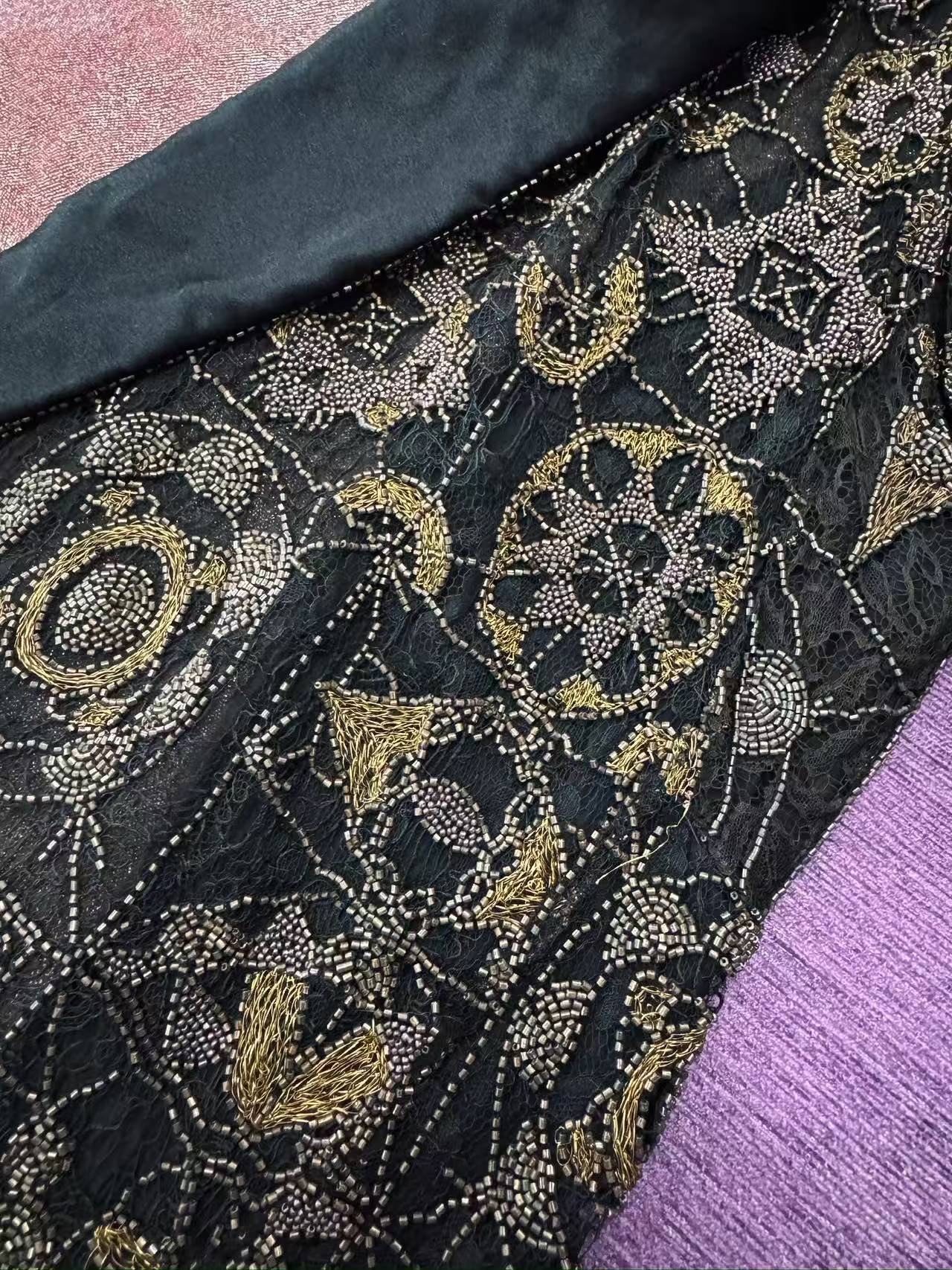
领口、袖口与前襟的法国蕾丝,以金线与银珠绣出几何化的太阳轮、
二、百年旧梦:从温哥华唐人街到蒙特利尔“暗夜星河”
这件大衣的主人,正是前文所述加拿大“老钱”家族的闺秀。
三、艺术孤品:Art Deco的“东方变奏”
此大衣的珍稀,在于它是Art Deco运动的“东方变奏”。
四、稀缺性:跨文化的“衣冠孤本”
全球存世的民国Art Deco风格大衣不足百件,而“黑缎+法国蕾丝+金线银珠+
五、结语:穿在身上的“暗夜星河”
当指尖拂过蕾丝上的金线太阳轮,仿佛能触摸到百年前蒙特利尔的“
This black satin coat from the 1920s and 1930s takes the posture of "gold flowing through the dark night," condensing the luxury of a Canadian "old money" family and the geometric aesthetics of Art Deco within its warp and weft. The main body of the coat utilizes heavy-weight black satin, with a cold light of "shining black jade" flowing through its threads. Distinct from the smooth softness of ordinary silks, this specific satin must undergo a specialized process of "triple steeping and triple sunning" to weave a texture that is "as black as lacquer, as bright as a mirror." This perfectly aligns with the artisan wisdom from The Exposition of the Works of Nature (Tian Gong Kai Wu): "For all satin, silk from Lake Tai must be held supreme."
The French lace along the collar, cuffs, and front lapels is embroidered with gold threads and silver beads to form geometric sunbursts, palm leaves, and stepped ziggurat patterns. Each motif requires the artisan's immense patience through "thousands of stitches and lines" to flawlessly merge the warm glow of the gold thread with the cold brilliance of the silver beads, creating a visual tension of "strength tempered with gentleness." The lace needlework draws inspiration from the openwork carving craftsmanship of French Chantilly lace, yet reconstructs the wildness of Art Deco through "Eastern symmetry"—precisely echoing the words of The Artificers' Record (Kao Gong Ji): "The season has its climate, the earth has its vitality, the material has its beauty, and the craftsman has his skill."
The owner of this coat was precisely a lady from the aforementioned Canadian "old money" family. In the 1920s and 1930s, she might have stunned the crowd at a "Dark Galactic Night" gala in Montreal, pairing this coat with the previously mentioned metallic woven-gold cocktail dress: the cold luster of the black satin making her skin appear as fair as snow, while the gold threads and silver beads of the lace danced under the chandeliers like a "galaxy in the dark night," its pleated collar swaying gently with her steps like "the wings of a black swan."
The rarity of this coat lies in its status as an "Eastern variation" of the Art Deco movement. Following the 1925 International Exhibition of Modern Decorative and Industrial Arts in Paris, the Art Deco style swept the globe. However, the uniqueness of this coat lies in its foundation of Eastern black satin, transforming Western sunbursts, palm leaves, and stepped patterns into "Eastern auspicious motifs"—the sunburst resembling "the rising sun in the east," the palm leaves invoking "the longevity of pines and cranes," and the stepped patterns subtly implying "rising step by step to higher heights."
Fewer than a hundred Republic of China-era Art Deco style coats survive worldwide, and the combination of "black satin + French lace + gold and silver threads + hand-stitched beadwork" makes this a unique piece among unique pieces. The black satin required the craftsmanship of the Jiangnan Weaving Bureau "using silk as the bone and light as the soul"; the French lace required the weaving skills of Chantilly artisans "using thread as ink and the needle as a pen"; and the gold threads and silver beads required the embroidery skills of Chinese needlewomen "using gold as the bone and beads as the flesh." The fusion of these three elements achieves a cross-cultural masterpiece where "the garment carries the culture."
When fingertips brush across the golden sunbursts upon the lace, it feels as though one can touch the "dark galactic night" of Montreal from a century ago—reflecting the cold glamour of Art Deco, the warm softness of Eastern black satin, and the glory and forbearance of a Canadian "old money" family in a foreign land. This coat is a living fossil of "cross-cultural fashion," an excellent footnote to "garments carrying culture," and a rare treasure in the collecting world where "thousands of gold pieces are easily acquired, but a single garment is hard to find."