深圳溯源
Couldn't load pickup availability
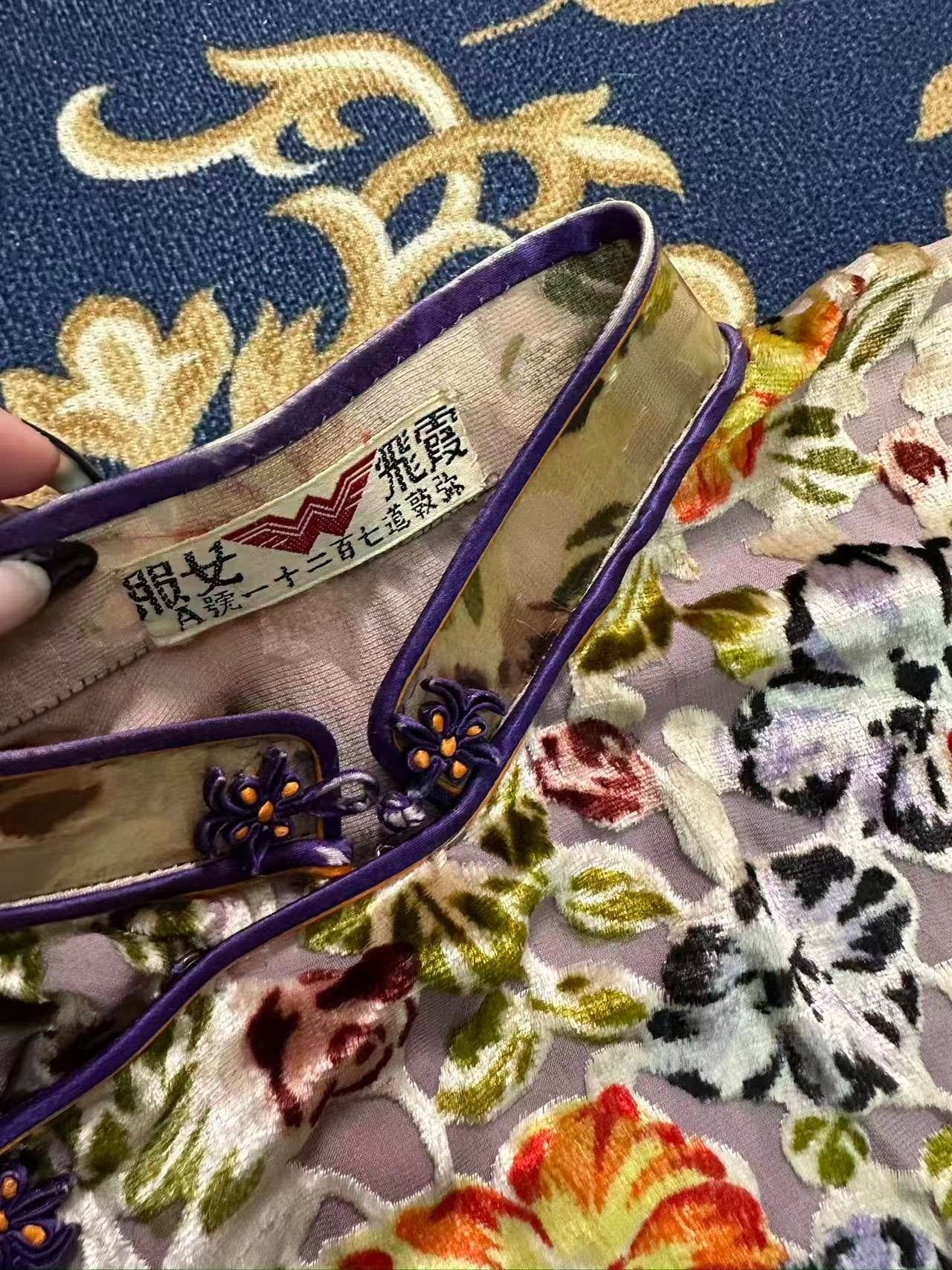
藕色地牵牛花纹烧花丝绒印花旗袍:四十年代海派风华的织物诗篇
此件旗袍以“藕色地”为基底,其色若初染轻罗,
更值一提者,乃“烧花丝绒”工艺之绝妙。丝绒面料本为近代上海“
此件旗袍的形制与纹样,堪称20世纪40年代上海“海派文化”
图案设计上,牵牛花的“写实”与“写意”并存:
此件旗袍的稀缺性,不仅源于烧花丝绒工艺的濒危,更在于其“
尤为难得者,旗袍领标“霞飞女服”字样(霞飞路,
当这件旗袍静卧于上海博物馆的展柜中,
[I. Artistic Conception: Weaving a Romantic Landscape] This Qipao features a "lotus-root-colored" base—a hue as delicate as newly dyed silk, exuding a gentle warmth mellowed by the passage of time. Overlaid upon this canvas is a vibrant profusion of morning glories; blossoms of orange-red, violet-blue, and pristine white intertwine with emerald-green vines and leaves. It is as if the romantic imagery of the Classic of Poetry (Shijing)—"I look at you as at the mallow flowers, you give me a handful of pepper"—has been woven into the very warp and weft of the fabric. The morning glory (anciently known as qiao), since its earliest records in the Er Ya lexicon, has been a literati symbol of an "unyielding spirit against autumn," standing tall toward the clouds. The artisans of this Qipao masterfully blended this motif with the lotus-root base, adhering to the compositional philosophy of the Mustard Seed Garden Manual of Painting: "Flowers should be vivid, while the ground should be elegant." This balance highlights the vitality of the flora without compromising the ethereal tranquility of the background.
[II. Mastery of Craft: The Visual Sculpture of Devoré Velvet] Of particular note is the exquisite "Devoré" (burn-out) velvet technique. While velvet represented the opulence of Shanghai’s cosmopolitan concessions, the devoré method fused traditional weaving with Western chemical and physical dyeing processes. Upon close inspection, the contours of the morning glories are slightly recessed into the velvet, while the centers of the petals stand plush and upright. In the interplay of light and shadow, the patterns emerge with sculptural depth, embodying the sentiment from The Exploitation of the Works of Nature (Tiangong Kaiwu): "Woven patterns like paintings, bringing the vitality of spring to the touch." Due to its immense material cost and technical difficulty, this craftsmanship was found only in the premier Qipao workshops of 1940s Shanghai, making surviving pieces exceedingly rare.
[III. Silhouette and Culture: The Haipai Spirit] The silhouette and patterns of this garment serve as a microcosm of 1940s "Haipai" (Shanghai-style) culture. Its tailoring clings to the body’s curves, while the sleeveless design and high-slitted hemline echo the 1947 fashion trend reported in The Shun Pao: "Simplify the complex to highlight the figure." Simultaneously, details such as the Mandarin collar and the intricate Frog Buttons (violet velvet knots adorned with orange centers, resembling "cherries on purple ribbons") steadfastly preserve the traditional genetic markers of the Qipao. As scholar Chen Jianhua remarked: "The essence of the Haipai Qipao lies in using Western tailoring as the bone to cast the soul of Chinese aesthetics."
[IV. Design Language: The Fusion of East and West] In its graphic design, the morning glories exist in a state of dualism—simultaneously realistic and impressionistic. The orange-red petals employ gradient printing to render light and shadow, aligning with the logic of Western chiaroscuro. Meanwhile, the violet-blue blossoms are outlined with fine-brush strokes, leaving white spaces that evoke the airy void of Oriental ink painting. This "East meets West" visual language is a cultural reflection of Shanghai’s status as a "World Metropolis"—influenced by the Western Art Deco movement yet deeply rooted in traditional Chinese painting systems such as the Ten Bamboo Studio Letterhead Manual. As Eileen Chang wrote in Chronicle of Changing Clothes: "The constant innovation in Qipao patterns reflects the state of mind of the era." The flourishing patterns of this piece are a material manifestation of the "lingering prosperity" amidst the aftershocks of war in 1940s Shanghai.
[V. Historical Identity: From Private Collection to Public Memory] The rarity of this Qipao stems not only from the endangered devoré technique but also from its "dual historical identity." First, it is a witness to the "bodily liberation" and "aesthetic awakening" of 1940s women—the softness of the lotus-root base and the fervor of the morning glories mirror the paradox of the intellectual women of that time, who maintained traditional virtues while pursuing modern trends. Second, it carries the contemporary narrative of "The Jeff Chang Collection" and its exhibition at the Shanghai Museum. Jeff Chang, intervening in Qipao research as a renowned singer, has curated thousands of antique pieces (including this one), regarded by academics as a definitive example of "preserving collective memory through private dedication." Its inclusion in the Glamour in Frames exhibition at the Shanghai Museum elevates it from a "private treasure" to a "public vessel of urban memory."
[VI. Epilogue: The Poetics of Textile] A particularly precious detail is the label "Avenue Joffre Ladies' Wear" (Avenue Joffre, now Huaihai Road, was the hub of elite Qipao boutiques in the 1940s), providing direct material evidence for the commercial history of Republican-era fashion. As this Qipao lies quietly in its display case, the morning glories shimmer under the gallery lights, whispering a story of Shanghai. It is the decadent melody of Night Shanghai, the desolate backdrop of Love in a Fallen City, and the "magnificent yet melancholic" footnote of Eileen Chang’s era. Today, it is no longer a mere garment; it is a piece of "Textile Poetics," standing in silent testimony to a century of the city's shifting elegance.