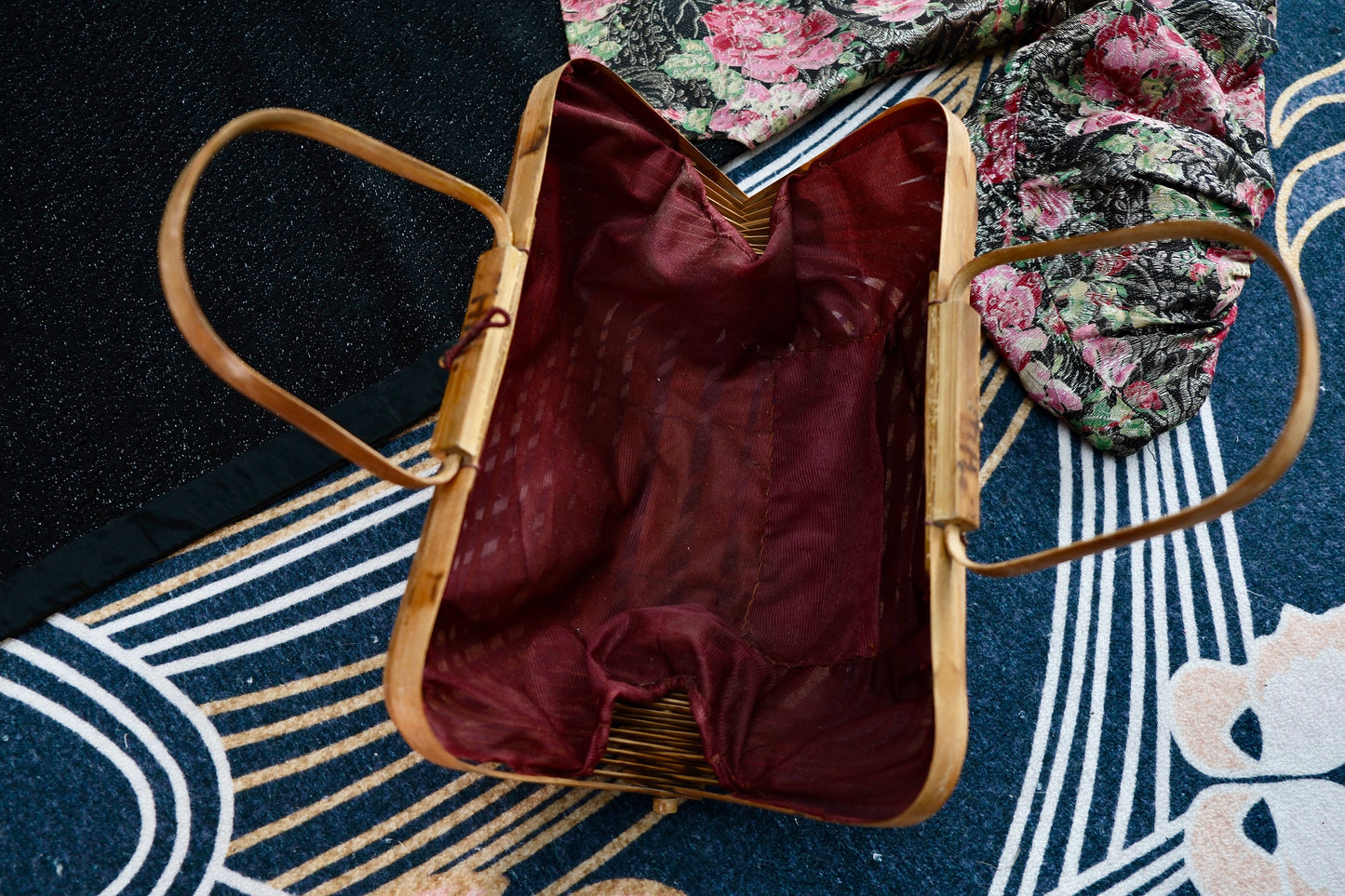
民国Art Deco竹编包:竹骨生花,时光里的几何诗篇
竹骨为诗:一只包里的时代叙事与艺术密码
这只竹编手提包,以天然竹片为骨,经手工切割、打磨、弯曲,以深色细线串联成“扇形层叠”的立体结构,提手与包身浑然一体,暗合Art Deco“形式追随功能”的设计理念。其稀缺性,藏于三重时代印记中:
1. 材质的在地性与工艺的现代性:竹,作为中国传统手工艺的核心材料,在此被赋予全新的几何形态——不再是传统竹编的“经纬交错”,而是以“平行竹片+放射状收束”构建出类似建筑立面的立体感,呼应Art Deco对“工业时代材料”(如钢铁、玻璃)的模仿,却以东方竹材的温润消解了机械的冰冷。这种“以传统工艺诠释现代美学”的尝试,在1930年代的中国极为罕见,多见于上海“月份牌”画报中的摩登女性配饰,实物存世极少。
2. 风格的跨文化对话:包身的“层叠竹片”设计,与同时期欧洲Art Deco珠宝(如卡地亚的“几何切割宝石”)、建筑(如纽约克莱斯勒大厦的“阶梯状轮廓”)形成跨时空呼应,却又因竹材的天然肌理与手工痕迹,保留东方美学的“留白”与“呼吸感”。正如艺术史家恩斯特·贡布里希所言:“装饰艺术的本质,是‘秩序’与‘变化’的平衡。”这只包恰以竹片的“规则排列”与“自然色差”,实现了这种平衡。
3. 时代的稀缺性:1930年代的中国,正值战乱与变革,能留存至今的竹编包,需历经材质老化、工艺断代、社会动荡三重考验。据《中国近代手工艺史》记载,此类融合Art Deco风格的竹编包,多由上海、杭州等地的“新式工坊”制作,专为都市知识女性设计,产量极低,且因竹材易损,完整存世者不足百件,堪称“民国时尚的活化石”。
竹影摇光:当一只包成为时代的注脚
这只包的故事,或许始于一位1930年代的上海女学生:她穿着旗袍,手提竹包,穿行于外滩的Art Deco建筑间,竹片的温润与锦缎的华丽,恰是她“传统底蕴”与“现代追求”的隐喻。竹包上的每一道竹纹,都是时光的刻痕;每一根细线,都是中西文化碰撞的丝线。
如今,它静置于织物之上,不仅是装饰艺术的实物见证,更是一段“摩登东方”的时尚叙事——在竹骨与锦缎的对话中,我们得以触摸那个“新旧交织、中西碰撞”的时代脉搏,感受艺术如何在日常器物中,成为跨越百年的美学共鸣。
Republic Era Art Deco Bamboo Bag: Blossoms on Bamboo Ribs, a Geometric Poem in Time
I. Bamboo as Poetry: Narrative and Artistic Codes Within a Bag
This bamboo handbag uses natural bamboo splints as its "skeleton," meticulously hand-cut, polished, and curved. Strung together with dark fine thread into a "tiered fan" three-dimensional structure, the handle and body merge seamlessly, silently echoing the Art Deco philosophy of "form follows function." Its scarcity is hidden within a triple imprint of the era:
-
Locality of Material vs. Modernity of Craft: Bamboo, a core material of traditional Chinese handicraft, is granted a brand-new geometric form here. Moving away from the traditional "warp and weft" weave, it uses "parallel splints + radial convergence" to construct an architectural, sculptural feel. This mirrors the Art Deco fascination with industrial materials (like steel and glass) while dissolving mechanical coldness through the warmth of Oriental bamboo. Such attempts to interpret modern aesthetics through traditional craft were exceptionally rare in 1930s China, appearing mostly in "Yuefenpai" (calendar poster) illustrations of modern socialites. Physical survivors are incredibly scarce.
-
A Cross-Cultural Dialogue of Style: The "tiered splint" design shares a trans-temporal resonance with European Art Deco jewelry (such as Cartier’s geometric cuts) and architecture (like the tiered silhouette of New York’s Chrysler Building). Yet, due to the natural grain and handcrafted marks of the bamboo, it retains the "white space" (Liu Bai) and "breathability" of Oriental aesthetics. As art historian E.H. Gombrich noted: "The essence of decorative art is the balance between 'order' and 'change'." This bag achieves that balance through the rhythmic arrangement and natural color variations of the bamboo.
-
Historical Scarcity: 1930s China was an era of turmoil and transformation. Any bamboo bag surviving to this day has endured three major challenges: material aging, the severing of traditional craft lineages, and social upheaval. According to the History of Modern Chinese Handicraft, these Art Deco-influenced bamboo bags were produced by "modernist workshops" in cities like Shanghai and Hangzhou, specifically designed for urban intellectual women. With low initial production and the fragile nature of bamboo, there are likely fewer than a hundred intact pieces remaining globally, making this a "living fossil" of Republic Era fashion.
II. Swaying Bamboo Shadows: A Bag as a Footnote to History
The story of this bag perhaps began with a 1930s Shanghai co-ed: dressed in a qipao, carrying this bamboo bag, she walked among the Art Deco buildings of the Bund. The warmth of the bamboo and the opulence of her brocade served as a metaphor for her "traditional roots" and "modern pursuits." Every grain on the bamboo is a scratch left by time; every fine thread is a silken link between Eastern and Western cultures.
Today, resting upon fabric, it is more than just a physical witness to Decorative Arts; it is a fashion narrative of "Modern Orientalism." In the dialogue between bamboo ribs and brocade, we are able to touch the pulse of an era where "the old and new intertwined, and the East and West collided," experiencing how art becomes a cross-century aesthetic resonance within a daily object.