深圳溯源
Couldn't load pickup availability
衣服尺寸:
胸围/腰围/臀围:100/88/110 厘米
衣长:109 厘米
细节描述:
【前言:时光的褶皱与衣褶】
张爱玲曾言:“对于不会说话的人,衣服是一种语言,随身带着的是袖珍戏剧。”当我们凝视这件诞生于上世纪六十年代的香港产古董旗袍时,我们看到的不仅仅是一件衣物,更是一段被织物封存的流金岁月。作为服装史的研究者,我深知在那个西风东渐、摩登与传统激烈碰撞的年代,香港旗袍正处于其发展史上的“黄金变奏期”。这件作品,便是那个时代审美巅峰的实物见证。
一、纹样赏析:笔墨淋漓的抽象写意
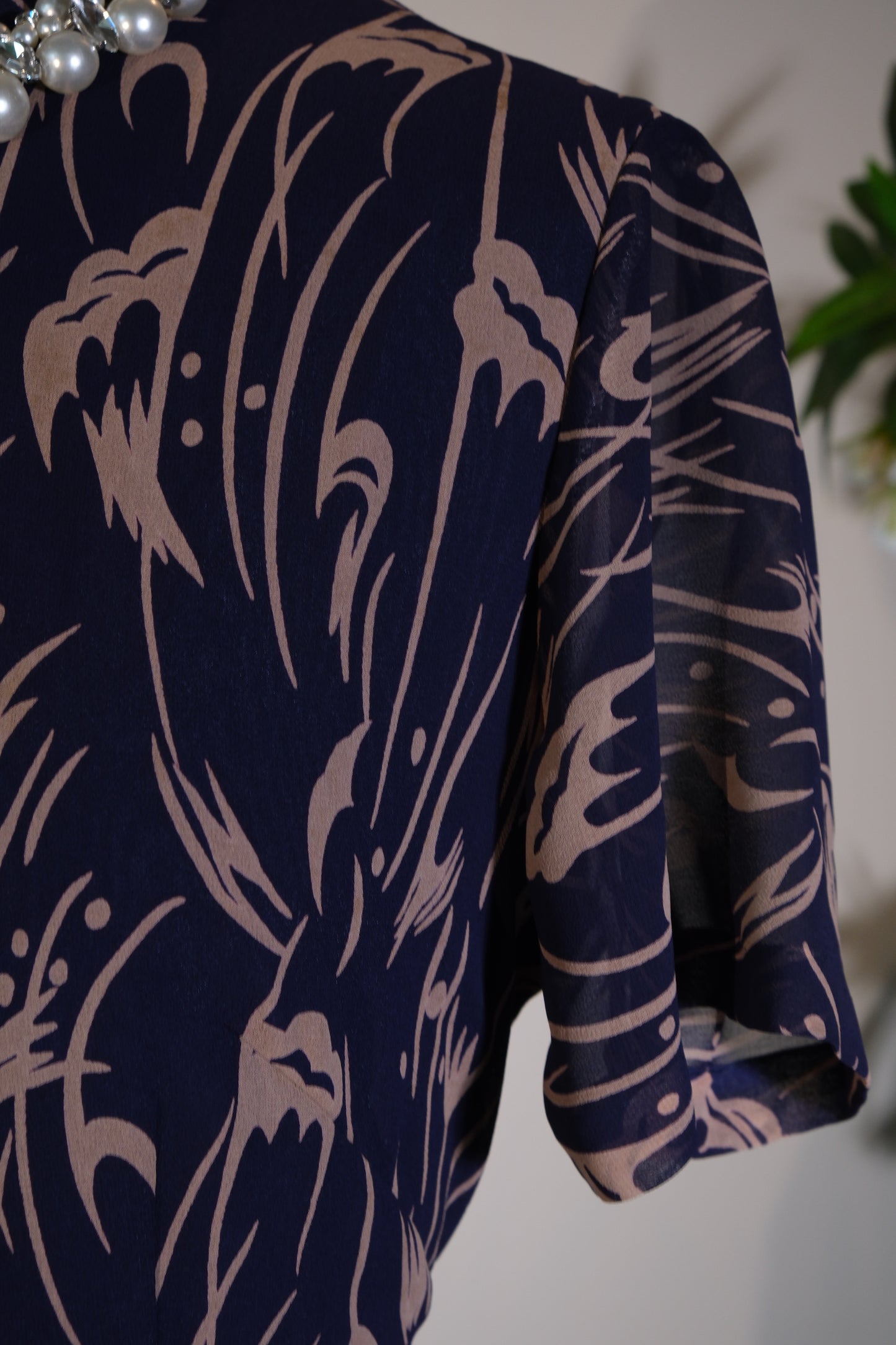
这件旗袍最引人入胜之处,在于其面料上那极具张力的图案设计。这并非传统意义上具象的花鸟虫鱼,而是一种深受当时西方现代主义艺术与中国传统水墨画双重影响的“抽象写意风格”。
- 视觉意象: 图案以深靛蓝(Indigo)为底,其上铺陈着米杏色或淡金色的线条。这些线条狂放而不失法度,宛如狂风中摇曳的芦苇,又似泼墨山水中飞白的笔触。它们相互交织、穿插,形成了一种类似“乱柴皴”或“解索皴”的视觉效果。
- 艺术解读: 这种图案打破了传统旗袍纹样的对称与规整,带有一种强烈的动态美和节奏感。它让人联想到20世纪60年代流行的欧普艺术(Op Art)与波普艺术的几何抽象,同时又保留了中国文人画中“气韵生动”的内核。这种“似花非花,似草非草”的朦胧感,恰恰符合了东方美学中“虚实相生”的高级意境。
二、材质与工艺:雪纺乔其纱的轻盈史诗
在服装材料学中,雪纺乔其纱(Chiffon Georgette) 被誉为“面料中的贵族”。
- 触感与光泽: 这种面料采用强捻丝线织造,表面具有独特的细微皱纹和砂感,透气性极佳。在光线下,它呈现出一种半透明的哑光质感,既不像丝绸那样张扬耀眼,也不像棉麻那般质朴无华,而是透着一种低调的奢华与神秘。
- 剪裁挑战: 乔其纱质地轻薄飘逸,极难驾驭。要在如此柔软的面料上实现六十年代标志性的立体剪裁——贴合人体曲线的省道(Darts)、挺括的立领以及流畅的装袖,对裁缝的技艺要求极高。这件旗袍的线条干净利落,毫无拖泥带水之感,证明了当年香港制衣工匠登峰造极的“归拔”功夫。
三、历史回响:六十年代香江的摩登旧梦
这件旗袍不仅是艺术品,更是历史的载体。
- 时代背景: 上世纪60年代的香港,是东西方文化交汇的熔炉。此时的旗袍已褪去30年代的繁复装饰,转向简洁、修身、现代化的西式剪裁。它不再仅仅是传统的符号,而是都市女性独立、自信的象征。
- 稀缺性考证: 由于雪纺乔其纱极其娇贵,难以保存,加之六十多年来的战乱、迁徙与生活方式的巨变,能完好保存至今且品相如此完美的同类古董旗袍,在收藏界已是凤毛麟角。大多数同类衣物早已因面料老化脆裂而消逝。因此,这件藏品不仅具有极高的审美价值,更具有不可再生的文物价值。
四、结语:穿在身上的诗词
《诗经》有云:“岂曰无衣?与子同袍。”衣裳从来都是情感的寄托。
这件深蓝色的古董旗袍,像是一首写在夜色里的散文诗。它记录了那个时代女性对于美的极致追求——既有东方的含蓄内敛,又有西方的热烈奔放。当你穿上它,或是将它珍藏于柜中,你便拥有了一段关于优雅、关于时光、关于那个回不去的香江时代的独家记忆。
这不仅是一件衣服,这是可以触摸的历史,是永不褪色的风华。
Measurements / Size Guide:
Bust / Waist / Hips: 100/88/110 cm
Total Length: 109 cm
Detailed Description:
The celebrated author Eileen Chang once insightfully observed: "To those who cannot speak, clothes are a language; what one carries with them is a pocket drama." When we gaze upon this antique qipao produced in Hong Kong during the 1960s of the last century, we are looking far beyond an ordinary article of clothing; we are beholding a chapter of golden years sealed permanently within the textile fibers. As a researcher of costume history, I am deeply aware that during that decade of sweeping Western influences—where modernization and tradition collided with intense velocity—the Hong Kong qipao was traversing its definitive "Golden Variational Phase." This masterwork stands as a pristine physical specimen witnessing the absolute zenith of that era's aesthetic refinement.
The most enchanting facet of this qipao resides in the intense visual tension of the pattern design layout across its fabric matrix. Deviating completely from conventional, representational depictions of flowers, birds, or seasonal scenery, it adopts an "abstract freehand expressionism" (Abstract Xieyi) profoundly shaped by the dual forces of contemporary Western modernist art and traditional Chinese ink-wash painting.
Visual Imagery: The layout establishes a deep, heavy indigo blue (Indigo) as its grounding background chassis, upon which lines of cream-apricot or pale gold are elegantly spread. These lineworks are fiercely uninhibited yet exceptionally disciplined—resembling reeds swaying gracefully in a wild gale, or the flying-white brushstrokes (Feibai) captured within freehand landscape scroll paintings. They interlace, cross, and punch through one another, engineering a specific textural visual manifestation closely akin to the "brushwood texture" (Luanchaizhun) or "untangled rope texture" (Jiesuozhun) techniques of classical master painters.
Artistic Interpretation: This composition thoroughly shatters the rigid symmetry and neat regulation of traditional qipao motifs, injecting a potent dynamic motion and rhythmic cadence. It directly evokes the geometric abstraction found in 1960s international design movements—such as Op Art and Pop Art—while impeccably preserving the core of Chinese literati painting: "vibrant narrative spirit and life resonance" (Qiyun Shengdong). This hazy, dreamlike quality where forms appear "halfway between floral and abstract, plant and brushstroke" perfectly actualizes the premier artistic ideal of Eastern aesthetics: "the mutual generation of solid and void spaces" (Xushi Xiangsheng).
Within the field of textile material sciences, chiffon georgette is universally revered as "the absolute royalty among fabric families."
Tactile Qualities and Luster: This specialized textile matrix is engineered utilizing highly twisted silk filaments, producing a surface characterized by fine, microscopic crepe wrinkles and a subtle sandy hand-feel that grants exceptional breathability. Exposed to ambient light, it projects a translucent, matte quality—neither loud and dazzling like traditional smooth silks nor plain and unadorned like organic cotton-linen. Instead, it filters light to exude a deeply restrained luxury and quiet mystery.
Pattern Drafting Challenges: Georgette is inherently featherlight, fluid, and notoriously difficult to tame on the cutting table. Attempting to execute the definitive three-dimensional silhouettes of the 1960s upon such a slippery, soft chassis—requiring highly accurate, form-contouring darting (Darts), an upright and crisp standing collar, and smoothly set-in sleeves—demanded a stratospheric level of craftsmanship from the master tailor. The silhouette lines of this qipao are exceptionally clean, sharp, and entirely free of dragging distortion, providing concrete material proof of the supreme mastery of "shaping through ironing and stretching" (Guiba) achieved by Hong Kong artisans of that era.
This qipao functions not only as a masterpiece of fashion art but more profoundly as a material archive of history.
Epochal Context: Hong Kong during the 1960s operated as a hyper-dynamic melting pot where Eastern and Western cultural vectors intersected. In this window, the qipao shed the heavy, complex surface augmentations of the 1930s, shifting aggressively toward clean, reduced, and modern Westernized pattern-cut philosophies. It ceased to operate as a static heritage symbol, transforming instead into the ultimate badge of independence and self-reliance for metropolitan women.
Scarcity Authentication: Because pure silk chiffon georgette is intensely delicate and highly susceptible to natural decay, it presents extreme curation challenges. Factoring in more than six decades of natural timeline marked by regional migration, societal shifts, and drastic transformations in daily lifestyles, encountering an antique georgette qipao that balances absolute completeness of form with such an immaculate preservation state is incredibly rare—a true phenomenon within global collection circles. The vast majority of contemporary sister garments have long since disintegrated due to the structural embrittlement of aging fibers. Consequently, this curated specimen commands immense aesthetic value alongside irreproducible cultural and artifact prestige.
The ancient text The Book of Songs (Shijing) poetically notes: "How can you say you have no apparel? I shall share my robes (Qipao) with you." Garments have eternally served as the ultimate emotional vessels for human lineage.
This deep indigo antique qipao operates exactly like a prose poem written directly into the midnight hour. It preserves the absolute zenith of that generation of women's pursuit of beauty—simultaneously packed with the containment of the East and the passionate liberation of the West. Whether it is worn gracefully across a room or carefully preserved within a curation vault, possessing this piece means owning an exclusive, irreplaceable archive of elegance, of time, and of that unrepeatable old Hong Kong era.
This transcends its definition as an article of clothing; it is history you can physically touch, and an eternal, unyielding grace.