深圳溯源
Couldn't load pickup availability
衣服尺寸:
胸围/腰围/臀围:96/72/100 厘米
衣长:112 厘米
细节描述:
【面料溯源:跨越山海的奢华邂逅】
这件诞生于上世纪六十年代的香港古董旗袍,是中西时尚文化碰撞的璀璨结晶。其面料选用当时极为珍贵的意大利进口烧花丝绒织金料。在战后经济腾飞的香港,这种面料往往是顶级裁缝店为显赫名媛定制的专属选择。
“烧花”工艺(Burnout Velvet)是一种极具风险的纺织技法,利用化学药剂腐蚀掉丝绒表面的部分绒毛,从而在厚重的丝绒上透出轻薄的底纱,形成虚实相生的浮雕感。而“织金”则是在经纬线中掺入金属线或仿金属丝,使暗红底色在光影流转间隐隐透出富丽堂皇的贵气。这种面料在当时不仅造价不菲,更因其娇贵难养,成为了身份与品位的极致象征。
【纹样解析:巴洛克藤蔓与东方剪裁的对话】
细观衣身,图案并非传统中式旗袍常见的牡丹或龙凤,而是呈现出浓郁的欧式巴洛克风格卷草纹(Arabesque)。
- 构图: 巨大的叶片与蜿蜒的藤蔓相互缠绕,呈S型曲线向上延伸,充满了动感与生命力。这种繁复、华丽且不对称的构图,带有强烈的西方装饰艺术特征。
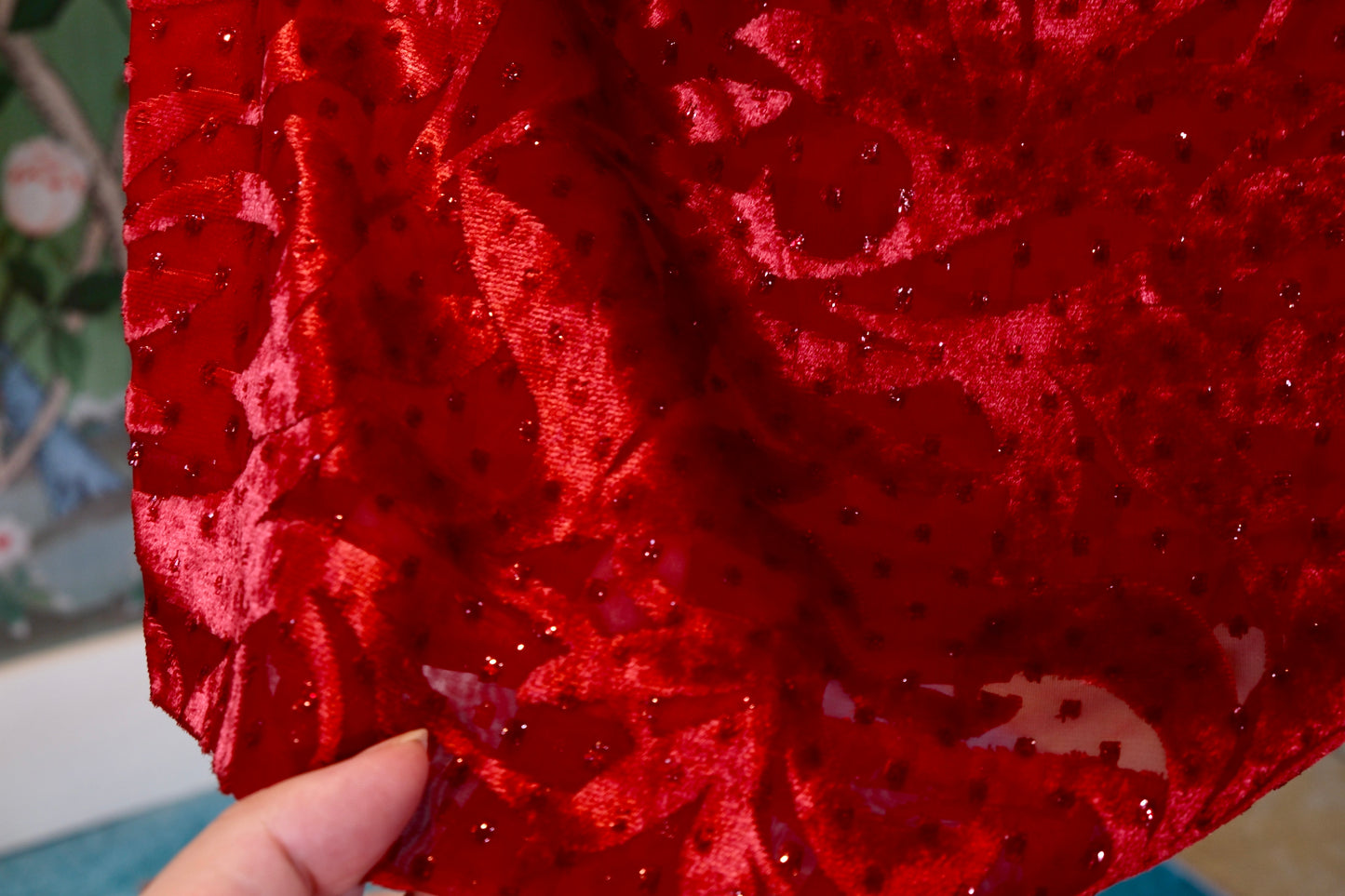
- 质感: 烧花工艺使得花纹处呈现出半透明的朦胧美,仿佛晨雾中的花园;而未烧花的丝绒部分则保留了深沉的酒红色泽,如同凝固的红酒。
- 点缀: 面料表面还散落着细小的金葱丝,如同夜空中的繁星,打破了深红色的沉闷,增添了几分六十年代特有的摩登与俏皮。
这种西式纹样被巧妙地裁剪进东方的立领与斜襟之中,正是那个时代“西风东渐”最生动的注脚。
【形制之美:黄金时代的优雅轮廓】
这件旗袍保留了六十年代香港旗袍的经典形制——海派改良风格。
- 立领: 依然坚守着传统的高立领,紧扣咽喉,含蓄而端庄,衬托出穿着者修长的颈部线条。
- 袖长: 采用了七分袖或九分袖的设计,既保暖又露出手腕的纤细,这是为了配合当时女性佩戴手表或玉镯的习惯。
- 收腰与开衩: 极度贴合人体工学的立体剪裁,完美勾勒出女性的胸腰臀曲线(Hourglass Silhouette)。下摆长度过膝,开衩适中,行走间隐约露出腿部线条,摇曳生姿却不失分寸。
【历史回响:张爱玲笔下的“衣服言语”】
张爱玲曾在《更衣记》中写道:“对于不会说话的人,衣服是一种语言,随身带着的是袖珍戏剧。”
这件旗袍,便是一出无声的戏剧。它让我们联想到六十年代的香港,那是一个东西方文化剧烈交融的黄金年代。想象一下,当年的某位名媛,或许是在出席一场重要的晚宴,或是前往半岛酒店喝下午茶时穿上了它。她颈间佩戴的珍珠项链(如图所示)与这酒红色的丝绒交相辉映,举手投足间,既有中国传统女性的温婉内敛,又有西方现代女性的自信张扬。
它不仅是一件御寒的衣物,更是一种社会地位的宣示,一种对美好生活的向往。在那个物质相对匮乏但精神极度昂扬的年代,拥有一件意大利进口的烧花丝绒旗袍,无异于今日拥有高定礼服般荣耀。
【收藏价值:不可复制的时光孤品】
作为一件流传至今的古董衣,它的稀缺性不言而喻:
1. 面料绝版: 这种老式的意大利烧花丝绒织金面料,因环保法规和生产成本原因,早已停止大规模生产,市面上几乎难觅踪迹。
2. 工艺失传: 当年的老裁缝多已凋零,那种纯手工归拔、熨烫出的立体版型,机器难以完全复刻。
3. 保存完好: 丝绒极易倒毛、虫蛀,但这件旗袍历经半个多世纪,色泽依然饱满,绒毛依然挺立,实属难得。
它不仅仅是一件衣服,更是一段被封存的时光,一份可以触摸的历史。穿上它,你便穿越了六十年的光阴,成为了那个风华绝代年代的主角。
结语:
“衣裳是文化的表征,衣裳是思想的形象。”这件六十年代的港产旗袍,以其独特的意式面料、西化纹样与中式剪裁的完美融合,诠释了那个时代独有的审美高度。它是博物馆级的藏品,也是值得代代相传的艺术瑰宝。
Measurements / Size Guide:
Bust / Waist / Hips: 96/72/100 cm
Total Length: 112 cm
Detailed Description:
Within the technical domains of textile conservation, structural design history, and material culture analysis, an exceptional historical garment functions as an active social text. It documents a precise intersection of ancestral handcraft and localized modernization.
This magnificent 1960s Hong Kong-produced, devoré metallic-woven silk velvet qipao (红地意大利烧花丝绒织金古董旗袍) stands as a pristine physical testament to that rare mid-century golden era. It materializes a complex sartorial dialogue where imported European luxury yardage converges with Westernized, highly disciplined pattern architecture. For curators, textile historians, and institutional archives, this specimen preserves a critical chapter in the evolution of the iconic Hong Kong silhouette, illustrating the peak of post-war international textile trade.
The physical construction of this qipao exemplifies the zenith of post-war textile manipulation, capturing a highly disciplined synthesis of Eastern tailoring conventions and Western anatomical modeling.
The 1960s Hong Kong bespoke framework relies on a traditional high Mandarin collar to establish absolute postural enclosure, framing the neck with linear severity. This architectural foundation moves into a tailored three-quarter length set-in sleeve (七分袖设计), before utilizing advanced hot-iron blocking and damp-tension manipulation (归拔工艺) to seamlessly shape the heavy velvet matrix. The pattern curves around the bust and pinches tightly at the waist, falling cleanly into an elegant, over-the-knee columnar hem balanced by moderate lateral side slits (开衩) that optimize spatial mobility for elite mid-century social functions.
Anatomical Integration: By abandoning the flat, two-dimensional layout of early mainland garment cutting, the master tailor utilized sophisticated dart manipulation to manage the considerable structural weight of the Italian silk velvet. This eliminates unseemly fabric pooling under the armscye and at the small of the back, yielding a crisp silhouette that forms an unyielding hourglass line.
Functional Proportioning: The deliberate three-quarter sleeve length serves an intentional socio-sartorial function. By clearing the wrists, it allowed the prominent madams of Hong Kong high society to frame their luxury timepieces or family jade bangles without causing abrasive friction against the delicate devoré pile.
The exceptional historical value of this specimen rests primarily upon its non-traditional material chassis: an elite, imported Italian burnout velvet integrated with a metallic-loomed woven gold background (意大利进口烧花丝绒织金料).
The Mechanics of Devoré Dissolution: The surface architecture relies on a complex chemical destruction technique known as devoré (烧花). A mild acid gel was applied directly to the textile, burning away the premium rayon/silk pile fibers to expose the ultra-lightweight, translucent sheer silk base fabric beneath. This creates a striking low-relief structural depth where the remaining uncut velvet pile forms dimensional, velvet-soft highlights against a shimmering, gossamer ground.
The Baroque Arabesque and Metallurgical Integration: Moving away from standard botanical motifs like chrysanthemums or peonies, this fabric features an elaborate European Baroque design layout (巴洛克卷草纹/Arabesque). Large, winding vines and stylized leaves twist upward across the seams in asymmetric S-curves. Interwoven into the warp-and-weft foundation are ultra-fine gold metallic filaments (金葱丝) that catch light dynamically as the wearer shifts angles, transforming the rich wine-red velvet into a deep, shifting field of shadow and gold-flecked luxury.
To appreciate the rarity of this qipao is to understand the socio-industrial transformation of 1960s Hong Kong—a unique post-war enclave where elite local handcraft met top-tier international trade networks.
The Bespoke Ateliers of the Peninsula Era: Following mid-century geopolitical shifts, elite master tailors relocated from Shanghai to Hong Kong, establishing exclusive custom ateliers across Central District and Kowloon. This garment is a direct relic of that migratory golden era, likely commissioned by a prominent lady of society for an evening gala or high tea at The Peninsula Hotel (半岛酒店). In an era when clothing operated as a personalized piece of theater (“衣服是一种言语,随身带着一种袖珍戏剧”), commissioning a gown out of imported Italian yardage was the absolute pinnacle of prestige, mirroring the cultural fluency of Hong Kong's cosmopolitan elite.
The Preservation Horizon: Authentic 1960s original specimens preserved with this level of structural stability are exceptionally rare. Antique silk-mix velvets are notoriously vulnerable to pile crushing (倒毛), atmospheric dye oxidation, and insect damage over a sixty-year horizon. The pristine condition of this piece indicates it was protected inside high-tier ancestral heirloom chests or specialized private institutional vaults, shielding it completely from environmental degradation.
When evaluated alongside modern reproductions, this 1960s artifact demonstrates strict irreproducibility across three core sectors:
| Curatorial Metric | Authentic 1960s Antique Specimen | Modern Commercial Reproduction |
| Material Base | Genuine silk/rayon blend devoré velvet with authentic woven metallic gold threads; deep, natural mat-refraction. | Low-density polyester burnout base; harsh, high-scatter synthetic glitter and chemical sheen. |
| Pattern Execution | High-precision Gui-Ba iron sculpting tailored to internal contours; clean pattern mirroring across the diagonal closure. | Flat, automated laser cutting; mismatched pattern lines along seams with stiff synthetic interfacing. |
| Historical Patina | "Fire-extinguished" (火气全消) material patina; deep, stabilized coloration acquired over a sixty-year natural horizon. | Harsh, chemical-retaining finish; bright, artificial dye profiles lacking chronological depth. |
As an irreplaceable, non-renewable piece of historical textile art, this Italian devoré qipao transcends standard vintage classifications, advancing directly into institutional and museum-grade collection spheres.
Collection Compatibility: This garment is ideally spec'd for inclusion in institutional fashion archives, dedicated museum collections focusing on regional textile histories, high-end fine art auctions, or elite private conservation portfolios.
Preservation Mandate: To ensure the longevity of the organic silk base and prevent irreversible pile crushing, the garment must be stored flat or on custom-padded hangers inside climate-controlled vaults. It must be maintained at a stable temperature of 18°C–22°C and a relative humidity of 45%–55%, completely isolated from ultraviolet exposure to prevent structural fiber breakdown.
Suyuan Archival Textile Registry — Documenting the material culture, preserving the technical lineage of ancestral craft.