深圳溯源
Couldn't load pickup availability
衣服尺寸:
胸围/腰围/臀围/衣长:96/82/100/103 厘米
细节描述:
一、 图案与面料:光影交织的“油画”质感
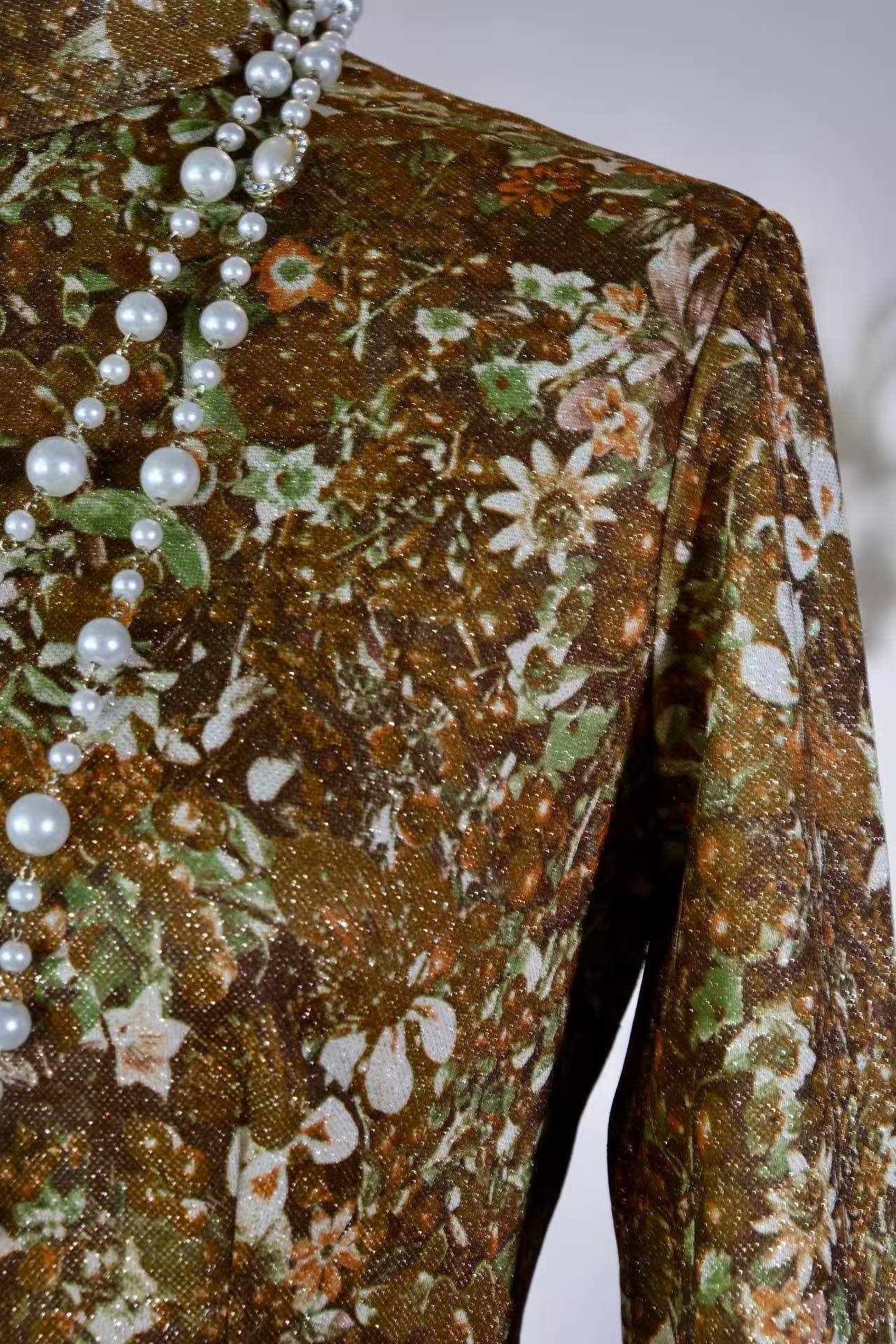
这件旗袍最引人入胜之处,在于其面料的独特性。它并非传统的丝绸印花或刺绣,而是采用了上世纪六十年代极为罕见的意大利进口“油画织银”提花面料。
- 视觉肌理: 细观衣身,面料表面呈现出一种类似印象派油画的厚重质感。底色调和了赭石、古铜与暗金,仿佛秋日午后斑驳的阳光洒在古老的庭院中。
- 花卉纹样: 图案并非具象的工笔花鸟,而是抽象化的繁花似锦。白色的雏菊、橙红的野花与翠绿的枝叶交织缠绕,通过金银丝的混织,使得花朵在光线下熠熠生辉,仿佛自带光源。这种织法让图案具有浮雕般的立体感,既有西方纺织工业的精密,又保留了东方审美的写意。
- 银丝游走: “织银”工艺是点睛之笔。银线并非大面积铺陈,而是如游丝般穿梭于花叶之间,随着穿着者的走动,衣褶间会流淌出若隐若现的金属光泽,低调而奢华。
二、 剪裁与形制:海派风华的巅峰时刻
从服装史的角度审视,这件旗袍的剪裁精准地定格了1960年代香港旗袍的黄金时代特征。
- 西式立体剪裁: 此时的香港旗袍已完全脱离了清末民初的平面裁剪,大胆引入了西方的省道(Darts)与装袖工艺。请看其肩部线条圆润挺括,腰部收省极其贴合人体曲线,完美勾勒出女性的S型身段。这是一种“东方的韵味,西方的骨架”。
- 经典的立领与长袖: 尽管融入了西式剪裁,但它依然坚守了中式旗袍的灵魂——那高耸而精致的元宝领,以及长度及腕的长袖设计。这种克制与包裹,反而衬托出一种端庄典雅的贵族气质,与繁复华丽的面料形成了完美的平衡。
三、 历史语境与稀缺性:大时代下的奢侈品
张爱玲在《更衣记》中曾写道:“对于不会说话的人,衣服是一种语言,随身带着的是袖珍戏剧。”这件旗袍,正是那个时代最华丽的一出戏。
- 产地与背景的互文: 20世纪60年代的香港,正处于东西方文化剧烈碰撞与融合的时期。当时的上流社会名媛,热衷于定制旗袍,而顶级的面料往往来自欧洲。这件旗袍选用意大利进口面料,由香港本地顶级裁缝制作,本身就是那个时代全球化贸易与本土精湛技艺结合的产物。
- 稀缺的艺术价值: 在那个年代,能够拥有如此重工织银面料的旗袍,绝非普通人家所能企及。它是身份的象征,是出席重要场合的战袍。历经六十载岁月,织银面料极易氧化变黑或断裂,但这件藏品保存完好,光泽依旧,实属凤毛麟角。它不仅是一件古董衣,更是研究战后香港时尚史、纺织贸易史的珍贵实物标本。
四、 结语
这不仅仅是一件旗袍,它是穿在身上的艺术史。它将意大利的浪漫织造技艺与香港的匠心剪裁完美熔铸,如同一首用金银丝线谱写的旧日情歌。在这个快时尚泛滥的年代,这样一件经得起时间审视、承载着厚重历史的孤品,值得被每一位懂它的藏家珍藏。
Measurements / Size Guide:
Bust / Waist / Hips / Total Length: 96/82/100/103 cm
Detailed Description:
The most captivating dimension of this specimen resides in the radical singularity of its material matrix. Diverging entirely from traditional silk prints or classical embroidery, it is constructed from an imported Italian "oil-painting style" silver-woven jacquard—a textile of exceptional rarity during the 1960s.
Visual Texture: Micro-inspection of the garment body reveals a dense, heavy surface topography heavily reminiscent of an Impressionist oil canvas. The ground coloration balances undertones of yellow ochre, warm bronze, and antique matte gold, evoking mottled autumn afternoon sunlight filtering into an ancient courtyard.
Botanical Iconography: The motifs eschew literal, fine-line traditional flower-and-bird illustrations (gongbi), pivoting instead toward an abstracted vision of blooming flora. White daisies, bittersweet orange wild blossoms, and jade-green foliage twist and interlock across the field. Through the complex core-spinning of gold and silver metallic threads, the blossoms gleam brilliantly under changing light as if lit from an internal source. This technical weave grants the pattern a high-relief, sculptural dimension—synthesizing the precision of Western textile engineering with the free-hand lyricism (xieyi) of Eastern aesthetics.
The Trajectory of Silver Filaments: The "silver-weaving" process serves as the structural punctuation mark of the textile. Rather than being deployed across large, unmediated planes, the silver filaments snake like fine webs between the petals and leaves. As the wearer moves, an intermittent, fluid metallic luster shifts within the architectural folds of the cloth, projecting a low-profile yet absolute luxury.
From the perspective of dress history, the pattern drafting of this specimen permanently captures the definitive morphological markers of the 1960s Hong Kong qipao golden age.
Western Three-Dimensional Drafting: By this decade, the Hong Kong qipao had completely emancipated itself from the two-dimensional, flat pattern-cutting of the late Imperial and early Republican eras. It aggressively adopted European structural darts and set-in sleeve construction. The shoulder lines are rounded yet crisp, while the engineered waist-reduction darts conform strictly to the curves of the biological form, flawlessly tracing the anatomical S-silhouette. It represents an absolute balance: Eastern poise supported by a Western structural armature.
The Classic Mandarin Collar and Full Sleeves: Despite the integration of Western tailoring engineering, the garment maintains absolute fidelity to the soul of Chinese dress—specifically through its tall, meticulously sculpted Mandarin collar (yuanbaoling) and full-length sleeves extending precisely to the wrist bones. This structural restraint and physical closure establish a formal, aristocratic composure, striking an impeccable equilibrium with the heavy, complex opulence of the textile.
As Eileen Chang famously posited in Reflections on Clothing (Geng Yi Ji): "For those who cannot speak, clothes are a language, a pocket theater carried upon the body." This qipao stands as one of the most brilliantly staged material dramas of its era.
Provenance and Geopolitical Synthesis: The Hong Kong of the 1960s operated as a volatile geographic crossroads where Eastern and Western cultures collided and synthesized. High-society elites and socialites commissioned bespoke qipaos as their mandatory public uniform, routinely sourcing premier yardage directly from Europe. This specimen—utilizing imported Italian textile manipulated by elite local artisans—stands as a direct physical archive of globalized trade routes intersecting with regional craft specialization.
Archival Premium and Preservation: During this period, owning a qipao built from such heavily manipulated, silver-woven textile was restricted to the highest economic echelons; it functioned as a visual marker of status and an aesthetic armor for elite civic occasions. Across a sixty-year historical timeline, silver-woven textiles are highly vulnerable to localized fracturing, structural embrittlement, and severe atmospheric oxidation. That this artifact survives in a pristine state of preservation, maintaining its original metallic brilliance, is an absolute anomaly. It serves as an elite, non-renewable material specimen for the study of post-war textile trade and East Asian fashion history.
This garment transcends the utilitarian boundaries of apparel to exist as a physical manifest of art history. By fusing the romantic textile engineering of Italy with the rigorous, bespoke cutting of the Hong Kong tailoring lineage, it functions as a silent love song written in gold and silver filigree. In an era dominated by rapid mass-production, this unique specimen—capable of enduring rigorous curatorial scrutiny and carrying the profound weight of its historical era—remains an irreplaceable treasure for the dedicated archivist.