深圳溯源
Couldn't load pickup availability
衣服尺寸:
胸围/腰围/臀围:92/76/98 厘米
衣长:131 厘米
细节描述:
“锦衣若梦,丝绒生香。”
在古董衣的浩瀚星河中,如果说丝绸是东方的温婉低语,那么丝绒便是那个时代最华丽的咏叹调。今日为您呈献的这件珍品,产自上世纪六十年代的香港——那个东西方文化激烈碰撞、时尚美学登峰造极的黄金年代。
一、 纹样解码:暗香浮动的几何诗篇
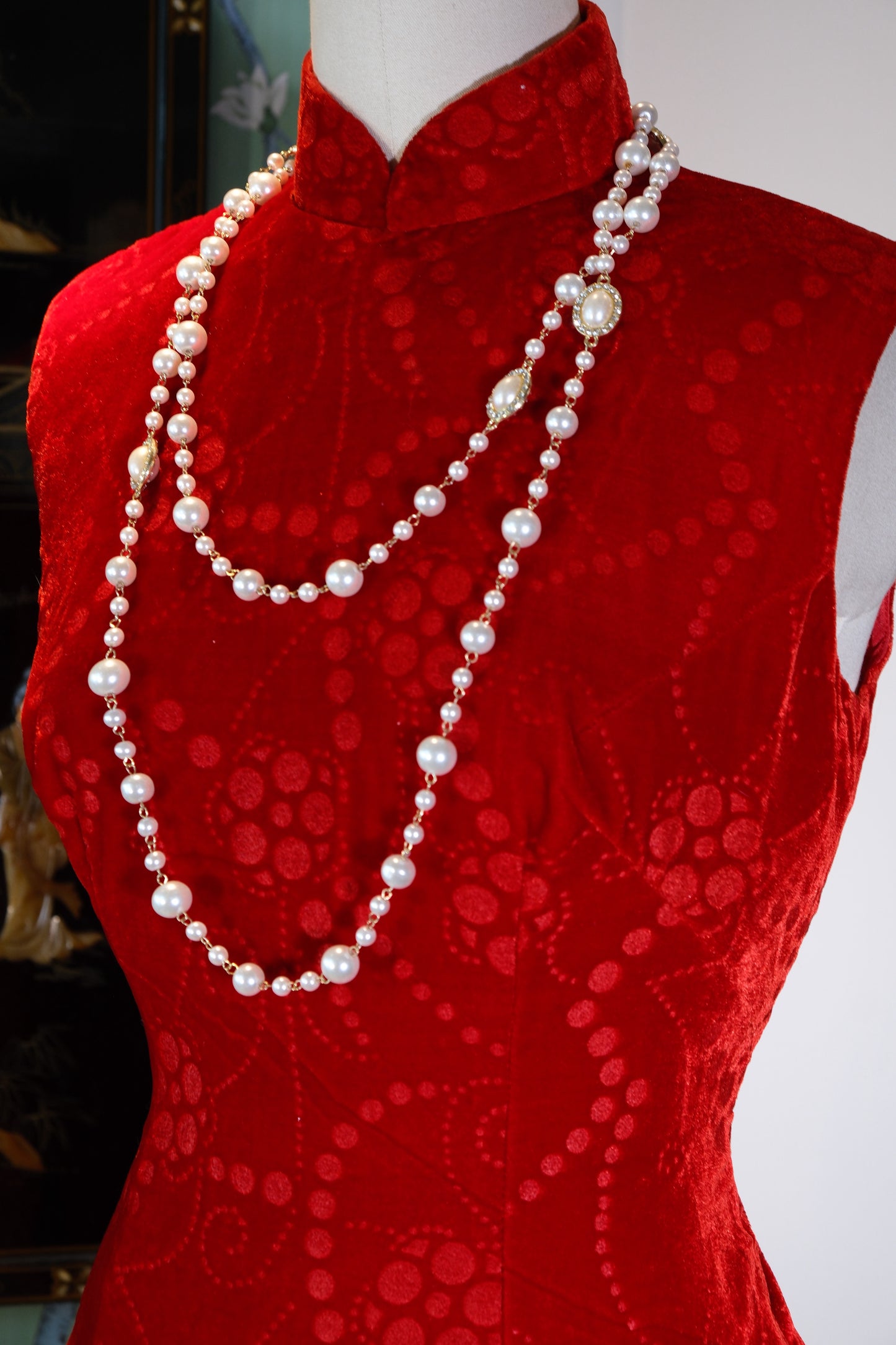
这件旗袍最引人入胜之处,在于其面料上繁复而精妙的暗纹压花工艺。
不同于传统的平面印花,这种工艺利用丝绒面料本身的倒顺毛特性,通过高温高压将图案“压”入织物肌理之中。细观其纹样,并非具象的花鸟虫鱼,而是一种极具现代主义色彩的抽象几何团花。
- 构图: 图案以圆形的点阵为骨架,如同老式留声机的唱片纹路,又似夜空中绽放的烟花。它们以不规则的菱形网格排列,疏密有致,打破了传统旗袍纹样的对称刻板。
- 光影: 这种暗纹在自然光下若隐若现,唯有当穿着者走动时,随着丝绒光泽的流转,那些红色的团花才会如呼吸般显现。这正应了古人云“衣裳有制,纹饰有章”,这里的“章”,不再是皇权的象征,而是六十年代女性追求独立、神秘与摩登的自我表达。
二、 剪裁与形制:西风东渐下的极致曲线
此衣乃典型的六十年代港派改良旗袍。
彼时的香港裁缝深受好莱坞电影与西方立体剪裁的影响,大胆引入了归拔工艺与西式省道。请看那高耸挺括的立领,依然坚守着东方的端庄;然而视线下移,腰身的收束极度贴合人体工学,臀部的线条圆润饱满,直至下摆处微微散开形成优雅的鱼尾状曳地长裙。
这种“S”型廓形,是对张爱玲笔下那些“乱世佳人”形象的最完美注脚。它不再束缚女性的身体,而是极力彰显女性的第二性征,那是属于那个时代的性感与自信。无袖的设计(或削肩设计)更是为了配合当时流行的晚宴社交,露出圆润的肩头,搭配一条长珍珠项链,便是那个年代名媛的标准像。
三、 稀缺性与艺术价值:不可复制的时代孤品
为何说它是稀缺的艺术品?
1. 面料的绝版: 六十年代的厚重丝绒(Velvet)与今日的化纤丝绒截然不同。那时的丝绒多为棉底或真丝底,手感敦实温润,垂坠感极佳,且随着岁月流逝,这种老料子会呈现出一种类似包浆的醇厚色泽,俗称“旧气”,是新面料无法模仿的。
2. 工艺的失传: 这种大面积的暗纹压花且保持丝绒不秃毛的工艺,对当年的机器和工匠要求极高。如今即便有钱,也难寻这般地道的老港工。
3. 保存的难度: 丝绒极难保存,易受潮、易倒毛、易虫蛀。这件旗袍历经六十载春秋,色泽依然如陈年红酒般醉人,绒毛依然丰盈,实属凤毛麟角。
四、 结语:穿在身上的文学
沈从文先生在《中国古代服饰研究》中曾言,服饰是“穿在身上的历史”。
这件红色丝绒旗袍,不仅仅是一件衣服,它是王家卫电影里那一抹挥之不去的暧昧红光,是李安《色·戒》中王佳芝眼波流转间的风情万种。它见证了那个中西合璧、纸醉金迷的香江往事。
拥有它,不仅是收藏了一件绝世美衣,更是珍藏了一段关于美、关于时间、关于东方女性觉醒的辉煌记忆。
Measurements / Size Guide:
Bust / Waist / Hips: 92/76/98 cm
Total Length: 131 cm
Detailed Description:
Within the grand universe of textile conservation, if pure silk represents the soft, modest whisper of Eastern heritage, premium velvet stands as its most operatic and magnificent aria. This exceptional masterwork traces its material lineage back to 1960s British Hong Kong—a legendary historical nexus marked by the fierce collision of post-war Western design principles and high-toned Eastern tailoring.
The definitive design triumph of this garment lies within its complex, highly sophisticated embossed matte velvet topography (anwen yahua).
Departing entirely from superficial surface printing, mid-century artisans weaponized the natural pile directional properties of high-register velvet, deploying targeted high-temperature and hydraulic pressure systems to permanently mold the motif deep into the structural grain of the textile.
The Avant-Garde Composition: The structural layout abandons predictable, traditional floral motifs in favor of abstract, modernist geometric medallions. Utilizing concentric dot-matrix configurations that mimic the grooved tracks of a vintage gramophone vinyl record, the medallions are arranged across an irregular diamond grid matrix. This calculated asymmetry successfully shatters the rigid, predictable symmetry found in ancestral regional dresses.
The Refractive Shifting: This dark embossing remains almost invisible under flat, direct light. However, the instant the wearer moves, the deep crimson medallions reveal themselves sequentially like a slow breath, responding to the natural fluid movement of the velvet pile. This physical phenomenon perfectly echoes historical textile philosophy where ornamentation remains completely subservient to the living movement of the human form—transforming surface decoration into a mysterious statement of mid-century cosmopolitan independence.
This gown serves as a definitive textbook specimen of the 1960s Hong Kong-style改良 qipao (gang-gong banxing).
During this golden era of costume history, Hong Kong master tailors, heavily influenced by Hollywood’s Golden Age cinema and Western anatomical draping, integrated radical Western three-dimensional darting and traditional iron-molding manipulation (归拔 / gui-ba) into traditional flat pattern making.
The Structural Balance: The mandarin collar rises exceptionally tall, stiff, and resolute, anchoring the traditional, disciplined dignity of the upper neck plane. Yet, as the gaze travels downward, the pattern layout shifts into an aggressive, anthropomorphic silhouette. The waistline tapers with millimeter precision, and the hip trajectory curves out organically, cascading down into an elegant, sweeping fishtail hemline that puddles beautifully across the floor.
The Liberation of Form: This fluid S-curve silhouette operates as an explicit material rejection of early-century restriction. It boldly accentuates the natural topography of the female form, translating mid-century confidence into pure geometry. The sleeveless, slightly recessed shoulder draft (xiao-jian) was custom-engineered specifically for high-society nighttime networking, gracefully exposing the shoulder lines to be framed by a classic strand of hand-selected pearls—the ultimate visual calling card of a mid-century Hong Kong matriarch.
From an academic textile conservation perspective, this specimen possesses an elite valuation based on three strict technical criteria:
The Extinction of Archival Velvet Matrixes: The heavy-weight velvet of the 1960s operates in a completely different category from modern synthetic polyester variants. This textile utilizes a robust, dense organic cotton or pure silk foundational ground, granting the garment a heavy, substantial tactile drop and perfect fluid drape. Over six decades of careful preservation, this specific composition develops a deeply mellowed, historic patina—a soft, internal glow that contemporary automated mills are structurally incapable of replicating.
The Loss of Master Press Engineering: Managing a full-body embossed pattern across dense velvet without destroying the pile or causing premature fiber baldness required an exceptional level of mechanical precision and artisanal temperature intuition. This specific breed of old-school Hong Kong craftsmanship has largely vanished from modern commercial supply chains.
The Miracle of Physical Preservation: Organic velvet is an incredibly volatile material matrix, highly prone to moisture degradation, pile crushing, permanent folding lines, and moth damage. For this gown to cross sixty years of history with its crimson color registers completely saturated like a cellared vintage wine, its structural interlining uncollapsed, and its pile remaining fully intact and lush is an exceptional rarity within material collections.
This crimson velvet qipao transcends the parameters of standard attire; it is a sealed piece of historical literature transformed into a wearable masterpiece. It captures the haunting, atmospheric crimson lighting of classic mid-century Hong Kong cinema and documents an era where cross-cultural sophistication and female independence achieved an absolute, unshakeable equilibrium. To own this piece is to preserve more than a breathtaking vintage silhouette; it is to secure a permanent, tangible archive of a golden era where time, craft, and style converged to write an eternal poem of Eastern grace.
Suyuan Silk Archive — Preserving the soul of historic textiles, documenting the lineage of master craft.