溯源
Couldn't load pickup availability
衣服尺寸:
胸围/腰围/臀围/衣长:104/100/110/115 厘米
细节描述:
【图案赏析:抽象写意与东方韵律的交响】
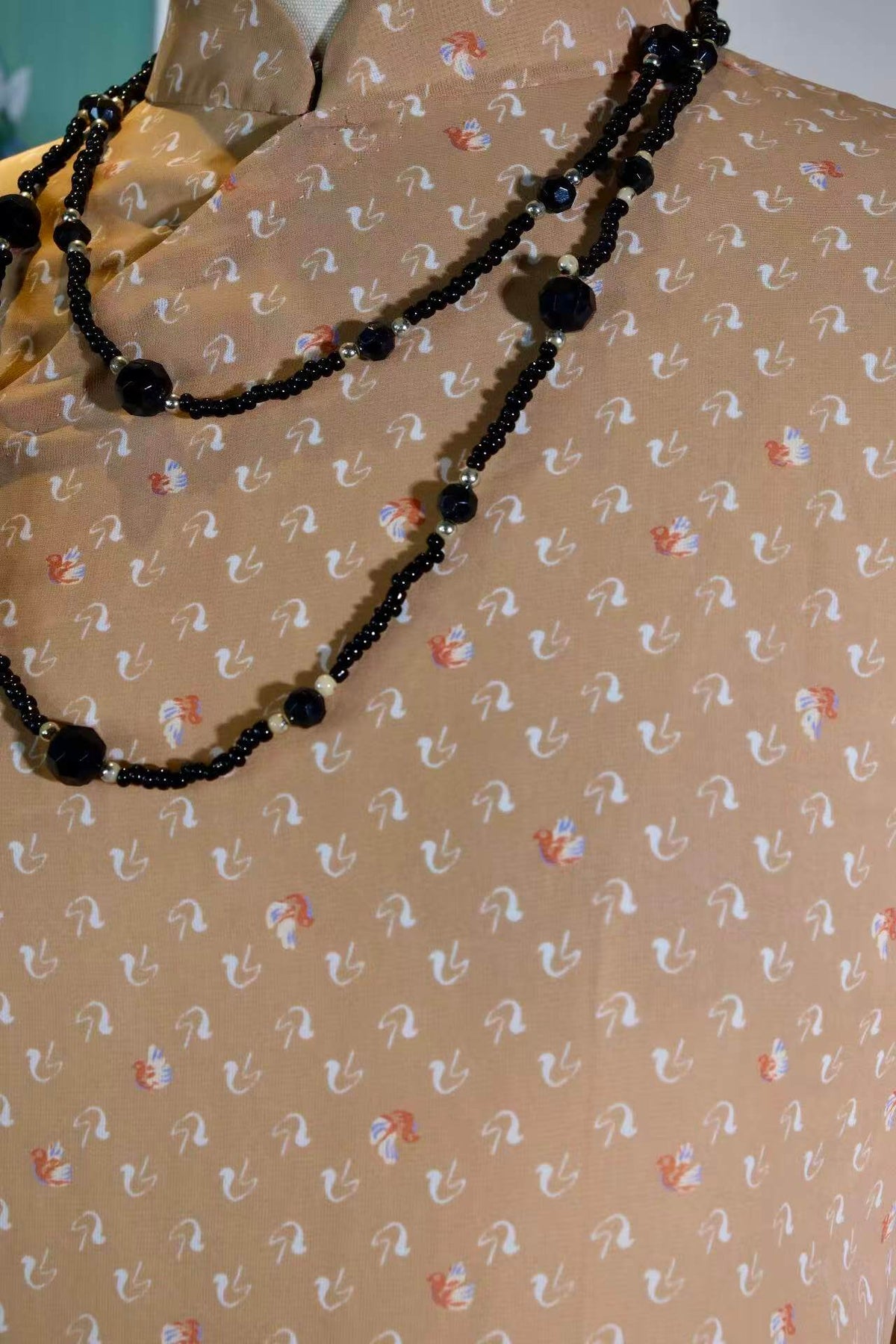
这件旗袍的视觉核心,在于其面料上独特的印花纹样。不同于传统旗袍中具象的牡丹、凤凰或山水,它采用了一种极具现代主义色彩的“抽象飞鸟”纹样。
细看之下,这些图案并非对自然界鸟类的如实描摹,而是经过高度提炼的符号化表达。白色的线条勾勒出类似“乙”字或云气的流动形态,宛如惊鸿一瞥的飞羽,又似书法中枯笔扫过的痕迹,充满了动感与速度感;而点缀其间的朱红与淡蓝小点,则像是鸟儿振翅时留下的斑斓光影,或是春日里飘落的花信。这种“似与不似之间”的艺术处理,既保留了中国传统绘画中“气韵生动”的美学追求,又暗合了六十年代全球范围内兴起的抽象表现主义潮流。它们在米黄色的底布上疏密有致地排列,如同漫天飞雪,又似群鸟归林,营造出一种空灵、透气且富有节奏感的视觉韵律。
【历史叙事:宝岛风华与西风东渐的缩影】
若要追溯这件衣裳的灵魂,我们必须将目光投向上世纪六十年代的台湾。那是一个特殊的历史时空,也是旗袍发展的“黄金余晖”时期。
彼时的台湾,正处于从传统农业社会向现代工商业社会转型的阵痛与新生之中。一方面,随国民政府迁台的大陆移民带来了京派与海派旗袍的精湛技艺与正统形制;另一方面,台湾本土的气候特征(炎热潮湿)以及受美国文化影响的开放风气,促使旗袍发生了深刻的在地化改良。
这件旗袍正是这一时代的完美见证。
- 面料的革命: 为了适应亚热带气候,传统的厚重织锦缎被轻薄透气的人造丝或尼龙薄纱所取代。这种面料在当时被称为“洋纱”,它不仅解决了穿着的舒适度问题,更赋予了旗袍一种前所未有的朦胧美与现代感。
- 剪裁的演变: 观察其版型,依然保留了海派旗袍严谨的归拔工艺,胸省与腰省的精准处理勾勒出女性曼妙的曲线。然而,其袖口略微放宽,领口高度适中,不再像三十年代那般极度束缚,体现了一种更为从容、生活化的穿着态度。这不仅是服装史的演变,更是当时女性社会地位提升、追求自由解放的无声宣言。
【艺术风格与稀缺性:引经据典下的孤品价值】
古人云:“罗衣何飘飘,轻裾随风还。”(曹植《美女篇》)这件旗袍恰恰诠释了这种古典文学中的轻盈意象。
从艺术风格上看,它属于“中西合璧”的典范。它将中国传统服饰的平面裁剪智慧(如连袖结构)与西方的立体造型理念(如省道运用)完美融合。面料上的抽象纹样,让人联想到宋代瓷器上的刻花,简约而不简单;而其整体的廓形,又呼应了六十年代国际时尚界推崇的“A型”或“H型”线条的过渡期特征——既有曲线的柔美,又不失直线的利落。
稀缺性在于:
1. 保存难度极大: 六十年代的薄纱面料极为娇贵,历经六十载岁月,极易脆化、褪色或破损。能像图中这样色泽温润、印花清晰、且整体结构完整的实物,实属凤毛麟角。
2. 时代断代标本: 它是研究战后台湾纺织工业发展与服饰审美变迁的活化石。那个特定年代的“台湾产”标签,代表了一段不可复制的纺织历史——那是台湾纺织业起飞的前夜,工匠们用最有限的材料,创造出了最惊艳的时尚。
3. 审美孤本: 这种特定的抽象小鸟印花,并非大规模工业化生产的通用花型,极有可能是当时某家知名布庄的定织定染款。它不具备现代快时尚的复制性,每一寸纹理都承载着那个时代独有的手工温度与审美情趣。
结语:
这不仅是一件衣服,更是一首穿在身上的散文诗。它记录了那个年代女性在传统与现代夹缝中绽放的优雅身姿,也封存了一段关于海峡对岸的流金岁月。拥有它,便是拥有了一段触手可及的历史体温。
Measurements / Size Guide:
Bust / Waist / Hips / Total Length: 104/100/110/115 cm
Detailed Description:
[Pattern Appreciation: Symphony of Abstract Expression and Eastern Rhythm]
The visual core of this cheongsam lies in the unique printed pattern across its fabric. Departing from concrete peonies, phoenixes, or landscapes found in traditional cheongsams, it adopts an "abstract flying bird" motif filled with modernist color sensibilities.
Upon close inspection, these patterns do not faithfully depict birds in nature, but represent highly refined, symbolic expressions. White lines outline flowing forms resembling the character "乙" (yi) or swirling clouds, like a fleeting glimpse of flying plumage or dry-brush strokes sweeping across a calligraphy canvas, brimming with dynamism and speed. Meanwhile, the small vermilion and light-blue dots scattered throughout resemble iridescent light and shadow left behind as birds flap their wings, or spring blossom signals drifting through the air. This artistic treatment of "hovering between resemblance and non-resemblance" preserves the aesthetic pursuit of "vital movement" (Qi Yun Sheng Dong) in traditional Chinese painting while quietly aligning with the global wave of Abstract Expressionism emerging in the 1960s. They are arranged with rhythmic density across the beige base fabric, like snow swirling through the sky or flocks returning to the forest, creating an ethereal, breathable, and rhythmic visual cadence.
[Historical Narrative: A Epitome of Island Grace and Western Influence]
To trace the soul of this garment, we must direct our gaze to Taiwan in the 1960s. That was a unique historical period and the "golden twilight" era for the evolution of the cheongsam.
Taiwan at that time was experiencing the growing pains and rebirth of transitioning from a traditional agricultural society to a modern industrial and commercial one. On one hand, mainland immigrants who migrated to Taiwan brought exquisite craftsmanship and orthodox silhouettes from both the Beijing-style (Jingpai) and Shanghai-style (Haipai) cheongsam traditions; on the other hand, Taiwan's local climate characteristics (hot and humid) and an open atmosphere influenced by American culture prompted profound local modifications to the cheongsam.
This cheongsam stands as a perfect witness to that era.
Revolution in Fabric: To adapt to subtropical climates, heavy traditional brocade satins were replaced by light, breathable rayon or nylon sheer. Known at the time as "foreign gauze" (Yang Sha), this fabric solved comfort issues while imparting an unprecedented misty beauty and sense of modernity to the cheongsam.
Evolution of Tailoring: Examining its silhouette, it retains the rigorous shaping and ironing techniques (Gui Ba) of Shanghai-style cheongsams, with precise bust and waist darts sculpting a woman's graceful curves. However, the cuffs flare slightly wider and the collar height sits at a moderate level—no longer excessively binding like the 1930s—reflecting a more relaxed, daily wearing attitude. This represents not only an evolution in clothing history, but a silent manifesto of women's rising social status and pursuit of freedom and liberation.
[Artistic Style and Rarity: One-of-a-Kind Value Drawn from Classics]
The ancients wrote: "How her silk garments flutter, her light skirts returning with the wind." (Cao Zhi, The Beautiful Lady). This cheongsam interprets precisely this lightweight imagery from classical literature.
From an artistic style perspective, it serves as a paragon of "East-meets-West" harmony. It seamlessly integrates the flat-pattern cutting wisdom of traditional Chinese attire (such as cut-on sleeve structures) with Western three-dimensional tailoring concepts (such as dart placement). The abstract pattern on the fabric evokes carved floral motifs on Song Dynasty porcelain, simple yet far from plain; its overall silhouette echoes the transitional characteristics of "A-line" or "H-line" contours championed by the international fashion world in the 1960s—possessing both the soft grace of curves and the crispness of straight lines.
Its rarity is defined by:
Extreme Preservation Difficulty: Sheer fabrics from the 1960s are extraordinarily delicate. Over six decades of time, they easily become brittle, fade, or tear. Finding a physical specimen like this with warm colors, clear printing, and an intact overall structure is a true rarity.
Historical Specimen of an Era: It is a living fossil for studying the post-war development of Taiwan's textile industry and shifts in apparel aesthetics. The "Taiwan Made" label from that specific period represents an irreplaceable textile history—the eve of Taiwan's textile boom, where artisans created the most breathtaking fashion using the most limited materials.
Aesthetic Unique Specimen: This specific abstract bird print was not a generic pattern for mass industrial production, but very likely a custom-woven and custom-dyed design commissioned by a prominent fabric house of the era. It lacks the replicability of modern fast fashion; every inch of texture carries the unique artisanal warmth and aesthetic flavor of that era.
Epilogue:
This is not merely a piece of clothing, but a prose poem worn on the body. It records the elegant posture of women blooming between tradition and modernity during that decade, sealing away a slice of golden history from across the strait. To own it is to possess a tangible, touchable warmth of history.