深圳溯源
Couldn't load pickup availability
衣服尺寸:
胸围/腰围/臀围:100/84/102 厘米
衣长:102 厘米
细节描述:
一、图案:暗香浮动的“墨戏”美学
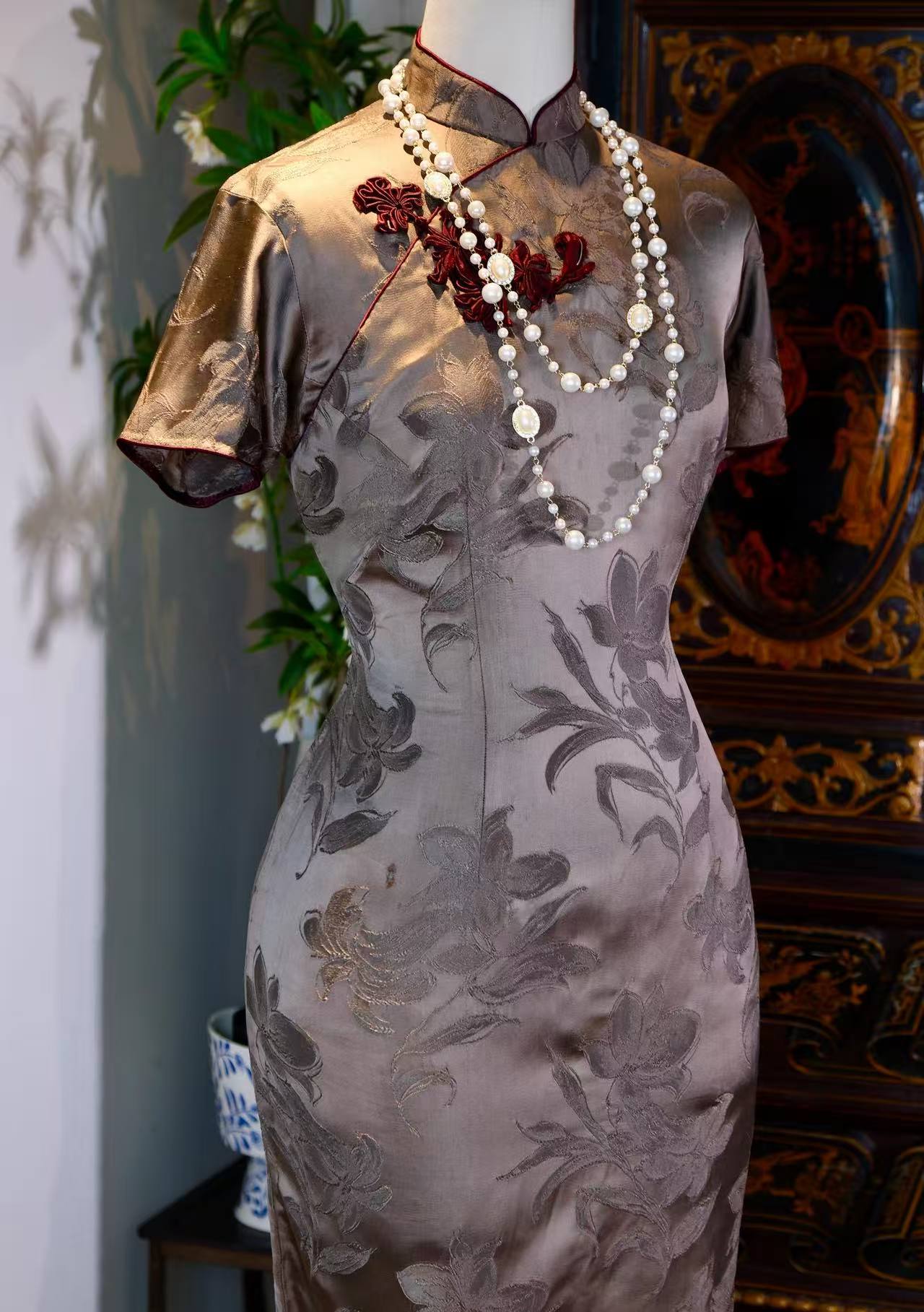
这件旗袍的面料,是上世纪五十年代意大利进口的提花织物,却以东方笔触写就了西方工业时代的精致。烟灰色底布上,暗纹花卉如雾中花、水中月,以“墨戏”般的写意姿态舒展——叶片似柳非柳,花瓣若兰非兰,线条在提花织机的精密控制下,呈现出宋元文人画“逸笔草草”的留白意境。这种“似与不似之间”的图案设计,恰如明代画家徐渭所言“不求形似求生韵”,在西方机械复制时代,反而复活了东方艺术“以形写神”的古老灵魂。
更妙的是,暗纹在不同光线下会呈现微妙的灰度变化:日光下如青瓷开片,灯光下似水墨晕染,行走间衣料流动,花叶仿佛在烟灰色雾霭中“活”了过来。这种“动态的静美”,正是五十年代香港旗袍设计的精髓——既非传统旗袍的浓墨重彩,也非西式礼服的直白张扬,而是在东西方美学的夹缝中,长出的“第三种诗意”。
二、故事:从米兰织机到香江裁缝铺的漂流记
1950年代的香港,是东西方贸易的“中转站”,也是旗袍艺术的“实验室”。这件旗袍的面料,诞生于意大利北部的丝绸工坊——彼时欧洲纺织业正从战后复苏,提花织机技术达到新高度,却因市场饱和,大量面料被运往远东。香港的裁缝师傅们如获至宝,用这些“西洋料”做“中国衣”,竟意外催生了旗袍史上的“黄金时代”。
可以想象:一卷烟灰色提花面料漂洋过海,落在中环某间裁缝铺。师傅用米尺量过客人的腰身,粉笔在布料上画出流畅的曲线,剪刀落下时,意大利的工业精密与香港的手工温度便融为一体。领口的绛红色滚边,是师傅特意加的“中国红”;胸前的绛红盘扣,做成缠枝莲纹,暗合《长物志》中“贵精不贵丽”的审美;而旗袍的收腰、开衩,则严格遵循五十年代香港流行的“海派改良”——既保留传统旗袍的立领、斜襟,又融入西式剪裁的立体感,让女性的曲线在含蓄中绽放。
这件旗袍的主人,或许是位穿梭于中环写字楼与太平山顶舞会的“新女性”:白日里,她穿着它谈生意,烟灰色的低调衬出专业;夜晚,配上珍珠项链,它又化作舞池里的“月光”,在爵士乐中摇曳生姿。它是殖民地的“混血儿”,却比任何纯血服饰都更懂东方女性的身体与灵魂。
三、稀缺性:当“不可复制”成为艺术的注脚
这件旗袍的稀缺,不仅在于“五十年代”“香港产”“意大利进口面料”这些标签,更在于它所承载的“时代断层”——
- 面料的绝版:1950年代的意大利提花织机,如今已被数控织机取代,那种“带着手工温度的机械纹理”再也无法复刻;
- 剪裁的消逝:五十年代香港旗袍的“海派改良”,是特定历史时期的产物——彼时上海裁缝南迁,与本地师傅碰撞出的火花,随着老一辈裁缝的离去,已成绝响;
- 审美的孤本:烟灰色暗纹的设计,在五十年代旗袍中极为罕见。彼时主流是鲜艳印花或素色绸缎,这种“低调的奢华”,更像是设计师的“私人实验”,存世量极少。
正如艺术史家贡布里希所言:“艺术的价值,往往在于它对‘常规’的突破。”这件旗袍,正是五十年代香港旗袍界的一次“突破”——它用西方面料讲东方故事,用工业技术写手工诗意,在“传统”与“现代”、“东方”与“西方”的夹缝中,找到了属于自己的“第三条路”。
如今,当我们凝视这件旗袍,看到的不仅是一件衣服,更是一段被织物封存的“南洋旧梦”——那些在香江码头卸下的面料卷,那些在裁缝铺里闪烁的剪刀光,那些穿着它走过殖民地街道的女性身影,都在烟灰色暗纹里,静静等待着被重新讲述。
Measurements / Size Guide:
Bust / Waist / Hips: 100/84/102 cm
Total Length: 102 cm
Detailed Description:
[I. Motifs: The Elusive Aesthetics of the "Ink-Play" Pattern] The textile of this Qipao—an imported Italian jacquard from the 1950s—deploys the geometric precision of the Western industrial age to execute a distinctly Eastern poetic brushwork. Upon the smoky gray ground, shadow-woven floral motifs unfurl like blossoms in a mist or the reflection of the moon in water, mimicking the expressive, calligraphic freedom of traditional Chinese Moxi (ink-play) paintings. The foliage mimics willow leaves yet remains distinct; the petals hint at orchids yet veer into abstraction. Under the meticulous tension of the mid-century jacquard loom, these lines revive the effortless, lingering spirit of Song and Yuan Dynasty literati paintings. This design—suspended between "the figurative and the abstract"—perfectly echoes the Ming Dynasty master Xu Wei’s artistic philosophy: "seeking not literal likeness, but the manifestation of living vitality." Within an era of mechanical reproduction, it miraculously resurrects the ancient Eastern soul of "capturing the spirit through form."
More enchanting still is how these subtle patterns shift in gray-scale variance under changing illumination: in daylight, they mimic the fine crackle of Song Dynasty celadon glazes; under evening lights, they diffuse like ink washing into raw rice paper. As the wearer moves, the textile flows, making the blossoms and foliage appear to "come alive" within a smoky gray haze. This "kinetic serenity" is the absolute quintessence of 1950s Hong Kong Qipao design—steering clear of the literal, heavy pigments of traditional robes and the overt, theatrical declaration of Western evening gowns, choosing instead to bloom as a "third poetic space" between Eastern and Western aesthetics.
[II. The Chronicle: An Odyssey from Milanese Looms to Hong Kong Tailor Shops] During the 1950s, Hong Kong operated as the grand entrepôt of East-West trade and the definitive avant-garde laboratory for Qipao design. The fabric of this garment was birthed in the historic silk mills of Northern Italy. As the European textile industry reconstructed itself post-WWII, mechanical jacquard engineering hit unprecedented heights; yet faced with domestic market saturation, vast bolts of premium yardage were shipped to the Far East. Hong Kong’s master tailors recognized these "Western materials" as absolute treasures, using them to fashion "Chinese silhouettes," inadvertently sparking a golden epoch in sartorial history.
One can easily envision the scene: a bolt of smoky gray jacquard crosses the oceans, coming to rest in a tailoring atelier in Central. The master tailor wraps his tape measure around a client's waist, maps out fluid curves with tailor's chalk, and as his shears descend, Italian industrial precision fuses seamlessly with the warmth of Hong Kong hand-craftsmanship. The rich crimson piping (Jianghong) along the collar was deliberately introduced by the master as a nod to traditional "China Red." The crimson frog closures decorating the chest are twisted into interlocking lotus motifs, whispering the aesthetic rule from the Ming Dynasty text Treatise on Superfluous Things (Chang Wu Zhi): "valuing refined precision over gaudy opulence." Concurrently, the cinched waist and side vents strictly adhere to the ergonomic "Shanghai-style refinement" dominant in mid-century Hong Kong—preserving the structural mandarin collar and diagonal opening while integrating Western three-dimensional draping to allow the female silhouette to bloom within absolute modesty.
The original custodian of this piece might well have been a "New Woman" navigating the corporate banking halls of Central by day and the elite balls of Victoria Peak by night. In the daylight, she wore it to conduct commerce, the understated smoky gray projecting pristine professionalism; by night, adorned with a pearl necklace, it transformed into liquid moonlight on the jazz-filled dance floor. It is a brilliant cultural hybrid of a colonial era, understanding the contours and spirit of the Eastern female form better than any ethnically pure garment ever could.
[III. Rarity: When "Irreplicability" Becomes the Definitive Archive of Art] The absolute rarity of this Qipao transcends its standard classification tags of "1950s," "Hong Kong-made," and "Imported Italian Textile." Its true worth resides in its status as a physical cross-section of a historical chasm:
The Extinction of the Textile: The 1950s Italian mechanical jacquard looms have long been replaced by modern computerized CNC machinery. That specific "mechanical texture possessing human-hand variation" can never be replicated again.
The Vanishing Technique: The "Shanghai-style refinement" executed by 1950s Hong Kong tailors was the product of a highly specific historical alignment—a brilliant spark ignited when migrating Shanghainese master tailors collided with indigenous Hong Kong craftsmen. With the passing of that generation of masters, this technique has become a lost art.
A Canonical Design Specimen: A smoky gray monochromatic shadow-pattern remains an exceptionally rare anomaly among 1950s Qipaos. In an era dominated by loud, saturated prints or high-gloss solid silks, this "understated opulence" represents a designer’s private avant-garde experiment, leaving an incredibly minuscule survival rate.
As the preeminent art historian Ernst Gombrich noted: "The value of art frequently rests upon its subversion of the 'convention'." This Qipao stands as a definitive subversion in mid-century fashion history—telling an Eastern story through Western textiles, writing manual poetry through industrial machinery, and discovering a "third path" right in the interstice of tradition, modernity, East, and West.
Today, when we gaze upon this Qipao, we are looking at far more than engineered fabric; we are witnessing a "South Sea Dream" meticulously preserved within the fibers of a textile. The bolts of fabric unloaded at the Hong Kong docks, the flash of shears inside mid-century ateliers, and the silhouettes of independent women walking colonial avenues—all remain preserved inside these smoky gray shadow-weaves, silently waiting to be told anew.