深圳溯源
Couldn't load pickup availability
衣服尺寸:
胸围/腰围/臀围:82/72/94 厘米
衣长:106 厘米
细节描述:
【器物之美:针线里的繁花与秩序】
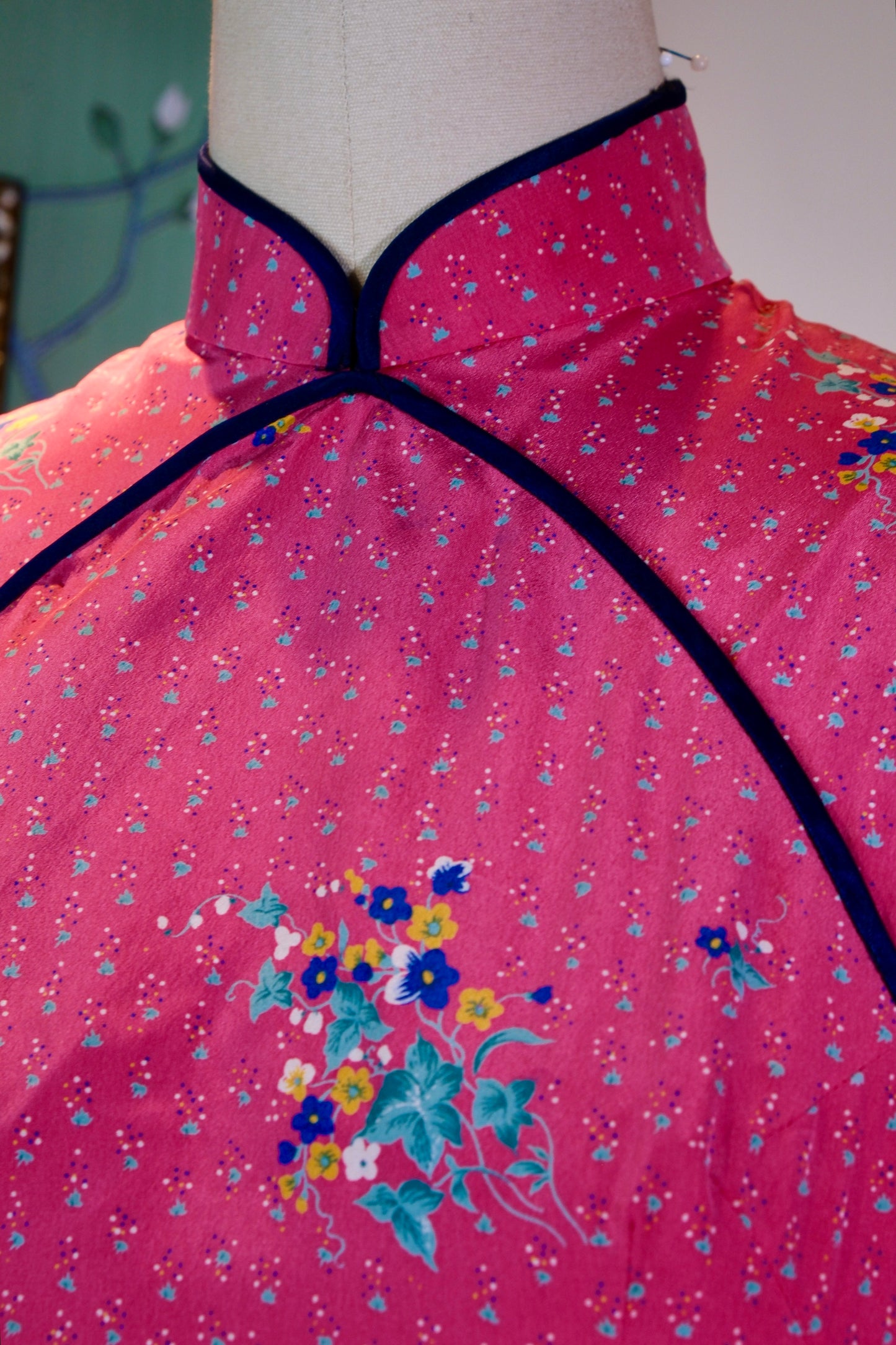
展现在我们面前的,是一件极具上世纪六十年代香港制衣工业黄金期特征的双襟玫红碎花旗袍。
色彩与面料:
其主色调为高饱和度的“玫红”(Rose Red),这种色泽在六十年代的合成纤维或混纺丝绸中极为常见,既保留了传统染织的艳丽,又带有那个时代特有的摩登张力。面料上密布着细碎的白色波点与淡蓝小花,如同夜空中的星尘,构成了极具韵律感的底纹。
图案解析:
最为精妙的是其散点式分布的花卉纹样。这些花朵并非传统的牡丹或龙凤,而是采用了更为清新、西化的“野花丛”设计——蓝色的牵牛花或勿忘我簇拥着黄色的花蕊,配以翠绿的藤蔓叶片。这种图案设计深受当时西方印花纺织品潮流的影响,体现了香港作为东西方文化交汇点的独特审美:既有中式的温婉,又有西式的活泼。
形制工艺:
这件旗袍采用了经典的“双襟”(亦称如意襟或琵琶襟的变体)设计。深海军蓝的滚边(Piping)如墨线勾勒般,沿着领口、肩线蜿蜒而下,不仅勾勒出女性优美的肩颈线条,更在视觉上打破了玫红色的大面积铺陈,增添了稳重感。这种滚边工艺要求极高的手工技巧,是当年香港高级裁缝店(Tailor Shop)水准的见证。
【历史回响:六十年代香江的流金岁月】
要读懂这件旗袍,必须回到那个风起云涌的六十年代香港。
彼时,张爱玲笔下的“传奇”尚未远去,而邵氏电影公司的歌舞片正如火如荼地塑造着新的都市女性形象。那是一个新旧交替、华洋杂处的年代。不同于三十年代老上海的颓废与奢华,六十年代的香港旗袍更加实用、修身且充满活力。
这件旗袍正是那个时代的缩影。它不再是为了深宅大院里的太太们量身定做,而是为了那些出入写字楼、茶餐厅,甚至在片场奔波的现代职业女性设计的。它的剪裁更加贴合人体工学,强调腰臀比,袖子长度适中,方便行动。“双襟”的设计在当时是一种时尚的宣言,它比单襟多了一份含蓄的层次感,又比全开襟多了一份端庄的仪式感,是当时名媛与影星出席半正式场合的首选。
正如文学评论家夏志清所言,那个时代的香港文学与艺术充满了“感性与理性的纠缠”。这件旗袍亦是如此,它在感性的玫红碎花中,蕴含着理性严谨的西式立体剪裁逻辑。
【稀缺性考证:不可复制的孤品】
在古董衣收藏界,六十年代的香港产旗袍之所以珍贵,在于其“过渡性”与“绝版性”。
1. 面料的断代: 图中这种特定的印花工艺与化纤混纺质感,随着七十年代成衣工业化量产的普及而逐渐消失。如今的数码印花无法复刻那种带有温度的、略带颗粒感的复古光泽。
2. 工艺的流失: 注意看领口的立领高度与滚边的平整度。当年的香港师傅讲究“归拔”工艺,通过熨斗的热度让平面布料产生立体弧度,而非单纯依赖省道。这种纯手工的温度,在现代流水线中已难觅踪迹。
3. 品相的奇迹: 历经六十载岁月,这件旗袍的色泽依然鲜亮如初,滚边未见磨损,这在古董衣中实属罕见。它像是一个被封存的时光胶囊,完好地保存了那个年代的审美密码。
【结语:穿在身上的文学史】
《诗经》有云:“岂曰无衣?与子同袍。”衣裳从来不仅仅是蔽体之物,它是文化的载体,是历史的皮肤。
这件玫红碎花双襟旗袍,不仅是一件衣服,更是一首凝固的粤语残片,是一页泛黄的香江时尚史。它见证了东方美学在西风东渐中的自我革新,也记录了无数女性在时代洪流中摇曳生姿的身影。
收藏它,便是收藏了一段回不去的流金岁月;穿上它,便是与六十年代那个风华绝代的自己,进行了一场跨越时空的对话。
Measurements / Size Guide:
Bust / Waist / Hips: 82/72/94 cm
Total Length: 106 cm
Detailed Description:
The artifact arrayed before us is a double-bodice (Shuangjin) magenta ditsy floral qipao, exhibiting the precise technical markers diagnostic of the absolute zenith of Hong Kong’s 1960s apparel manufacturing golden epoch.
Chromatographic Architecture and Materiality: The primary palette relies on a high-saturation "Magenta" (Rose Red). This specific tonal calibration was highly pervasive among the synthesized polymers or silk-blended texturing fibers of the 1960s, successfully safeguarding the absolute opulence of traditional heritage dyeing while projecting a distinct, highly modern mid-century aesthetic tension. The textile matrix is densely populated by minuscule white micro-polka dots and pale blue secondary florets, generating a highly rhythmic, kinetic background canvas reminiscent of cosmic star dust.
Motif Engineering: The most sophisticated execution resides in the scattered, all-over distribution of the primary floral motifs. These botanical illustrations completely break away from traditional peony clusters or sacred dragon-and-phoenix iconography, absorbing instead a fresher, decidedly Westernized "wildflower thicket" blueprint—where clusters of azure morning glories or forget-me-nots encircle brilliant yellow stamens, supported by emerald-green trailing vines and foliage vectors. This composition was deeply conditioned by mid-century international printed textile movements, crystallizing Hong Kong’s unique vantage as a point of cross-cultural reconciliation: it perfectly synthesizes Eastern interiorized grace with Western spirited vitality.
Structural Shape and Craftsmanship: The garment implements a classic "Double-Bodice" configuration (functioning as a highly stylized variant of the traditional Ruyijin or Pipa-style overlapping bodice matrix). A deep navy blue silk piping (Piping / Bianyuan) traces the collar circumference and plunges smoothly along the shoulder seam line like a disciplined ink stroke. This structural intervention simultaneously articulates the anatomical lines of the neck and shoulders while visually slicing through the sweeping expanse of the primary magenta canvas to introduce a grounding, solemn equilibrium. Executing this caliper of piping alignment demanded extraordinary manual tension control, standing as a direct material testament to the high-born standards of period elite Hong Kong tailor shops.
To decode the structural semiotics of this qipao, one must pivot directly back to the hyper-dynamic cultural landscape of 1960s Hong Kong.
During this timeline, the cinematic and literary "legends" penned by Eileen Chang had not yet dissolved into myth, while the musical and dance masterpieces issued by the Shaw Brothers studio were actively formulating a new archetype for the cosmopolitan Asian woman. It was an era of intense epochal transition, characterized by a complex, integrated multi-ethnic urban demographic (Huayang Zachu). Shifting decisively away from the decadent, hyper-luxurious romanticism of 1930s Shanghai, the 1960s Hong Kong qipao evolved toward an intensely practical, highly contoured, and kinetic structural volition.
This specimen operates as a flawless physical crystallization of that macro-societal shift. It was no longer engineered for the cloistered, domestic leisure of aristocratic matrons residing within traditional courtyard mansions; instead, it was custom-tailored for the vanguard of modern professional women navigating high-rise corporate offices, metropolitan tea restaurants (Cha Chaan Tengs), and bustling cinematic studio backlots. Its pattern-drafting adheres strictly to advanced ergonomic principles, emphasizing high-reduction waist-to-hip proportions with mid-length sleeve parameters calibrated for optimal physical mobility. The choice of a double bodice functioned in period fashion terminology as a powerful modernist declaration—introducing a complex, interiorized layer of depth absent in single-bodice patterns, while preserving a stately, ceremonial decorum superior to full-opening configurations. Consequently, it reigned as the premier choice of regalia for prominent socialites and cinema icons attending semi-formal metropolitan assemblies.
As the preeminent literary critic C.T. Hsia famously noted, the literature and art of that specific Hong Kong era pulsed with "the intricate entanglement of the emotional and the rational." This qipao mirrors that exact dialectic: within its highly expressive, emotive magenta ditsy floral exterior operates the cold, mathematically rigorous logic of Western three-dimensional ergonomic darting and construction.
Within the elite networks of antique apparel conservation, 1960s Hong Kong-produced qipaos command an extraordinary premium precisely due to their status as non-reproducible transitional holotypes charting the industrialization of fashion.
Chronological Fabric Discontinuity: The highly specific roller-printing chemistry and exact texture of this synthetic-silk blend systematically vanished following the total triumph of full-scale industrialized ready-to-wear production lines in the 1970s. Contemporary digital surface printing is fundamentally incapable of replicating the specific thermal character and slightly granular, low-relief retro luster native to this textile matrix.
Lineage Discontinuity of Craftsmanship: Particular attention must be paid to the towering stability of the standing collar and the absolute flatness of the piped contours. The master artisans of this epoch relied heavily on the specialized Guiba ("shaping through ironing and stretching") technique, deploying calculated thermal tension from heavy iron-work to compel a flat textile plane to generate permanent, organic three-dimensional shapes rather than relying blindly on excessive structural darting. This absolute human mastery over fabric physics has completely vanished from modern automated assembly chains.
Miraculous State of Preservation: Having traversed more than six decades of environmental timeline, the garment's chromatographic saturation remains completely untarnished, and the structural piping shows zero mechanical abrasion. This represents an extreme statistical anomaly in textile curation. It performs as a flawlessly sealed time capsule, preserving the authentic aesthetic algorithms of its historical epoch.
The ancient Classic of Poetry (Shijing) records: "How can you say you have no clothes? I shall share my robes with you." Garments have never functioned merely as passive instruments for shielding the physical body; they operate as the primary material vessels of culture, the literal living epidermis of history.
This magenta ditsy floral double-bodice qipao transcends its utility as clothing to serve as a silent, moving frame of mid-century cinema—a pristine physical page extracted directly from the history of East Asian metropolitan fashion. It documents the self-directed modernization of Eastern aesthetics under the sweeping winds of mid-century Westernization, while permanently archiving the swaying, majestic silhouettes of the women who navigated the currents of that golden era.
To curate this specimen is to permanently archive a fragment of liquid history; to step into its structure is to engage in a profound, cross-temporal dialogue with the sovereign elegance of an unrepeatable golden youth.