溯源
Couldn't load pickup availability
【序言·岁月流金】
时光回溯至20世纪70年代,那是一个旗袍的“中兴时代”。彼时的台湾,承接了大陆江南遗韵与海派风情,旗袍不再仅仅是闺阁里的旧梦,而是成为了外交场合、团拜盛会中女性的“国服”。这件大红醋酸面料旗袍,正是那个时代“团拜礼服”的巅峰代表作,它见证了那个年代名流仕女的雍容华贵。
【面料·流光溢彩】
* 大红醋酸(Acetate Satin):
在合成纤维尚属新贵的70年代,醋酸面料因其独特的“人造丝”光泽,被誉为穷人的丝绸、贵族的衣料。这件旗袍选用的正红醋酸缎面,光泽感如流动的岩浆般热烈。醋酸面料垂坠感极佳,抗皱且挺括,完美承托起重工刺绣的重量,让整件衣裳在灯光下呈现出一种近乎奢华的流动感,宛如《红楼梦》中那般“大红洋绉”般的富贵气象。
【版型·中西合璧】
* 无袖立领与S型剪裁:
不同于传统宽袍大袖的温婉,这件70年代的旗袍采用了改良的西式剪裁。无袖设计(Sleeveless)大胆地展露女性肩部线条,极具现代感;高立领则严守东方礼教,护颈修身。其收腰、放摆的“葫芦形”版型,精准地勾勒出女性的丰腴之美,这正是70年代“海派与台式”融合的审美极致。
【工艺·针尖上的繁花】
* 手工珠绣(Hand-beaded Embroidery):
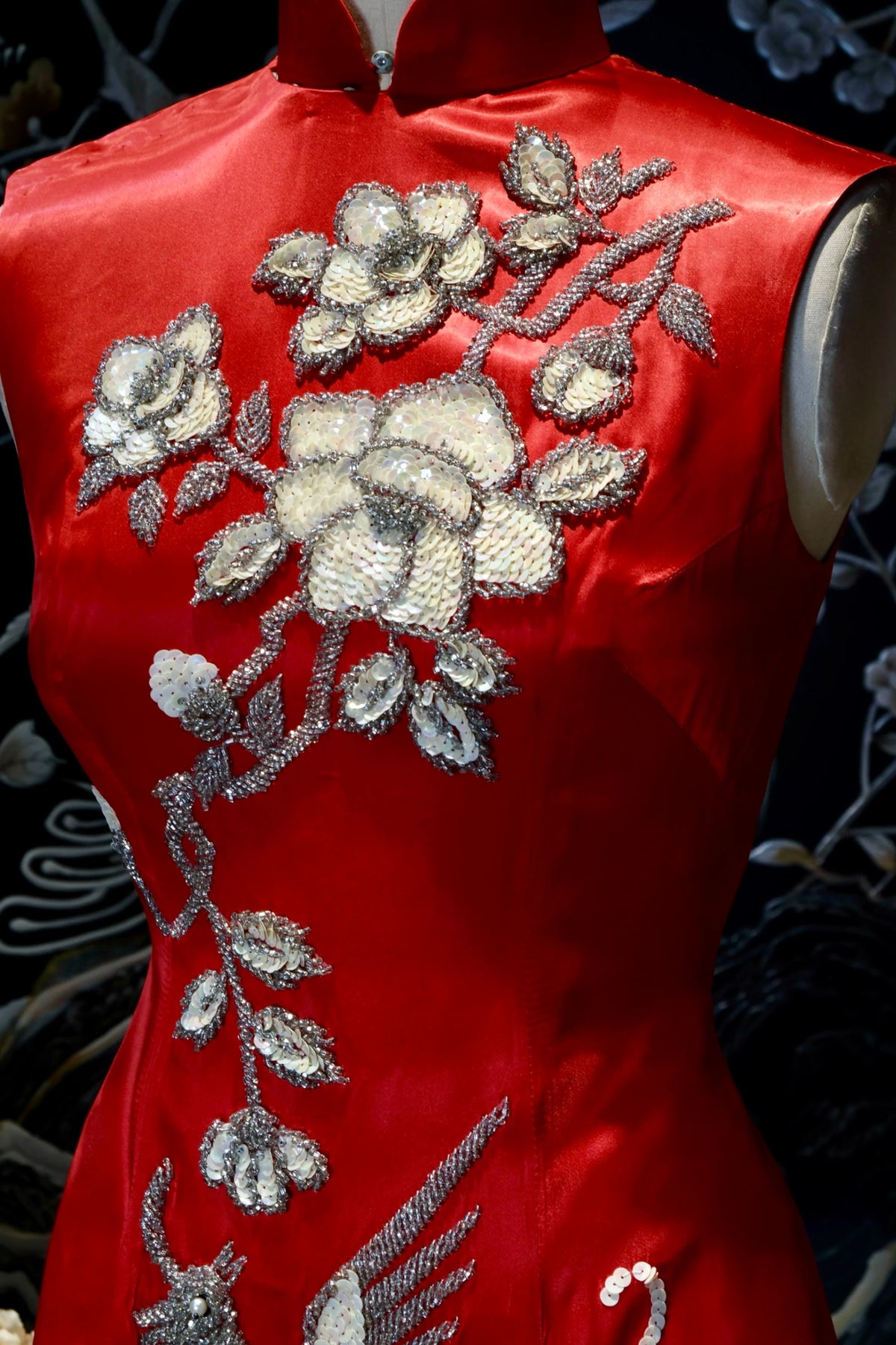
这是整件衣裳的灵魂所在。不同于机器刺绣的呆板,匠人运用了大量米珠、亮片与丝线进行手工盘绣。
* 上部·牡丹花开: 胸前的牡丹花纹样,使用了大量的亮片模拟花瓣的层叠感,花蕊处点缀珍珠,寓意“花开富贵”。这种“盘金绣”与“珠绣”结合的工艺,使得花朵具有浮雕般的立体感,正如唐人李正封诗中云:“国色朝酣酒,天香夜染衣。”
* 下部·凤舞九天: 腰腹至裙摆处,一条银凤蜿蜒而上。工匠利用不同大小的珠片,巧妙构建出凤凰的羽翼与长尾,线条灵动,仿佛下一秒便要破衣而出。
【纹样·凤穿牡丹的文化隐喻】
* 龙凤呈祥,阴阳和合:
“凤穿牡丹”是中国传统纹样中的顶级题材。在古代,龙凤代表帝后,象征阴阳调和;到了近现代,凤穿牡丹则演变为对女性地位的提升与对美好生活的极致祝愿。
这件衣服以“凤”为主体,凤凰尾羽长且卷曲,环绕于牡丹花下,既象征着女性的坚韧与高贵,又暗合了70年代女性在社交场合中独当一面的时代精神。
【结语·藏品价值】
这件旗袍,不仅是一件御寒蔽体的衣物,它更是一段凝固的历史。它将70年代台湾纺织业的精湛工艺、传统吉祥文化的深厚底蕴,以及东方女性温婉而自信的气质,完美地缝合在了一起。
穿上它,便是穿越了半个世纪的时光,重回那个衣香鬓影、流光溢彩的流金岁月。
Turning back the clock to the 1970s brings us to a "renaissance era" for the Qipao. Carrying forward the lingering elegance of mainland Jiangnan traditions alongside Shanghainese glamour, Taiwan during this decade elevated the Qipao beyond a nostalgic boudoir dream into the official "national dress" worn by women at diplomatic functions and grand New Year gatherings. Tailored from crimson acetate fabric, this Qipao stands as the pinnacle archetype of that era's festive banquet attire, bearing witness to the stately grace and opulence of mid-century society women.
Crimson Acetate Satin (Acetate Satin): During the 1970s, when synthetic fibers were celebrated as modern marvels, acetate earned acclaim as both "the people's silk" and "the fabric of aristocrats" for its distinctive rayon-like luster. The true-red acetate satin chosen for this Qipao gleams with a radiance as passionate as flowing magma. Boasting exceptional drape, wrinkle resistance, and crisp structure, the textile effortlessly bears the substantial weight of heavy embroidery—imbuing the entire garment with an almost luxurious fluidity under ambient light, evoking the rich splendor of "crimson foreign crepe" depicted in Dream of the Red Chamber.
Sleeveless Mandarin Collar & S-Curve Cut: Departing from the gentle modesty of traditional wide-sleeved robes, this 1970s Qipao adopts a reformed Western-influenced cut. The sleeveless design (Sleeveless) boldly reveals the feminine shoulder line with striking modernity, while the high mandarin collar upholds classical Eastern decorum, framing and elongating the neck. Its cinched waist and flaring hem form an hourglass "gourd silhouette," sculpting feminine fullness with precision—representing the aesthetic zenith of 1970s Haipai-Taiwanese fusion.
Hand-Beaded Embroidery (Hand-Beaded Embroidery): Here resides the true soul of the garment. Far removed from the mechanical rigidity of machine stitching, master artisans worked densely by hand using seed beads, sequins, and silk threads:
Upper Bodice — Blooming Peonies: The peony motifs across the chest deploy layered sequins to mimic overlapping petals, accented with pearls at the stamens to symbolize "blossoming wealth and honor." This synthesis of couched gold work and bead embroidery gives the blossoms a sculptural, bas-relief dimensionality, echoing the Tang poet Li Zhengfeng's verses: "National beauty flushed with morning wine; heavenly fragrance dyes her robes by night."
Lower Skirt — Phoenix Dancing Through the Nine Heavens: Rising sinuously from the hem across the waist and abdomen is a silver phoenix. By grading sequins of varying sizes, the artisan deftly articulated the phoenix’s wings and sweeping tail feathers with living fluidity—appearing ready to take flight right off the silk at any second.
Auspicious Harmony of Yin and Yang: "Phoenix Among Peonies" (Feng Chuan Mudan) ranks among the supreme subjects in traditional Chinese decorative arts. In antiquity, the dragon and phoenix signified emperor and empress, symbolizing cosmic balance; in the modern era, the phoenix paired with peonies evolved into an emblem celebrating the rising stature of women and wishes for a flourishing life. Centered prominently around the phoenix—whose long, curling tail feathers sweep beneath the peonies—the composition honors both feminine resilience and nobility, subtly reflecting the 1970s spirit of women stepping confidently into public and social spheres in their own right.
Far more than a garment meant simply to clothe the body, this Qipao is a solidified passage of history. It seamlessly stitches together the exquisite textile engineering of 1970s Taiwan, the profound heritage of traditional auspicious iconography, and the gentle yet self-assured poise of the Eastern woman.
Slipping into it is to step backward across half a century—returning to an unforgettable golden age of fragrant robes, shadowed tresses, and resplendent light.